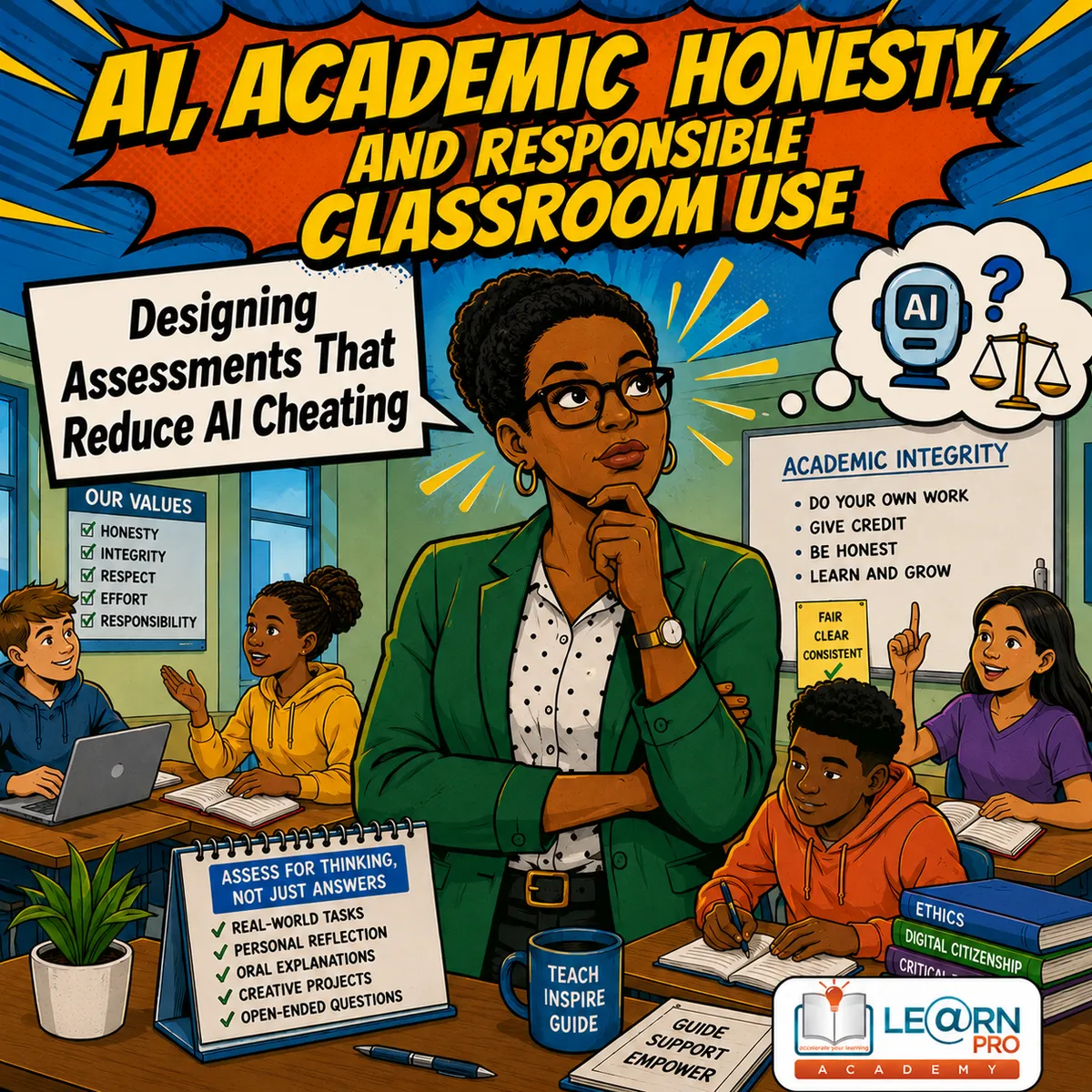
Designing Assessments That Reduce AI Cheating
This is article #3 of 5 in the AI, Academic Honesty, and Responsible Classroom Use Series
Introduction
Artificial intelligence (AI) is changing education in many positive ways. It can explain difficult concepts, generate practice questions, improve writing, and support independent learning. However, it has also created a new challenge for educators. Many traditional assignments can now be completed quickly by asking an AI tool to generate an answer.
This does not necessarily mean that learners understand the topic.
If an assessment can be completed by copying an AI response without requiring learners to think, analyse, explain, or apply their knowledge, the assessment may no longer be measuring what it was designed to assess.
This does not mean schools should stop using assignments or ban AI altogether. Instead, educators need to rethink how assessments are designed. Good assessment design makes learner thinking visible. It encourages genuine understanding rather than memorisation and makes dishonest AI use far less useful.
The goal is not to create "AI-proof" assessments. Such assessments may never exist. The goal is to design learning experiences that encourage independent thinking, reward genuine understanding, and prepare learners for a future where AI will be a normal workplace tool.
This article explores practical strategies educators can use to design assessments that promote authentic learning while reducing opportunities for inappropriate AI use.
Why Assessment Design Matters More Than Ever
For many years, educators focused on whether learners copied work from books or websites.
Today, AI can generate original-looking responses within seconds.
This means that simply checking for plagiarism is no longer enough.
Instead, educators should ask a more important question:
Does this assessment require learners to demonstrate their own understanding?
If the answer is yes, AI becomes a learning aid rather than an easy shortcut.
If the answer is no, learners may complete the task without developing the intended skills.
Good assessment design has always been important. AI simply makes it even more important.
Focus On Learning Rather Than Technology
It is tempting to think that AI itself is the problem. In reality, the focus should remain on learning.
An assessment should answer questions such as:
Does the learner understand the concept?
Can the learner explain their reasoning?
Can the learner apply knowledge to new situations?
Can the learner justify their decisions?
Can the learner solve unfamiliar problems?
When assessments measure these skills, AI becomes much less capable of replacing genuine learner effort.
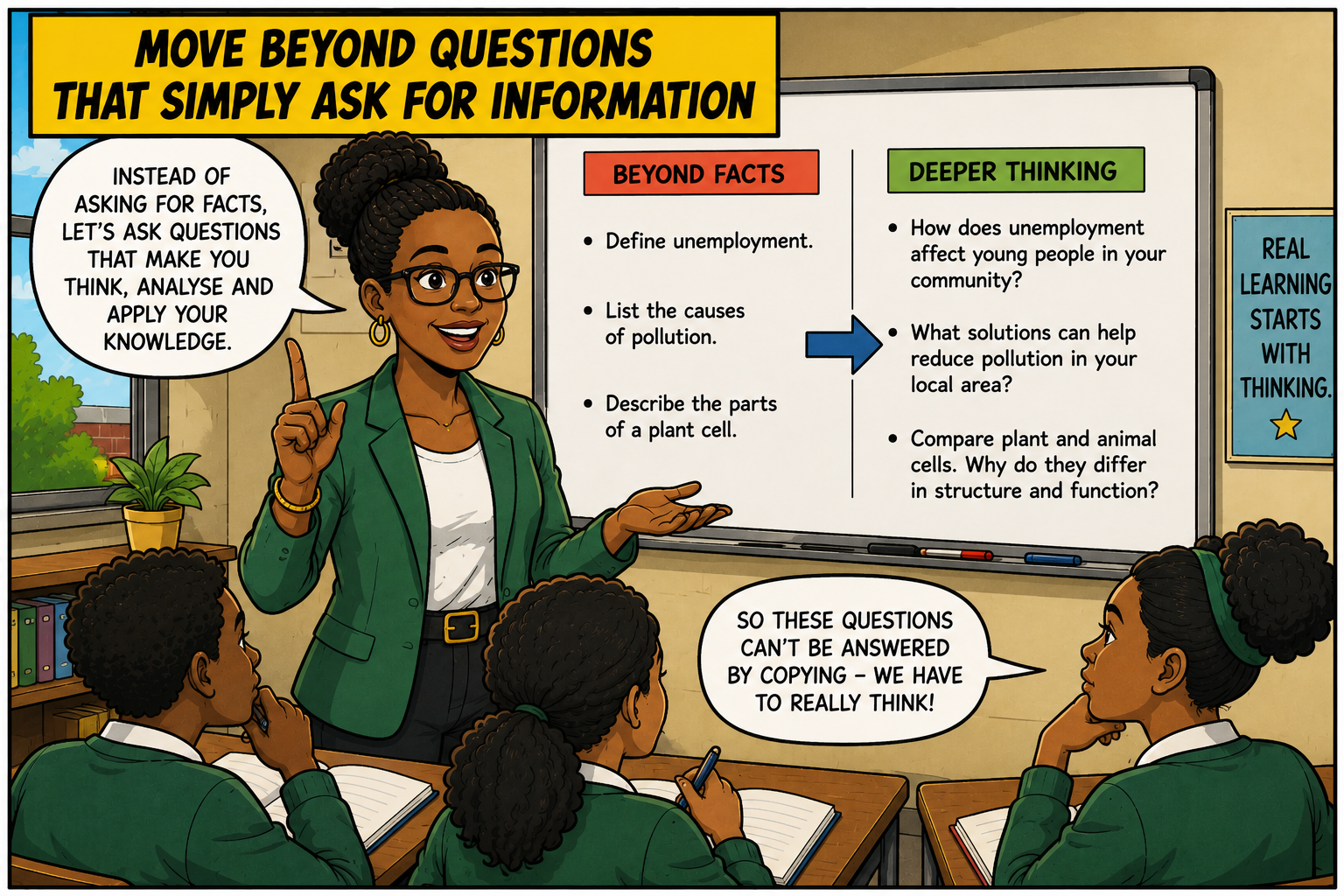
Move Beyond Questions That Simply Ask For Information
Many traditional assignments ask learners to:
Define a concept.
List facts.
Describe a process.
Summarise information.
These tasks are now easily completed by AI.
Instead, educators can ask learners to:
Compare different viewpoints.
Explain why they reached a conclusion.
Apply knowledge to a local problem.
Reflect on their own learning.
Defend their decisions.
Evaluate different solutions.
These tasks require thinking rather than copying.
Use Real-World South African Contexts
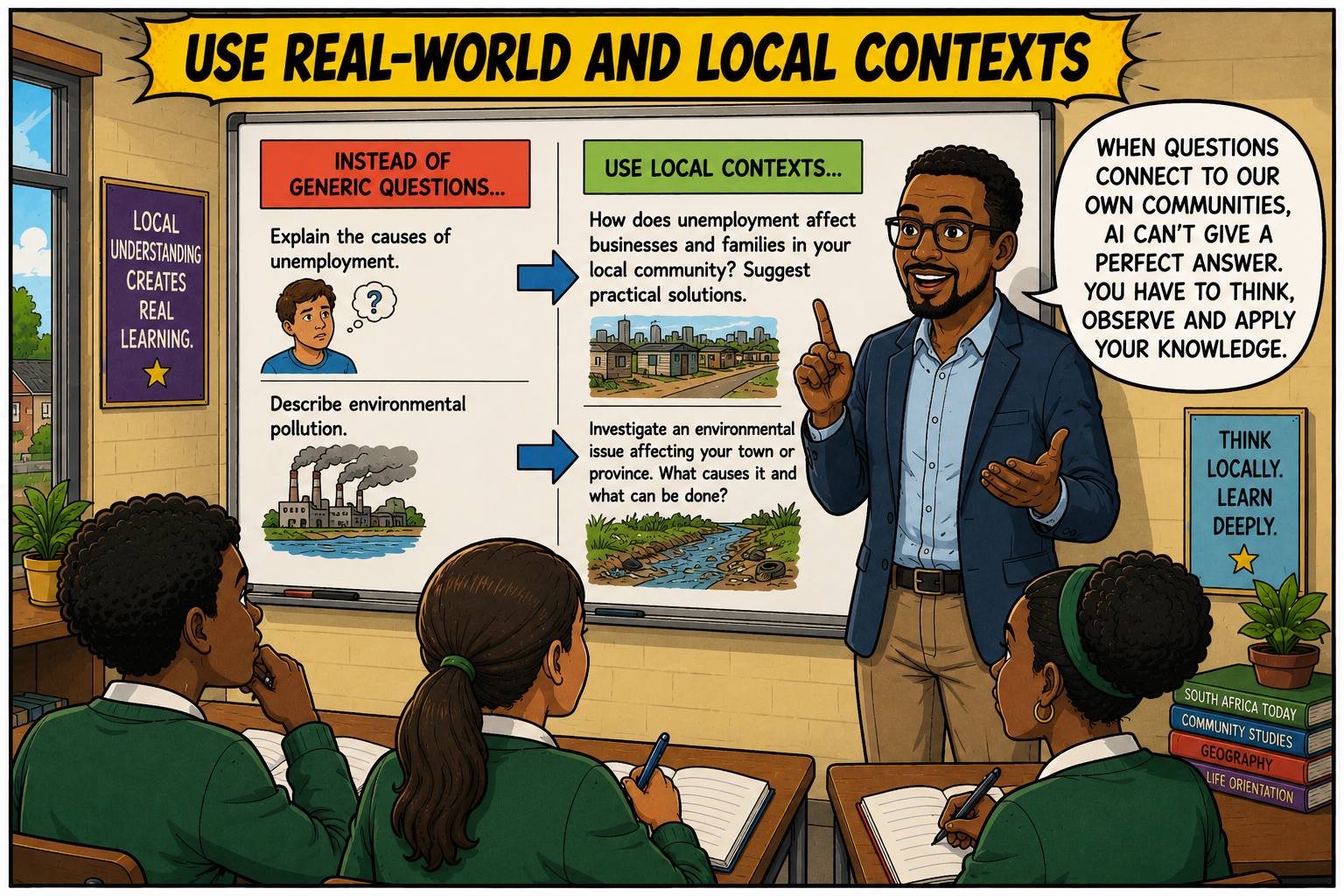
Generic questions are easier for AI to answer. Questions connected to local experiences encourage deeper thinking.
For example: Instead of asking: "Explain the causes of unemployment."
Ask: "How does unemployment affect businesses and families in your local community? Suggest practical solutions that could work in South Africa."
Similarly: Instead of asking learners to describe environmental pollution generally, ask them to investigate environmental challenges affecting their own town, province, or school.
Local context encourages observation, discussion, and personal understanding.
Design Assessments That Require Personal Reflection
AI cannot genuinely describe a learner's own experiences.
Consider including questions such as:
What did you find most difficult about this topic?
Which strategy helped you solve this problem?
What would you do differently next time?
Which part of your research surprised you most?
How has your understanding changed?
Reflection demonstrates learning in ways AI cannot easily replace.
Break Large Assignments Into Smaller Stages
Many opportunities for AI misuse occur because educators only see the final product.
Instead, assess the learning process.
For example:
Stage 1: Choose a topic and explain why you selected it.
Stage 2: Submit research notes.
Stage 3: Create a planning outline.
Stage 4: Submit the first draft.
Stage 5: Reflect on teacher feedback.
Stage 6: Submit the final version.
This approach allows educators to observe how learner understanding develops over time.
It also makes it much harder to submit entirely AI-generated work.
Include Classroom Checkpoints
Not every assessment needs to happen at home. Short classroom activities provide valuable opportunities to observe learner thinking.
Examples include:
Brainstorming sessions.
Planning activities.
Group discussions.
Mind maps.
Short written reflections.
Exit tickets.
Mini quizzes.
These checkpoints help educators compare classroom performance with submitted assignments.
Ask Learners To Explain Their Thinking
Being able to explain an answer is often more important than producing the answer itself.
After submitting an assignment, educators can ask questions such as:
How did you reach this conclusion?
Why did you choose this example?
Which sources influenced your thinking?
What was your biggest challenge?
Can you explain this section in your own words?
Short conversations often reveal genuine understanding more effectively than written work alone.
Make Oral Components Part Of Assessment
Oral explanations provide valuable evidence of learner understanding. This does not require formal presentations every time.
Examples include:
Two-minute verbal summaries.
Partner explanations.
Teacher interviews.
Group discussions.
Short question-and-answer sessions.
When learners know they may need to explain their work, they are more likely to engage with the learning process.
Assess Application Rather Than Memorisation
AI performs well when repeating information. It performs less effectively when learners must apply knowledge to unique situations.
Instead of asking: "What are the characteristics of a successful entrepreneur?"
Ask: "A young entrepreneur in your community wants to start a recycling business. What advice would you give and why?"
Application encourages deeper thinking.
Encourage Creative Problem-Solving
Many subjects offer opportunities for creative thinking.
Ask learners to:
Design solutions.
Improve existing ideas.
Create awareness campaigns.
Solve community problems.
Develop business ideas.
Recommend improvements.
There may be several acceptable answers.
This reduces the value of simply copying AI-generated responses.
Use Authentic Assessment
Authentic assessments reflect real-life situations.
Examples include:
Community investigations.
Practical demonstrations.
Interviews.
Surveys.
Experiments.
Design projects.
Case studies.
Authentic tasks encourage learners to engage with real people, real situations, and real problems.
These experiences cannot easily be replaced by AI.
Require Evidence Of The Learning Process
Rather than assessing only the final product, collect evidence such as:
Planning notes.
Drafts.
Mind maps.
Research logs.
Reflection journals.
Feedback responses.
This provides a clearer picture of learner development.
It also encourages continuous learning instead of last-minute submission.
Encourage Responsible AI Disclosure
Rather than banning AI completely, consider asking learners to explain how they used it.
For example:
"I used AI to generate revision questions."
"I asked AI to explain photosynthesis before writing my own summary."
"I used AI to improve grammar after completing my first draft."
This encourages honesty rather than secrecy.
Create Clear Assessment Instructions
Learners should know exactly what is expected.
Assignment instructions may include statements such as:
AI may be used for brainstorming.
AI may not write your final submission.
All sources must be verified.
Final analysis must represent your own thinking.
Be prepared to explain your work in class.
Clear expectations reduce confusion.
Assess Collaboration Carefully
Group work presents additional opportunities for AI misuse.
To improve accountability:
Allocate individual responsibilities.
Require individual reflections.
Assess both group and individual contributions.
Ask learners to explain their own sections.
Observe group discussions where possible.
This ensures every learner participates meaningfully.
Design Better Research Assignments
Instead of asking learners simply to collect information, ask them to:
Compare sources.
Identify bias.
Evaluate reliability.
Explain conflicting viewpoints.
Draw conclusions.
Recommend solutions.
Research becomes about thinking rather than copying.
Value The Process As Much As The Product
Education is about learning, not simply producing finished work.
Reward behaviours such as:
Good planning.
Improvement over time.
Effective research.
Reflection.
Revision.
Independent thinking.
When these skills are assessed, learners understand that effort matters.
Avoid An Over-Reliance On AI Detection Tools
Some educators hope AI detection software will solve the problem. Unfortunately, these tools have significant limitations.
They may:
Incorrectly identify genuine learner writing.
Miss AI-generated content.
Produce inconsistent results.
Detection software should never replace professional judgement. Educators know their learners.
They observe progress, participation, classroom discussions, and writing development throughout the year.
This evidence is often more reliable than automated detection.
A South African Perspective
South African schools differ greatly in their access to technology. Some learners have constant internet access. Others rely on shared devices or limited connectivity.
Assessment design should remain fair regardless of technological access.
Where AI is permitted, educators should ensure all learners have equal opportunities.
Where AI is not required, assessment should continue to reward knowledge, reasoning, creativity, and effort rather than access to technology.
Schools should also remember that many South African employers and universities are beginning to explore AI responsibly.
Preparing learners for this future means teaching ethical use rather than avoiding the technology completely.
Practical Classroom Strategies
Educators can strengthen assessment quality by:
Using more classroom-based assessment.
Including oral explanations.
Breaking projects into stages.
Assessing planning as well as final products.
Asking learners to justify decisions.
Encouraging reflective writing.
Creating locally relevant scenarios.
Using authentic tasks connected to real life.
Discussing responsible AI use openly.
Providing clear assessment expectations.
These approaches improve learning while making inappropriate AI use less attractive.
Questions Educators Can Ask When Designing Assessments
Before setting an assessment, consider asking:
What learning outcome am I measuring?
Could AI complete this task without genuine understanding?
Does this assessment require independent thinking?
Can learners explain their reasoning?
Am I assessing both the learning process and the final product?
Does the task encourage creativity or simply information retrieval?
Would I know whether genuine learning has taken place?
These questions help educators create stronger assessments.
Preparing Learners For The Future
AI will almost certainly become part of future workplaces. Professionals will use AI to improve productivity, organise information, and generate ideas.
However, successful employees will still need to:
Think critically.
Solve problems.
Communicate clearly.
Make ethical decisions.
Apply knowledge creatively.
Schools should therefore assess these higher-order skills rather than simply testing the ability to reproduce information.
This prepares learners for both academic success and future employment.
Conclusion
Designing assessments that reduce AI cheating is not about making assignments impossible for technology to complete. Instead, it is about creating meaningful learning experiences that encourage learners to think, reflect, apply knowledge, and demonstrate genuine understanding.
By focusing on authentic assessment, clear expectations, classroom observation, and the learning process, educators can make AI misuse far less valuable while promoting academic integrity. Learners benefit when assessments reward curiosity, creativity, effort, and critical thinking rather than simply producing correct answers.
As AI becomes a permanent part of education and the workplace, schools have an opportunity to redesign assessment in ways that better reflect the skills learners will need in the future. The most effective assessments will continue to value human judgement, independent thinking, and real understanding — qualities that remain at the heart of meaningful education.
Additional Articles in the AI, Academic Honesty, and Responsible Classroom Use Series
What Counts as Cheating When Learners Use AI?
How to Talk to Learners About Responsible AI Use
Designing Assessments That Reduce AI Cheating
How to Create a Classroom AI Policy That Is Fair and Practical
Teaching Integrity in an Age of Easy Answers
Disclaimer
AI Tools were used to assist with research. Remember to always cross-check everything that you read.