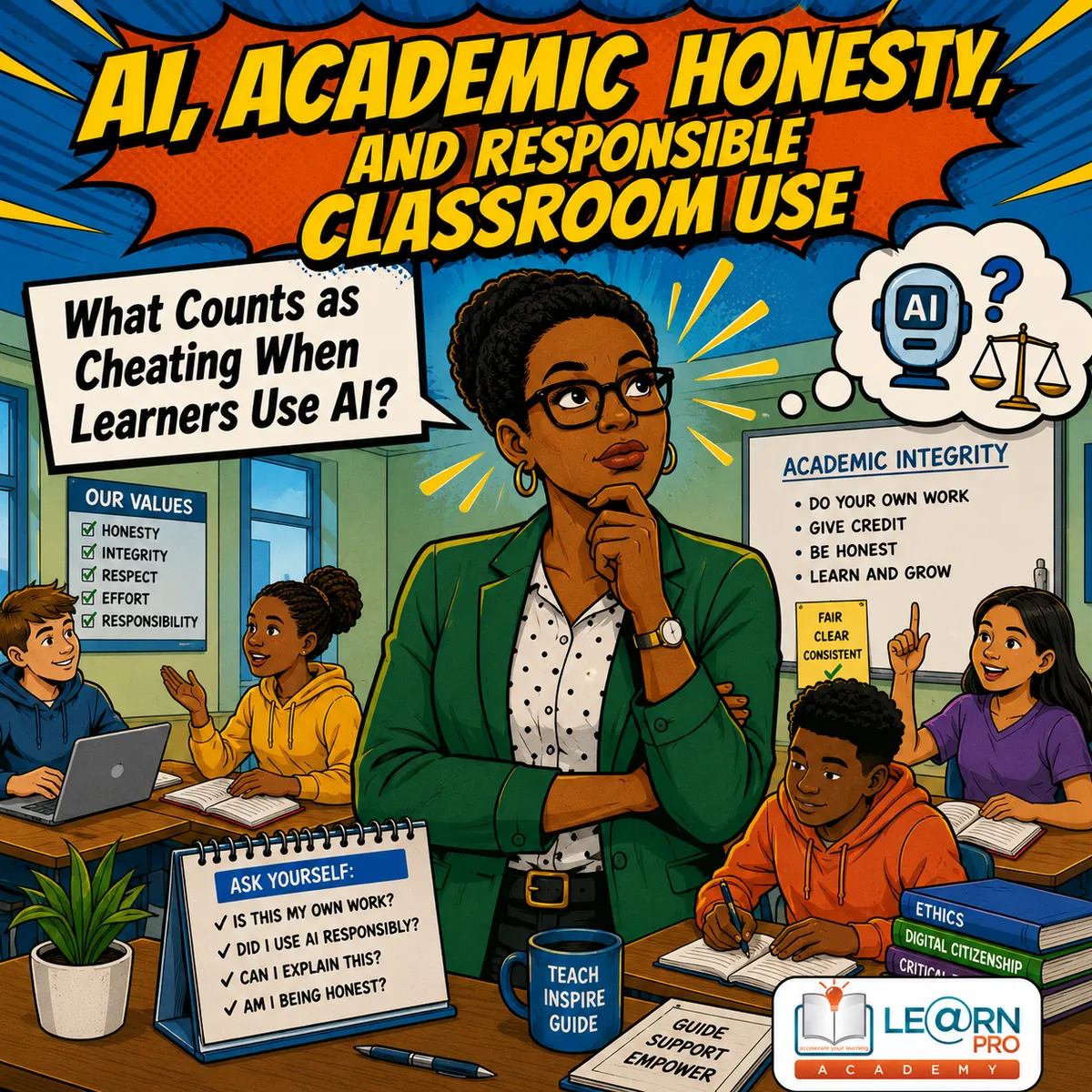
What Counts as Cheating When Learners Use AI?
This is article #1 of 5 in the AI, Academic Honesty, and Responsible Classroom Use Series
Introduction
Artificial intelligence (AI) is becoming a normal part of everyday life. Many learners already use AI tools to explain difficult concepts, generate ideas, summarise notes, and help with homework. As these tools become more common, educators face an important question: When does using AI become cheating?
The answer is not always simple.
In the past, academic dishonesty mainly involved copying another learner's work, plagiarising information from books or websites, or getting someone else to complete an assignment. Today, AI introduces new situations that schools have not always prepared for. A learner may use AI to improve grammar, brainstorm ideas, explain a difficult topic, or even write an entire essay. These actions are very different from one another, yet they all involve AI.
Many schools do not yet have clear policies that explain where the boundary lies. As a result, educators may respond differently to similar situations, leaving learners confused about what is acceptable.
Rather than viewing AI as either completely good or completely bad, educators need practical ways to distinguish between responsible learning support and dishonest academic behaviour. The goal is not simply to catch learners using AI but to help them use it honestly while still developing their own knowledge, thinking, and skills.
This article explores how educators can recognise the difference between appropriate AI assistance and cheating, establish clear expectations, and encourage responsible use in South African classrooms.
Why This Conversation Matters
AI is not disappearing. Whether schools formally allow it or not, many learners already have access to AI tools through smartphones, computers, and online platforms.
Ignoring AI does not prevent its use.
Instead, educators need to prepare learners for a future where AI will be a normal workplace tool while ensuring that schools continue to assess genuine learning.
The focus should remain on an important question: Has the learner demonstrated their own understanding?
If AI supports learning while the learner still completes the thinking, learning continues.
If AI replaces the learner's thinking, learning suffers.
This simple principle provides a useful starting point for making fair decisions.
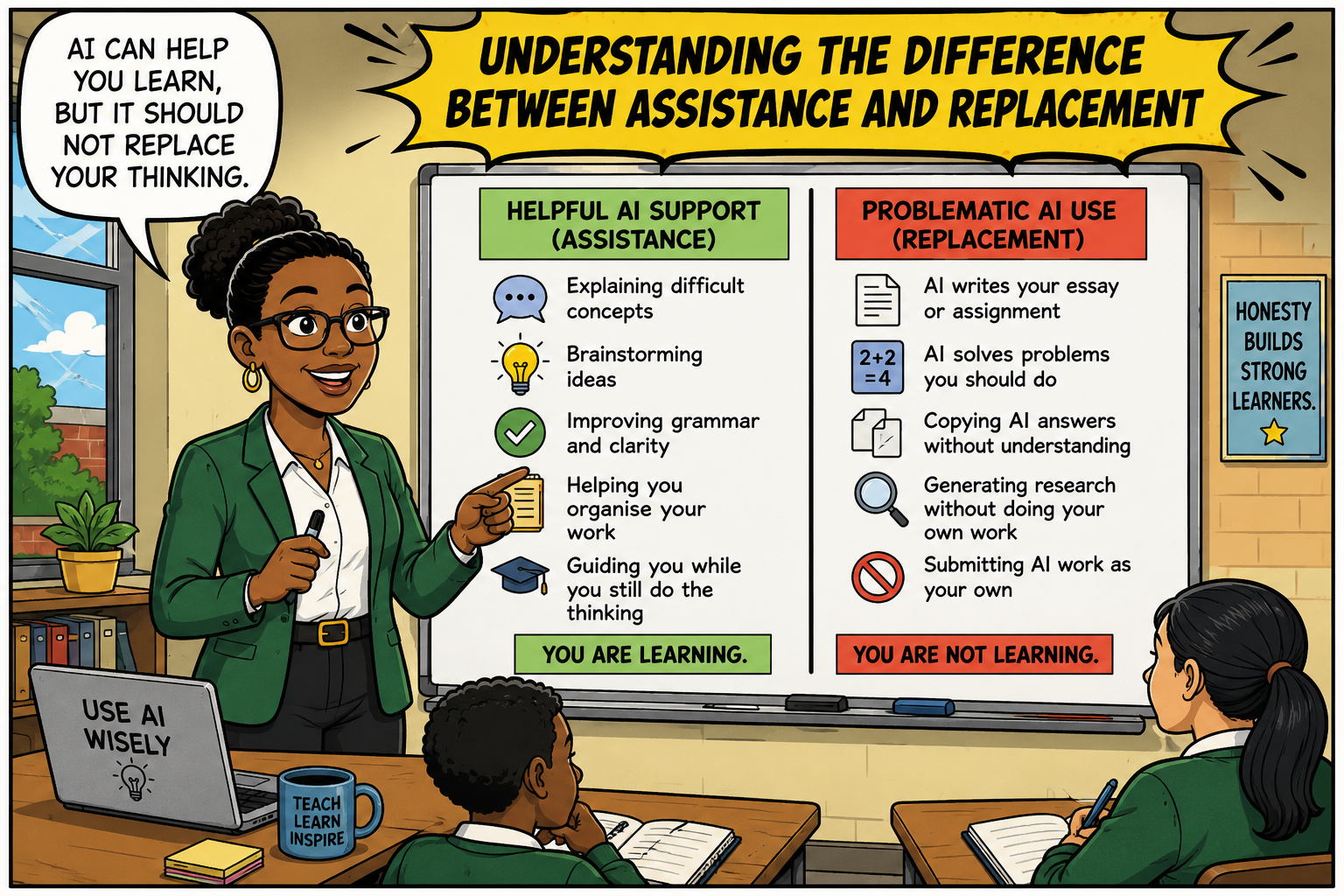
Understanding The Difference Between Assistance And Replacement
Learners have always received help while learning:
Teachers explain concepts.
Parents assist with homework.
Friends study together.
Textbooks provide worked examples.
Educational videos explain difficult topics.
AI simply adds another source of assistance.
The important issue is not whether help exists. The important issue is how much of the learner's own work remains.
Helpful support includes:
Explaining difficult concepts
Giving examples
Creating practice questions
Improving grammar
Helping organise ideas
Suggesting study techniques
Problematic use begins when AI replaces work the learner is expected to complete independently.
For example: Instead of learning to write an essay, the learner asks AI to produce the final essay.
Instead of solving mathematics problems, the learner copies AI-generated solutions without understanding them.
Instead of researching a project, the learner submits AI-generated content as their own.
The difference lies in whether the learner is learning or simply submitting AI-generated work.
Why Definitions Of Cheating Need To Change
Traditional plagiarism involved copying another person's words.
AI creates something new each time it responds.
This means educators cannot simply rely on old definitions.
A learner may submit work that appears original but was entirely produced by AI.
Even though the wording may not match published sources, the learner still did not complete the work independently.
Therefore, educators should move beyond asking: "Did this learner copy someone else's words?"
Instead, ask: "Did this learner demonstrate their own thinking and understanding?"
This shift focuses on learning rather than technology.
Situations Where AI Use Is Usually Acceptable
Not every use of AI is dishonest. In many cases, AI can genuinely improve learning.
Examples include:
Understanding Difficult Topics
A learner asks AI to explain photosynthesis in simpler language before completing homework.
The learner still answers the questions independently.
This supports learning.
Revising Before Tests
AI creates practice quizzes or flashcards.
The learner uses them to prepare for an assessment.
The learner still completes the actual test independently.
Improving Writing Skills
A learner writes their own essay first.
AI identifies grammar mistakes or suggests clearer wording.
The learner reviews the suggestions and decides which changes to make.
This resembles using spelling and grammar tools.
Brainstorming Ideas
AI suggests possible research topics.
The learner chooses one and completes the research independently.
The learner still performs the thinking.
Planning A Project
AI helps organise a timeline or checklist.
The learner completes the work themselves.
Again, AI supports organisation rather than replacing effort.
Situations That Are Usually Considered Cheating
Some uses of AI clearly cross the line. These include situations where learners present AI-generated work as their own.
Examples include:
Submitting an AI-written essay without editing or understanding it.
Copying AI answers directly into an assignment.
Using AI to complete take-home assessments intended to measure independent thinking.
Asking AI to solve calculations that learners were expected to complete themselves.
Generating project reports without conducting the required research.
Using AI during tests where external assistance is prohibited.
In each case, the learner has replaced their own work rather than supporting it.
The Importance Of The Learning Process
Many assessments are designed to measure more than the final answer.
Teachers also want to evaluate:
Research skills
Critical thinking
Planning
Drafting
Problem-solving
Reflection
Communication
If AI performs these steps instead of the learner, the assessment no longer measures the intended skills.
For example, if a writing assignment aims to assess argument development, submitting an AI-written essay prevents the educator from seeing the learner's actual ability.
The learning process matters as much as the final product.
Not Every Assignment Requires The Same Rules
Different tasks may require different expectations.
For example:
Homework Practice
Teachers may allow learners to use AI to explain difficult concepts while practising at home.
Essays
Teachers may allow AI for brainstorming but require learners to write the final essay independently.
Research Projects
Teachers may allow AI to generate research questions but require learners to verify sources and produce original analysis.
Oral Presentations
Learners may use AI to help structure ideas but must explain concepts in their own words during the presentation.
Examinations
Most formal examinations should continue to assess independent learner performance unless AI use has been specifically authorised.
Being clear about expectations reduces confusion.
Why Clear Instructions Matter
Many learners do not intentionally cheat. Sometimes they simply misunderstand what is allowed.
An assignment that says: "Complete this project." does not explain whether AI assistance is acceptable.
Instead, educators can provide clear guidance, such as:
AI may be used to brainstorm ideas.
AI may not write your final answer.
You must verify any facts generated by AI.
All final writing must reflect your own understanding.
Be prepared to explain your work during class.
These expectations reduce uncertainty.
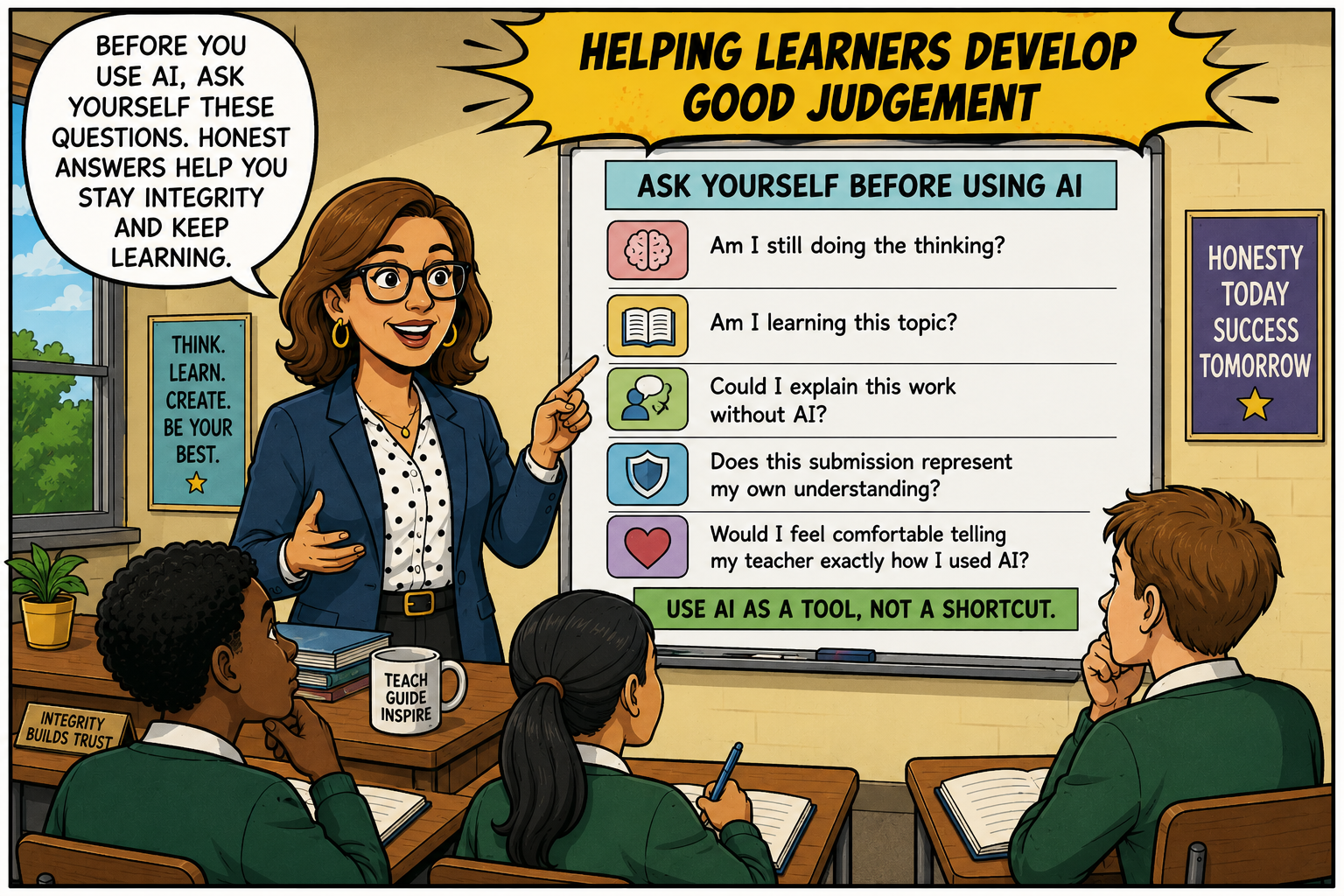
Helping Learners Develop Good Judgement
Rules alone cannot cover every situation. Learners also need good judgement.
Before using AI, encourage learners to ask themselves:
Am I still doing the thinking?
Am I learning this topic?
Could I explain this work without AI?
Does this submission represent my own understanding?
Would I feel comfortable telling my teacher exactly how I used AI?
If the answer to these questions is "no," they may be relying on AI too heavily.
These questions encourage honesty rather than fear.
Teaching Learners To Disclose AI Use
Some schools are beginning to encourage learners to explain how AI assisted them.
Simple disclosures may include statements such as:
"AI helped me brainstorm possible topics."
"AI explained this concept before I completed the assignment."
"AI suggested improvements to grammar after I wrote the first draft."
Disclosure promotes transparency. It also helps educators distinguish between responsible support and inappropriate dependence.
As school policies develop, disclosure may become an important part of responsible AI use.
Why Detection Should Not Be The Main Strategy
Many discussions about AI focus on detection software. While detection tools may occasionally assist investigations, they are not reliable enough to become the primary method of identifying AI use. Some AI-generated writing is difficult to detect. Some detection systems incorrectly identify genuine learner writing as AI-generated.
False accusations can damage trust between educators and learners.
Instead of depending only on detection, educators should:
Design better assessments.
Require drafts where appropriate.
Include classroom discussions.
Ask learners to explain their thinking.
Observe learner progress over time.
These approaches provide stronger evidence of genuine understanding.
Building Trust Instead Of Fear
Learners are more likely to use AI responsibly when they trust their teachers. If every conversation about AI focuses only on punishment, learners may simply hide their use.
Instead, educators can create a classroom culture where honest conversations are encouraged.
For example: "I don't expect you to avoid AI completely. I do expect you to use it honestly and still do your own thinking."
This message is both realistic and educational.
It recognises that AI exists while protecting academic integrity.
A South African Perspective
South African schools vary widely in their access to technology. Some learners have constant internet access and smartphones. Others have limited connectivity or share devices with family members.
Educators should avoid assuming that every learner has equal access to AI tools. Schools should also ensure that assessment practices remain fair regardless of technology access.
As AI becomes more common across South African universities and workplaces, learners will increasingly need guidance on responsible use rather than simple prohibition.
Teaching ethical AI use today helps prepare learners for future study and employment.
Practical Classroom Strategies
Educators can reduce confusion by introducing practical classroom routines.
Some useful strategies include:
Discuss acceptable AI use at the beginning of each term.
Include AI expectations in assignment instructions.
Give examples of acceptable and unacceptable use.
Require learners to keep planning notes or drafts for major assignments.
Ask follow-up questions about submitted work.
Encourage learners to verify AI-generated information.
Praise honest disclosure of AI assistance.
Focus feedback on learner understanding rather than only the final answer.
These practices support both learning and integrity.
Questions Educators Can Ask When Reviewing Work
When reviewing assignments, educators may find it useful to ask questions such as:
Can the learner explain this answer?
Does the work match the learner's usual ability?
Is there evidence of planning and development?
Has the learner demonstrated understanding during classroom discussions?
Does the assessment measure genuine learning or simply information retrieval?
These questions encourage balanced professional judgement rather than automatic assumptions.
Preparing Learners For A Future With AI
AI will almost certainly become part of many careers. Future employees may use AI to draft reports, organise information, solve problems, and improve productivity.
However, employers will still expect people to think critically, solve new problems, communicate effectively, and make sound decisions.
Schools should prepare learners for both realities.
They should learn how to use AI responsibly while continuing to develop independent knowledge and skills.
Education should not become a competition between learners and AI.
Instead, it should teach learners how to work alongside technology without allowing it to replace their own thinking.
Conclusion
Determining what counts as cheating when learners use AI is not always straightforward, but the central principle remains clear: AI should support learning, not replace it.
Educators do not need to ban every use of AI to maintain academic integrity. Instead, they can establish clear expectations, explain acceptable boundaries, and design learning experiences that encourage genuine understanding.
By focusing on learner thinking rather than simply policing technology, schools can create fairer, more consistent approaches to AI use. Learners benefit when they understand that honesty, effort, and independent thinking still matter, even in a world where powerful AI tools are readily available.
Ultimately, the goal is not to prevent learners from using AI. The goal is to help them become responsible, ethical, and capable individuals who know when technology is a helpful learning partner and when it crosses the line into academic dishonesty.
Additional Articles in the AI, Academic Honesty, and Responsible Classroom Use Series
What Counts as Cheating When Learners Use AI?
How to Talk to Learners About Responsible AI Use
Designing Assessments That Reduce AI Cheating
How to Create a Classroom AI Policy That Is Fair and Practical
Teaching Integrity in an Age of Easy Answers
Disclaimer
AI Tools were used to assist with research. Remember to always cross-check everything that you read.