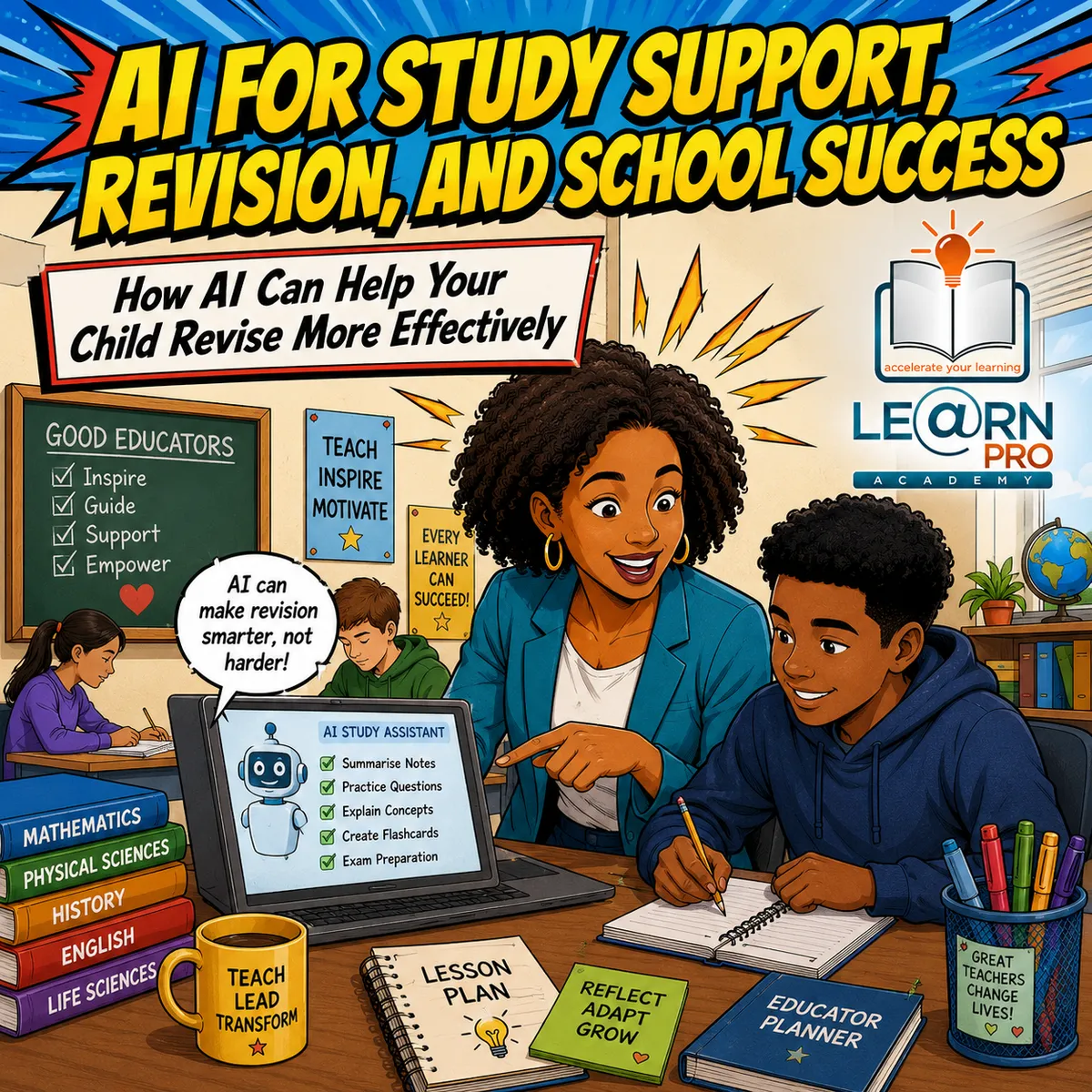
How AI Can Help Your Child Revise More Effectively
This is article #1 of 5 in the AI for Study, Support, Revision, and School Success Series
Introduction
How AI Can Help Your Child Revise More Effectively
Revision is one of the most challenging parts of high school. As tests and examinations approach, many learners feel overwhelmed by the amount of work they need to remember. This is especially true in Grades 11 and 12, where learners prepare for important examinations that can influence their future study and career opportunities.
Parents often want to help, but many feel unsure about the subjects their child is studying. Some parents also worry that artificial intelligence (AI) will encourage shortcuts instead of real learning. These concerns are understandable. However, when AI is used correctly, it can become a valuable revision partner rather than a replacement for studying.
AI cannot learn on behalf of your child. It cannot write knowledge into their memory or replace the effort needed to understand a subject. What it can do is make revision more organised, interactive, and personalised. It can explain difficult topics, create practice questions, summarise notes, build flashcards, and test understanding in ways that help learners stay actively involved.
The key is understanding that AI should support revision — not do the revision.
This article explains how parents can encourage healthy AI use during revision while helping their child remain responsible, independent, and prepared for examinations.
Understanding What Good Revision Really Means
Many learners believe revision means reading through the same textbook or notes repeatedly. While reading is important, it is usually not enough on its own.
Effective revision involves actively working with information by:
Explaining ideas in your own words
Testing your memory
Answering questions
Solving problems
Identifying weak areas
Revisiting difficult topics several times
Educational research consistently shows that active learning helps information stay in long-term memory better than passive reading alone.
AI works best when it supports these active revision methods rather than replacing them.
Why Revision Can Feel So Difficult
Parents often notice that their child studies for many hours but still feels unprepared.
There are many reasons for this.
The learner may:
Not know where to begin
Feel overwhelmed by large amounts of content
Forget what they studied earlier
Spend too much time on subjects they already know
Avoid difficult chapters
Lose motivation
Become anxious about examinations
AI cannot remove these challenges completely, but it can make revision feel more manageable by breaking large tasks into smaller, achievable steps.
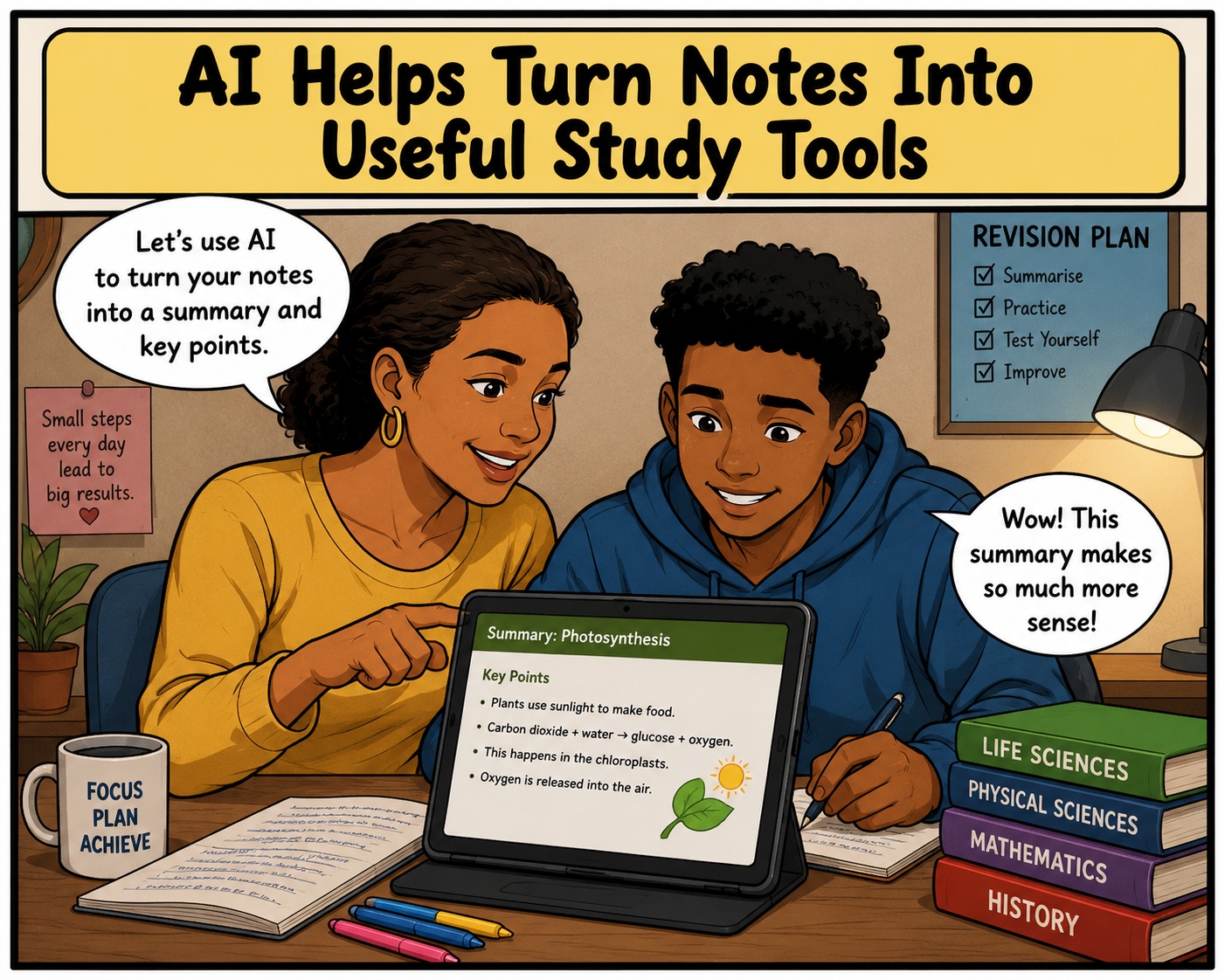
AI Helps Turn Notes Into Useful Study Tools
Many learners spend hours creating notes but never use them effectively afterwards.
AI can transform existing notes into practical revision resources.
For example, a learner can ask AI to:
Summarise a chapter
Highlight key concepts
Create bullet-point revision notes
Identify important definitions
Produce memory aids
Create comparison tables
Organise information by topic
Instead of reading twenty pages repeatedly, learners receive shorter summaries that are easier to review.
Parents should remember that these summaries should never replace textbooks or class notes completely. They are simply tools that make revision more focused.
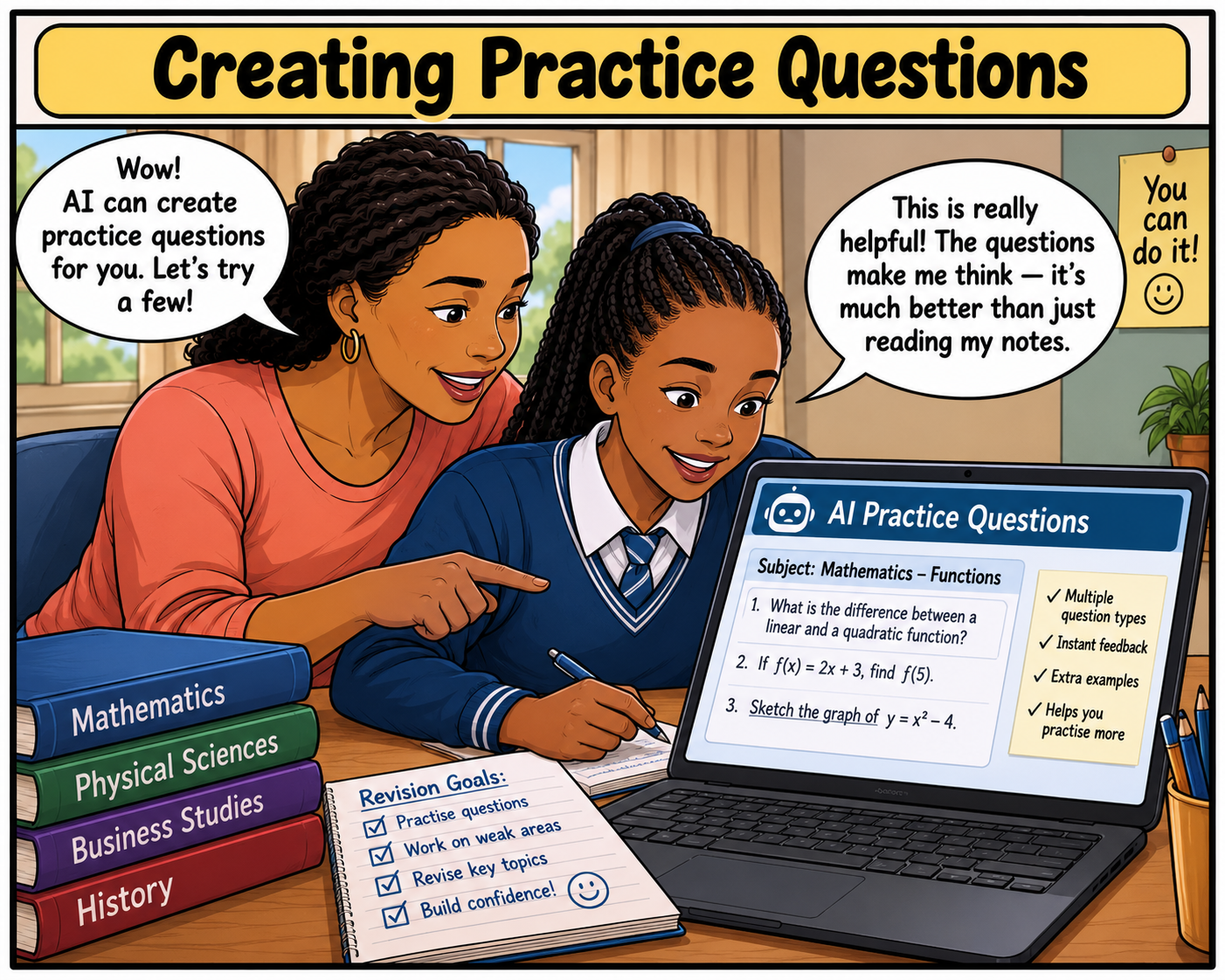
Creating Practice Questions
One of AI's greatest strengths is generating practice questions. Instead of only reading notes, learners can test themselves.
For example, AI can create:
Multiple-choice questions
Short-answer questions
Essay questions
True or false questions
Fill-in-the-blank activities
Matching exercises
Parents can encourage children to answer these questions without looking at their notes first.
This builds recall, which is one of the most effective revision techniques.
Building Flashcards For Quick Revision
Flashcards have been used successfully for many years. AI simply makes creating them much faster.
Instead of writing every card by hand, learners can ask AI to generate flashcards covering:
Vocabulary
Definitions
Formulae
Dates
Historical events
Scientific processes
Accounting concepts
Business Studies terminology
Life Sciences facts
Flashcards work especially well because they encourage repeated recall over time.
Many learners use them during short study sessions throughout the day instead of only sitting for long revision periods.
Explaining Difficult Topics In Different Ways
Every learner understands information differently. Sometimes the explanation in a textbook simply does not "click."
AI can explain the same topic:
Using simpler language
Step by step
With everyday examples
With South African examples where appropriate
Using analogies
At different levels of difficulty
For example, instead of giving one complicated explanation of photosynthesis, AI can explain it as though speaking to a Grade 10 learner, then gradually increase the level of detail.
This flexibility helps learners build confidence before moving to more complex material.
Helping Learners Identify Weak Areas
One common mistake during revision is spending most of the time on topics that already feel comfortable.
AI can help learners identify areas where they struggle.
For example, after answering practice questions, a learner can ask:
Which questions did I answer incorrectly?
Which topics need more revision?
What should I practise next?
Which concepts seem to confuse me?
This encourages smarter revision instead of simply studying harder.
Parents can remind their children that improvement comes from working on weak areas, not avoiding them.
Making Revision More Interactive
Many learners become bored after reading notes for long periods. AI introduces interaction into revision.
Instead of only reading, learners can:
Ask questions
Receive immediate explanations
Request extra examples
Solve practice problems
Test themselves
Compare answers
Explain concepts back to AI
This creates a conversation instead of passive reading.
The learner remains mentally engaged throughout the revision session.
Supporting Different School Subjects
AI can assist revision across many South African high school subjects.
For example:
Mathematics
Step-by-step worked examples
Formula explanations
Extra practice questions
Physical Sciences
Breaking down scientific concepts
Explaining calculations
Reviewing definitions
Life Sciences
Simplifying biological processes
Creating labelled summaries
Producing quizzes
History
Timeline creation
Cause-and-effect questions
Source-based practice
Geography
Explaining physical processes
Mapwork revision
Climate summaries
Business Studies
Business terminology
Case study questions
Concept explanations
Accounting
Practice transactions
Financial statement questions
Definitions
English Home Language And First Additional Language
Literature revision
Grammar practice
Vocabulary building
Comprehension questions
AI supports revision differently depending on the subject, but in every case the learner should remain actively involved.
AI Should Never Replace Thinking
Parents sometimes worry that AI gives learners all the answers. This can happen if AI is used poorly.
Instead of asking: "Give me all the answers."
Encourage questions like:
"Explain why this answer is correct."
"Can you show me another example?"
"Can you quiz me on this chapter?"
"Please explain this step differently."
These prompts encourage learning instead of copying.
Helping Learners Revise In Smaller Sections
Looking at an entire textbook can feel overwhelming.
AI can divide revision into smaller pieces.
For example:
Instead of: "Study the whole History syllabus."
AI can help create:
Monday: Causes of World War II
Tuesday: Key battles
Wednesday: Peace agreements
Thursday: Practice questions
Friday: Self-test
Smaller goals reduce stress and help learners see steady progress.
Parents Do Not Need To Know Every Subject
Many parents worry because they no longer remember school content. Fortunately, helping with revision does not require expert subject knowledge.
Instead of teaching the work yourself, ask questions like:
What did you revise today?
Which topic was easiest?
Which topic was hardest?
What did AI explain differently?
Can you teach me one idea you learned?
What do you still find confusing?
If your child can explain a topic clearly, it usually shows growing understanding.
Encouraging Honest AI Use
Revision should always strengthen learning rather than replace it.
Parents can encourage honesty by reminding learners to:
Answer questions before asking AI
Compare their answers with AI explanations
Admit when they do not understand
Correct mistakes themselves
Practise regularly
This develops confidence alongside knowledge.
Avoiding Overdependence On AI
AI is helpful, but learners should not rely on it for everything.
Signs of healthy AI use include:
The learner attempts questions first.
AI explains mistakes.
AI creates additional practice.
The learner still uses textbooks and class notes.
School resources remain the primary source of learning.
Signs of unhealthy dependence include:
Copying AI answers without reading them.
Never thinking independently.
Avoiding textbooks completely.
Expecting AI to solve every problem.
Becoming anxious when AI is unavailable.
Parents should encourage balance.
Helping Build Revision Confidence
Confidence grows through preparation.
Every successful practice question, summary, flashcard, or explanation helps learners realise that they are making progress.
AI can reduce some of the fear learners experience because it offers immediate support whenever they become stuck.
However, confidence comes from doing the work—not from having access to technology.
The learner still needs to revise consistently.
Managing Exam Stress
Examination pressure affects many South African learners.
Parents often notice:
Poor sleep
Anxiety
Irritability
Lack of motivation
Panic close to exams
AI can reduce stress by helping learners:
Organise revision
Break work into manageable tasks
Focus on priorities
Track completed topics
Practise regularly instead of cramming
Combined with healthy sleep, exercise, balanced meals, and encouragement from home, AI becomes one part of a healthier revision routine.
Practical Ways Parents Can Support AI Revision
You do not need to supervise every study session. Instead, focus on creating a supportive environment.
You can:
Encourage daily revision instead of last-minute cramming.
Ask your child to explain what they learned.
Celebrate effort as well as results.
Remind them to use textbooks alongside AI.
Encourage breaks during long study sessions.
Help them build realistic revision goals.
Praise improvement rather than perfection.
Talk openly about responsible AI use.
These simple habits often make a bigger difference than trying to teach every subject yourself.
Questions Parents Can Ask After A Revision Session
Rather than asking only, "Did you study?", ask questions that encourage reflection.
Examples include:
What topic did you revise today?
What new thing did you understand?
What did AI explain that helped you?
Which questions were difficult?
What will you revise tomorrow?
Is there anything you still need help with?
These conversations encourage learners to think about their own learning.
AI Is A Study Assistant, Not A Shortcut
Perhaps the most important message for parents is this:
AI is most valuable when it supports effort rather than replacing it.
The learner still needs to:
Read
Think
Practise
Make mistakes
Correct misunderstandings
Revise consistently
Complete schoolwork honestly
AI simply makes these activities more organised, interactive, and personalised.
Conclusion
Revision is rarely easy, especially during the demanding high school years. Learners often face pressure from large amounts of work, upcoming examinations, and the fear of forgetting important information. Parents naturally want to help, even if they do not remember every subject or feel confident with modern technology.
AI offers practical ways to make revision more effective. It can turn notes into summaries, create quizzes and flashcards, explain difficult concepts, generate extra practice questions, and help learners focus on the topics that need the most attention. Used wisely, these tools can make study sessions more engaging and less overwhelming.
At the same time, successful revision still depends on the learner's own effort. AI cannot replace thinking, practising, or developing understanding. It works best when it encourages active learning rather than providing easy shortcuts.
As a parent, your role is not to become an expert in every subject or every AI tool. Your greatest contribution is creating a supportive home environment, encouraging honest study habits, asking thoughtful questions, and reminding your child that consistent effort leads to lasting success. When AI is used responsibly alongside good study habits, it can become a valuable partner in helping learners prepare with confidence for tests, examinations, and future learning.
Additional Articles in the AI for Study, Support, Revision, and School Success Series
How AI Can Help Your Child Revise More Effectively
Using AI to Build a Study Plan for Exams and Tests
Can AI Help Your Child with Difficult Subjects Like Maths or Science?
Helping Your Child Use AI to Practise for Exams Instead of Panic Before Them
How Parents Can Use AI Conversations to Check Understanding at Home
Disclaimer
AI Tools were used to assist with research. Remember to always cross-check everything that you read.