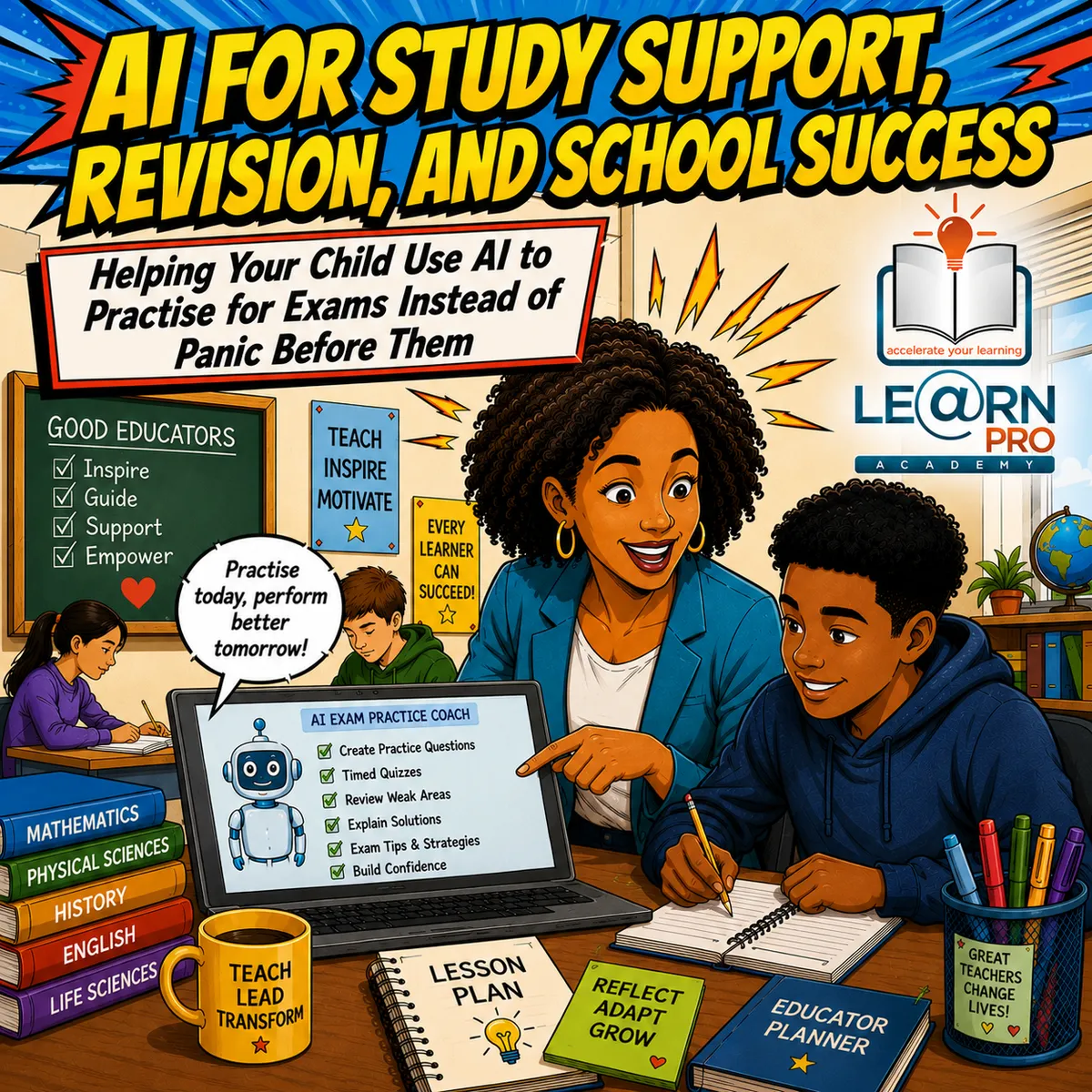
Helping Your Child Use AI to Practise for Exams Instead of Panic Before Them
This is article #4 of 5 in the AI for Study, Support, Revision, and School Success Series
Introduction
For many high school learners, exam season is one of the most stressful times of the year. As examination dates draw closer, pressure begins to build. Learners often look at the amount of work they still need to revise and feel overwhelmed. Some respond by studying long hours in the final few days before an exam, while others become so anxious that they struggle to begin at all.
Parents frequently recognise these signs. A child who seemed relaxed only weeks earlier may suddenly become worried, irritable, tired, or convinced that there is simply too much work to complete. These feelings are common, especially for learners in Grades 11 and 12, where examinations carry significant importance.
Artificial intelligence (AI) offers an opportunity to change this pattern. Instead of encouraging last-minute cramming, AI can help learners begin preparing earlier, practise regularly, identify weak areas, and build confidence through active learning. Rather than simply reading notes repeatedly, learners can interact with the material by answering questions, explaining concepts, and checking their understanding.
This article explains how parents can use AI to encourage calm, structured exam preparation that develops knowledge, confidence, and healthy study habits.
Why Many Learners Leave Revision Too Late
Most learners know they should begin studying early. Yet many still postpone revision.
This happens for several reasons:
The amount of work feels overwhelming.
They do not know where to start.
They underestimate how much time revision requires.
They believe they work better under pressure.
Difficult subjects create anxiety.
They become distracted by everyday activities.
Unfortunately, delaying revision usually increases stress instead of reducing it.
Parents can help learners replace procrastination with manageable daily progress.
Understanding The Difference Between Revision And Practice
Many learners think revision simply means reading through notes.
Although reading is useful, it is only one part of effective exam preparation.
Real exam practice involves:
Answering questions.
Solving problems.
Explaining ideas.
Identifying mistakes.
Improving weak areas.
Repeating difficult concepts.
AI supports this type of active learning, making revision far more effective than passive reading alone.
How AI Turns Revision Into Active Practice
One of AI's greatest strengths is its ability to create personalised practice activities.
Instead of simply reviewing notes, learners can ask AI to:
Generate multiple-choice questions.
Create short-answer questions.
Produce essay questions.
Develop calculation problems.
Generate source-based questions.
Create case studies.
Design revision quizzes.
Every practice session requires learners to think actively instead of only reading information.
Starting Exam Preparation Earlier
Parents often hear the same sentence: "I'll start studying next week."
Unfortunately, next week often becomes next month. AI can help learners begin earlier by creating simple daily tasks.
For example:
Week One:
Revise one Mathematics topic.
Complete ten practice questions.
Week Two:
Review Life Sciences.
Complete one History source exercise.
Small, regular sessions are much easier to maintain than trying to revise an entire syllabus during the final weekend before exams.
Creating Practice Questions For Every Subject
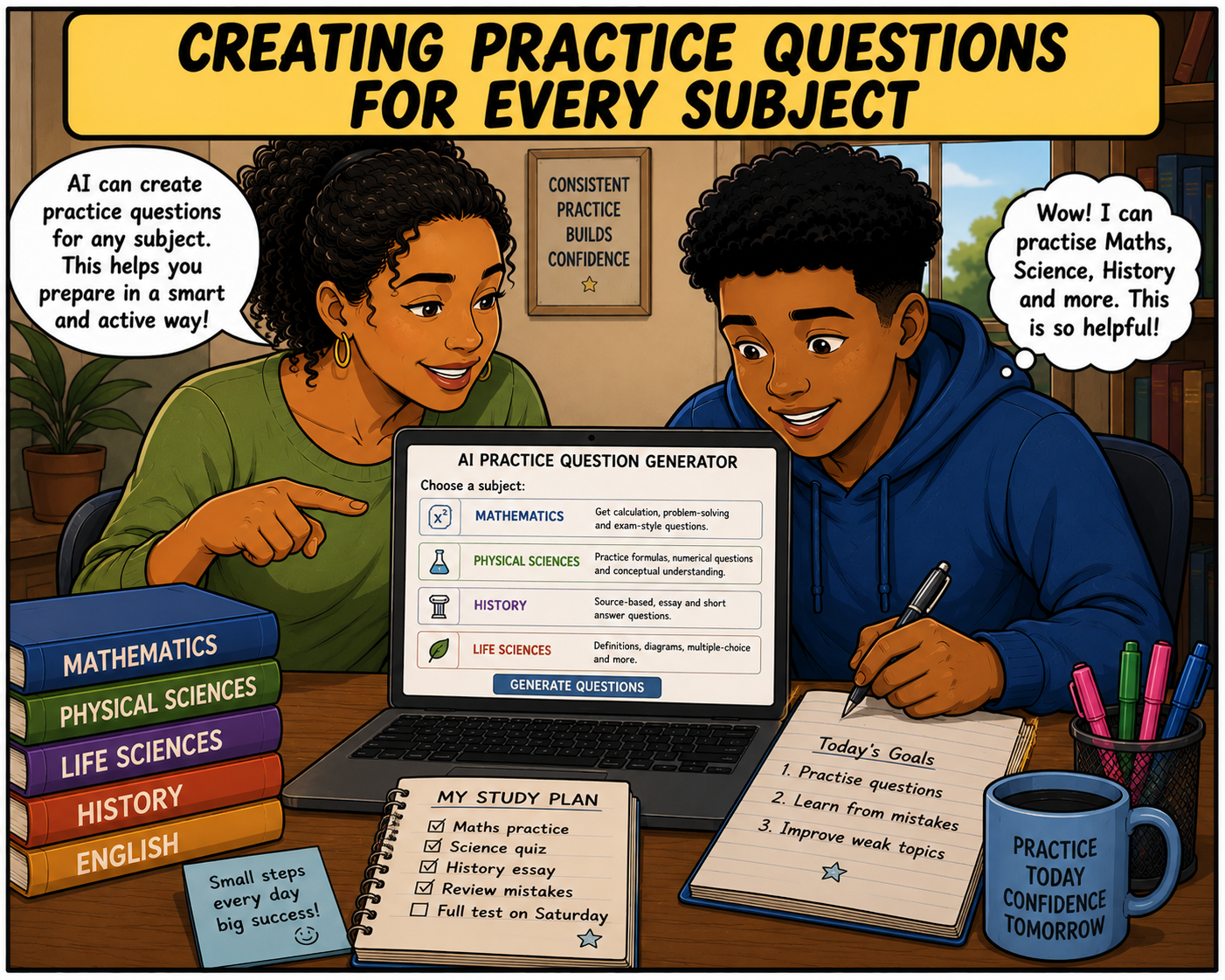
AI can generate almost unlimited practice material.
Examples include:
Mathematics
Calculation questions
Problem-solving activities
Physical Sciences
Formula application
Practical scenarios
Life Sciences
Definitions
Diagrams
Multiple-choice questions
History
Source analysis
Essay questions
Business Studies
Case studies
Scenario questions
Accounting
Transactions
Financial statements
Languages
Comprehension questions
Grammar exercises
Essay planning
The variety keeps revision interesting while exposing learners to different question styles.
Helping Learners Discover Weak Areas
One major advantage of regular practice is that it reveals what still needs attention.
Instead of waiting until the examination to discover weaknesses, learners can identify them much earlier.
AI can help learners recognise:
Frequently repeated mistakes.
Topics that require more revision.
Question types they avoid.
Areas where confidence is low.
Parents can encourage children to see these discoveries as opportunities rather than failures.
Encouraging Learners To Attempt Answers First
Responsible AI use always begins with independent effort.
Before asking AI for the answer, learners should:
Read the question carefully.
Attempt a solution.
Identify where they became stuck.
Ask AI for guidance rather than the final answer.
For example:
Instead of asking: "Solve this for me."
Try asking: "Can you explain why my second step is incorrect?"
This protects problem-solving skills while still providing support.
Simulating Real Exam Conditions
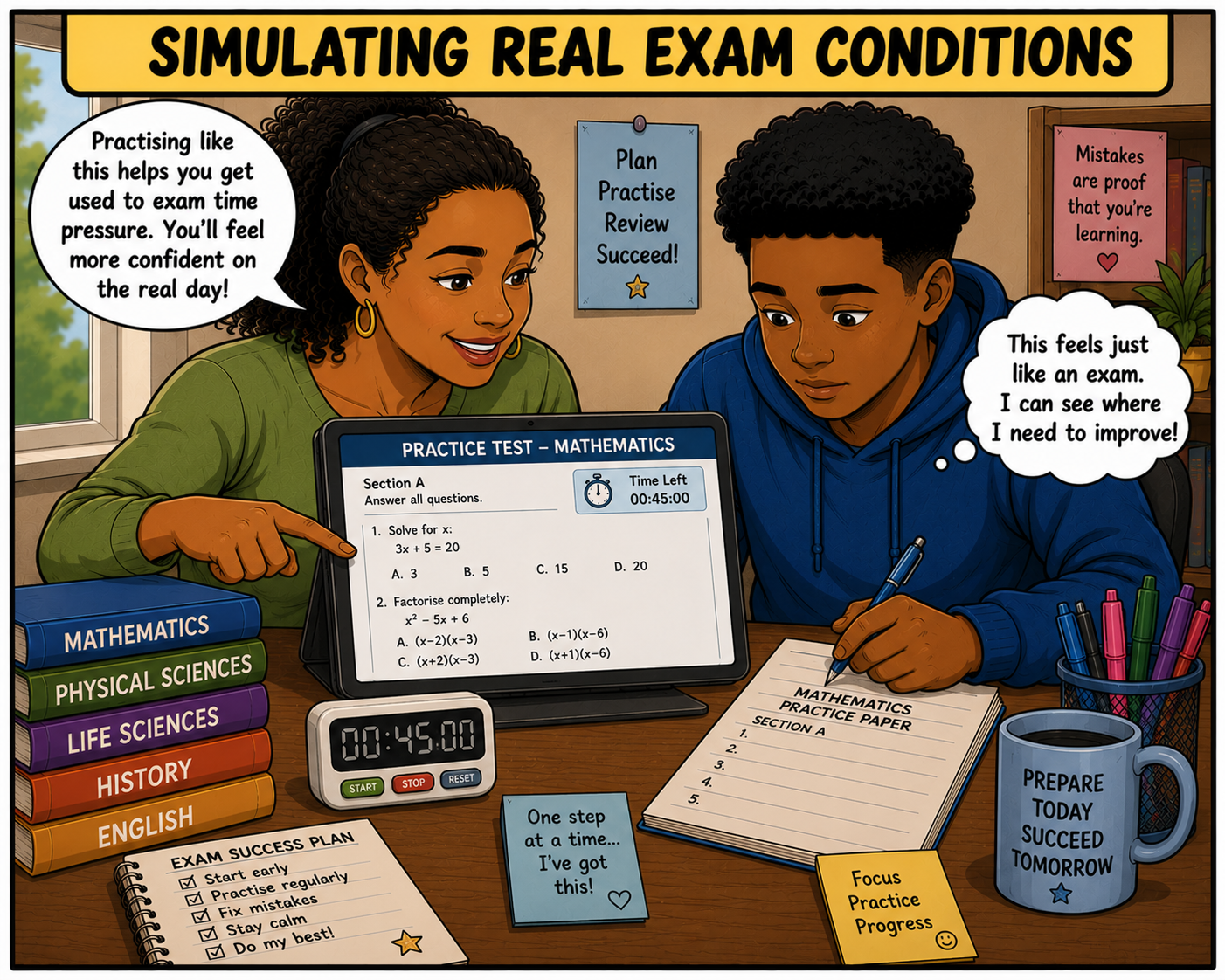
Many learners only revise in comfortable, low-pressure situations. The real examination environment feels very different.
AI can help learners practise under realistic conditions by creating:
Timed quizzes.
Full-length practice papers.
Mixed-topic revision sessions.
Exam-style questions.
Parents can occasionally encourage children to complete practice sessions without using notes.
This builds confidence and improves time management.
Building Confidence Through Small Successes
Confidence develops gradually. Each correctly answered question reminds learners that they are making progress.
AI provides immediate opportunities to:
Practise.
Receive feedback.
Correct mistakes.
Try again.
Parents should celebrate effort, consistency, and improvement rather than focusing only on perfect marks.
Replacing Panic With A Routine
Exam panic often develops because learners feel uncertain.
They wonder:
Have I studied enough?
What if I forget everything?
Which topics should I revise next?
A regular routine reduces this uncertainty.
For example:
Monday: Mathematics practice.
Tuesday: Geography revision.
Wednesday: English essay planning.
Thursday: Physical Sciences questions.
Friday:
Review weak areas.
AI helps maintain this routine by suggesting manageable daily activities.
Using AI To Review Mistakes
Many learners answer questions incorrectly but never review why.
This limits improvement.
AI can explain:
Why the answer was wrong.
Which concept was misunderstood.
How to solve similar questions.
Common mistakes learners make.
Parents can encourage children to spend as much time reviewing mistakes as answering new questions.
Learning often happens during correction.
Making Revision More Interesting
Long revision sessions can become repetitive.
AI introduces variety by creating:
Flashcards.
Quizzes.
Interactive questions.
Games.
Scenario-based activities.
Challenge questions.
This keeps learners mentally engaged while still covering important content.
Parents Do Not Need To Know Every Subject
Many parents worry that they cannot assist because they no longer remember the curriculum.
Fortunately, helping with exam preparation does not require subject expertise.
Instead, ask questions like:
What did you practise today?
Which questions were difficult?
What did AI explain differently?
Which topic still needs work?
What will you revise tomorrow?
These conversations help learners reflect on their progress.
Encouraging Healthy Exam Habits
Good preparation involves more than studying.
Parents can encourage:
Regular sleep.
Healthy meals.
Exercise.
Water breaks.
Screen breaks.
Realistic study hours.
AI works best when learners are physically and mentally prepared to learn.
Avoiding Last-Minute Cramming
Cramming creates several problems:
Increased stress.
Poor memory.
Mental fatigue.
Lower confidence.
Reduced understanding.
AI encourages earlier preparation by dividing work across several weeks.
Parents can help by encouraging consistent study sessions instead of marathon revision days.
Helping Learners Stay Calm During Exams
Even well-prepared learners experience nervousness.
Parents can support calmness by reminding children that:
No one knows everything.
Preparation matters more than perfection.
Mistakes are normal.
Every exam is one step in a much longer educational journey.
AI helps reduce uncertainty because learners know they have practised many different question types before the examination.
Working Together With Teachers
AI should never replace classroom teaching.
Teachers remain the best source of:
Curriculum guidance.
Examination expectations.
Marking standards.
Professional feedback.
Parents should encourage learners to combine:
Teacher explanations.
Class notes.
Textbooks.
Past examination papers.
AI practice activities.
This balanced approach provides the strongest preparation.
Helping Learners Reflect After Practice Sessions
Reflection improves learning.
After every practice session, parents can ask:
Which questions were easiest?
Which were hardest?
What mistakes did you correct?
What will you revise next?
What did AI help you understand?
These questions encourage learners to become active participants in their own learning.
Practical Ways Parents Can Support Exam Practice
Parents can make a significant difference by:
Encouraging early preparation.
Creating a quiet study environment.
Helping learners build routines.
Praising consistency.
Avoiding unnecessary pressure.
Supporting healthy sleep habits.
Encouraging honest AI use.
Celebrating progress.
Small daily encouragement often has a greater impact than occasional pressure close to examinations.
AI Is A Practice Partner, Not A Shortcut
The purpose of AI is not to provide easy answers.
Its purpose is to help learners:
Practise regularly.
Think independently.
Identify weaknesses.
Improve understanding.
Build confidence.
The learner still needs to:
Read.
Solve.
Explain.
Revise.
Learn from mistakes.
Parents should continue encouraging effort alongside responsible technology use.
Conclusion
Many learners experience unnecessary stress during exam season because they delay preparation until the final days before an assessment. Last-minute cramming often leads to panic, tiredness, and reduced confidence, making it much harder to perform at their best. Parents can play an important role in helping their child replace this cycle with calmer, more consistent preparation.
AI offers practical ways to make exam practice more effective. By creating personalised questions, generating quizzes, identifying weak areas, explaining mistakes, and simulating real exam conditions, it transforms revision from passive reading into active learning. Learners gain confidence because they regularly practise applying what they know instead of hoping they remember everything on exam day.
The most successful approach combines AI with good study habits, teacher guidance, school resources, and family support. AI should never replace independent thinking or honest effort, but it can become a valuable practice partner that encourages steady progress throughout the term.
As a parent, your encouragement, patience, and interest in your child's learning remain far more important than knowing every subject yourself. By helping your child practise consistently instead of panicking at the last minute, you are supporting habits that will benefit them not only in school but throughout their future education and careers.
Additional Articles in the AI for Study, Support, Revision, and School Success Series
How AI Can Help Your Child Revise More Effectively
Using AI to Build a Study Plan for Exams and Tests
Can AI Help Your Child with Difficult Subjects Like Maths or Science?
Helping Your Child Use AI to Practise for Exams Instead of Panic Before Them
How Parents Can Use AI Conversations to Check Understanding at Home
Disclaimer
AI Tools were used to assist with research. Remember to always cross-check everything that you read.