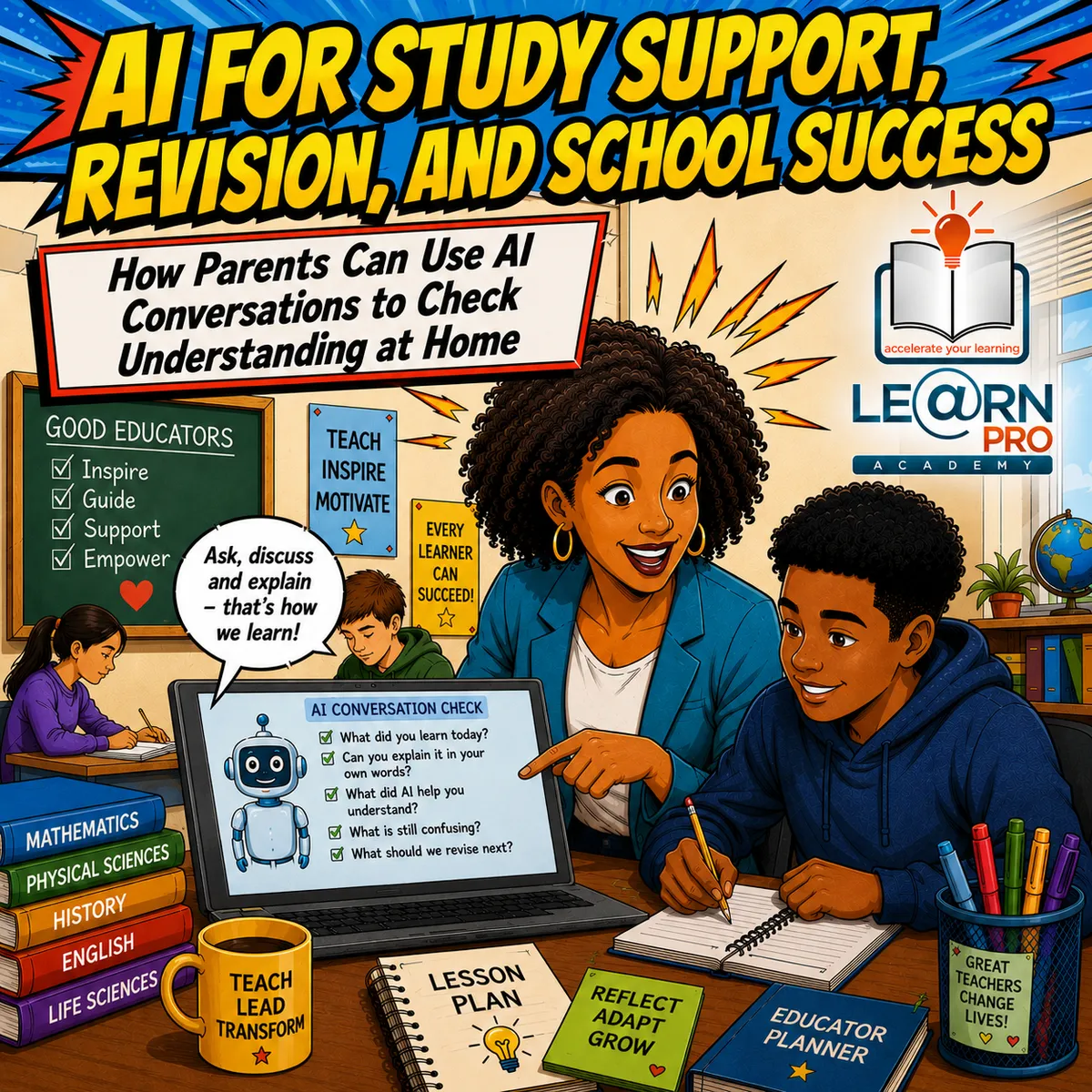
How Parents Can Use AI Conversations to Check Understanding at Home
This is article #5 of 5 in the AI for Study, Support, Revision, and School Success Series
Introduction
Many parents believe they cannot help with schoolwork because they no longer remember subjects like Mathematics, Physical Sciences, Accounting, or History. Others worry that the curriculum has changed so much that they would struggle to explain the work correctly. As a result, they sometimes feel they have little to contribute once their child reaches high school.
Fortunately, supporting learning at home does not require parents to know every answer. One of the most effective ways to help a learner is simply by encouraging meaningful conversations about what they are learning. Asking thoughtful questions, listening carefully, and showing genuine interest often provides valuable insight into whether a learner truly understands a topic.
Artificial intelligence (AI) makes these conversations even more useful. AI can explain concepts, answer questions, generate examples, and help learners prepare for tests. Parents can then use these AI-supported learning experiences as starting points for conversations that reveal what the learner understands, what still feels confusing, and where additional support may be needed.
This article explains how parents can use simple AI-related conversations to strengthen understanding, build confidence, and support learning at home without needing to become subject experts themselves.
Why Conversation Is A Powerful Learning Tool
Many learners believe they understand a topic because they recognise it in their notes. However, recognising information is very different from understanding it. One of the best ways to test understanding is through conversation.
When learners explain something aloud, they must:
Organise their thoughts.
Use their own words.
Connect ideas together.
Identify gaps in their knowledge.
Think carefully about what they have learned.
Parents who encourage these conversations help children move beyond memorising facts towards genuine understanding.
Parents Do Not Need To Know Every Subject
One of the biggest misconceptions is that parents must be able to teach the subject. That is not true.
Your role is not to replace the teacher.
Instead, your role is to:
Listen.
Ask questions.
Encourage thinking.
Show interest.
Support learning.
Even if you cannot solve a Mathematics problem yourself, you can still ask your child to explain how they solved it.
Often, the explanation itself helps the learner strengthen their understanding.
How AI Supports Learning Conversations
AI gives learners another way to explore topics before discussing them at home.
For example, learners can ask AI to:
Explain difficult concepts.
Summarise chapters.
Create quizzes.
Generate examples.
Compare ideas.
Clarify confusing terms.
Parents can then build on these experiences by asking questions about what AI explained and whether the learner agrees with the explanation.
The conversation becomes about understanding rather than simply checking homework.
Asking Better Questions
Many parents ask: "Did you study?"
While this is understandable, it usually leads to short answers like: "Yes."
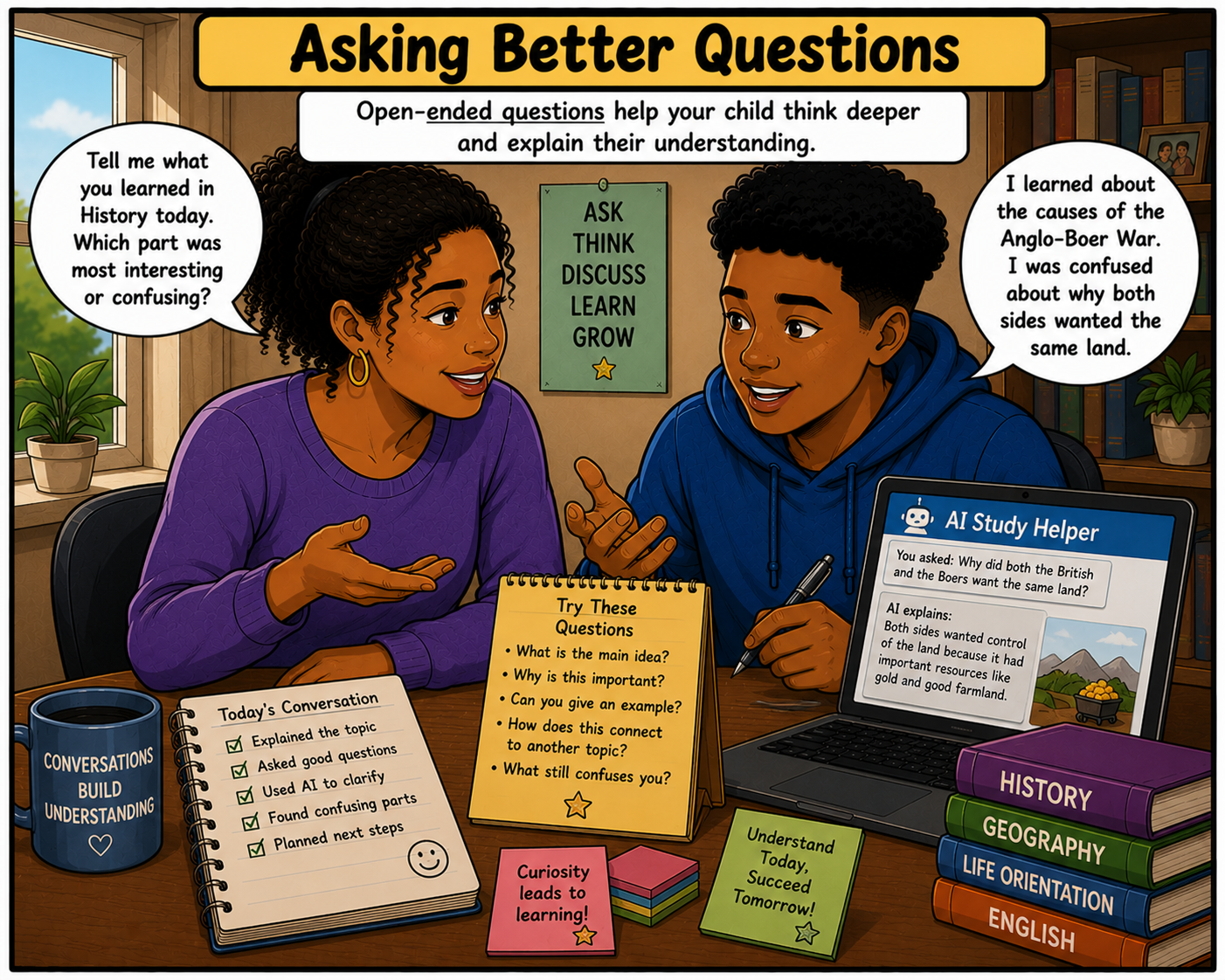
Instead, ask open-ended questions such as:
What did you learn today?
Which topic was most interesting?
Which topic was most difficult?
What did AI explain that helped?
What still feels confusing?
Can you teach this topic to me?
These questions encourage much richer conversations.
The "Teach Me" Technique
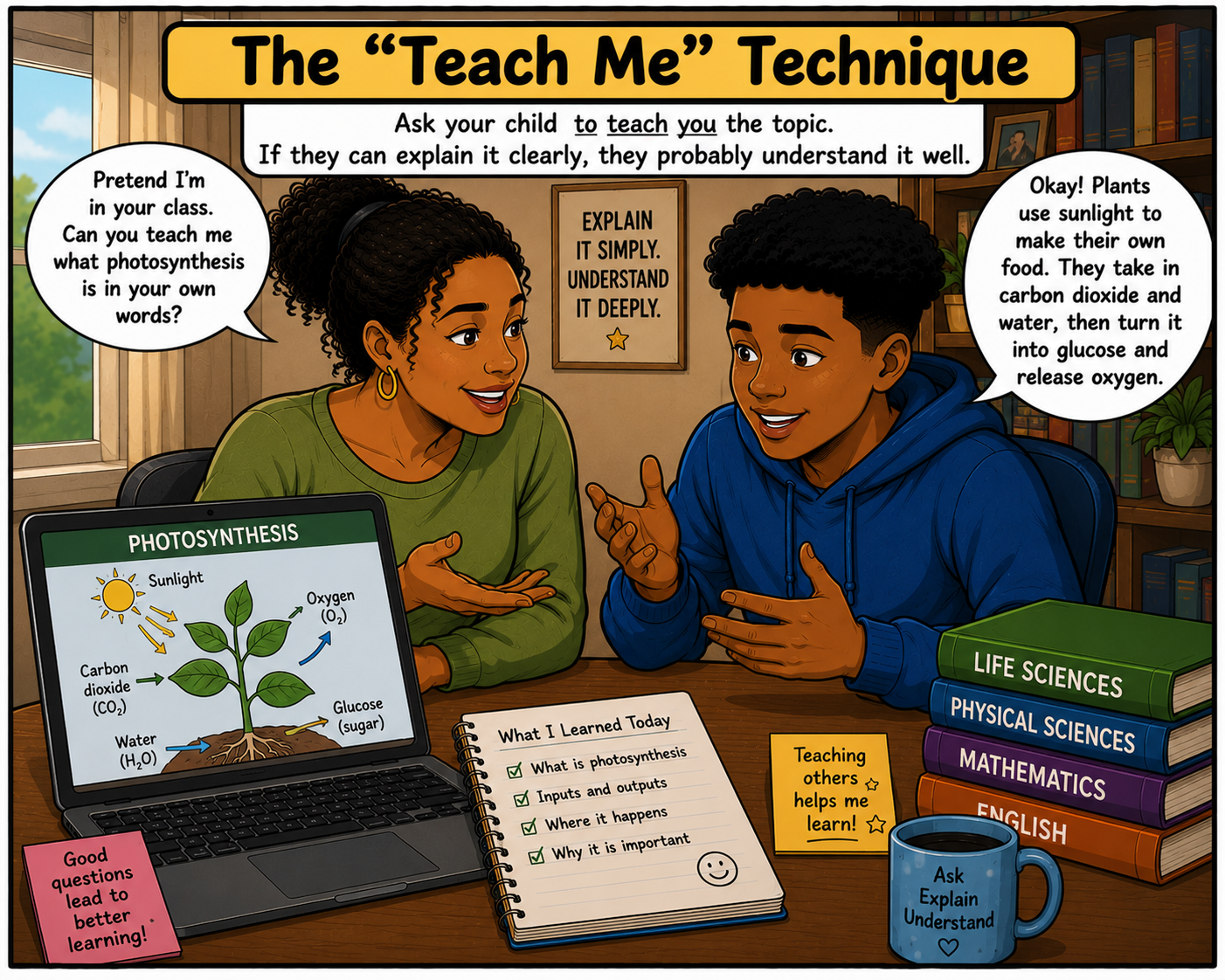
One of the simplest ways to check understanding is to ask your child to become the teacher.
For example: "Pretend I'm in your class. Teach me this topic."
If the learner can explain the concept clearly, they probably understand it well. If they struggle to explain it, it often reveals areas that still need revision.
Parents do not need to know whether every detail is correct.
Simply listening carefully often provides enough information to identify uncertainty.
Encouraging Learners To Explain In Their Own Words
Some learners simply repeat textbook definitions. This may sound impressive, but memorising words is not always the same as understanding.
Encourage explanations using everyday language.
For example:
Instead of repeating the textbook definition of photosynthesis, ask: "Can you explain it as if you were talking to your younger brother or sister?"
Or: "Can you explain it without using difficult scientific words?"
AI can also help learners practise giving simpler explanations.
Talking About What AI Helped With
Rather than focusing only on the school subject, ask questions about the AI experience itself.
Examples include:
What question did you ask AI?
Why did you ask that question?
Did AI explain it clearly?
Did you ask any follow-up questions?
Did AI explain it differently from your teacher?
These discussions help learners think critically about how they use AI.
Helping Learners Identify Confusion
Many learners hesitate to admit they do not understand something. Parents can create a safe environment where confusion is viewed as a normal part of learning.
Ask questions like:
Which part still feels difficult?
What confused you most today?
What should we ask AI next?
What would help you understand better?
This encourages honesty instead of pretending everything is understood.
Using AI To Generate Discussion Questions
AI can create questions that encourage deeper thinking.
For example:
Why do you think this happened?
What would happen if...?
Can you compare these two ideas?
Which solution is better and why?
How does this apply in real life?
These conversations develop reasoning instead of simple memorisation.
Encouraging Critical Thinking
AI is a useful tool, but it is not always correct.
Parents can encourage critical thinking by asking:
Does this answer make sense?
Does it match your textbook?
Did your teacher explain it differently?
How could we verify this information?
These questions teach learners to evaluate information instead of accepting every AI response without question.
Helping Learners Connect Different Subjects
Learning becomes stronger when learners recognise connections.
Parents can ask:
How does this topic relate to another subject?
Where could this knowledge be useful?
Have you seen this idea before?
Does this remind you of something you learned earlier?
AI can also suggest cross-subject examples that strengthen understanding.
Encouraging Reflection After Studying
Reflection helps learners become more aware of their own learning.
After a study session, ask:
What did you understand today?
What improved?
What still needs work?
Which AI explanation helped most?
What will you revise tomorrow?
These conversations build independent learners who think about their own progress.
Helping Build Confidence
Confidence grows when learners realise they can explain ideas clearly.
Parents should celebrate:
Good explanations.
Honest questions.
Improved understanding.
Curiosity.
Persistence.
Praise effort rather than perfection.
A learner who asks thoughtful questions is often learning more deeply than one who simply memorises answers.
Keeping Conversations Positive
If every conversation becomes an interrogation, learners may become defensive.
Avoid questions that sound like tests.
Instead of saying: "Do you even know this work?"
Try: "I'd love to hear how you understand this topic."
The goal is support — not pressure.
Making Conversations Part Of Daily Life
Learning conversations do not need to be long. Five or ten minutes each day can make a significant difference.
Good opportunities include:
During dinner.
While travelling to school.
After homework.
During evening walks.
Before bedtime.
Short, regular conversations often produce better results than occasional lengthy discussions.
Helping Learners Develop Independence
Over time, learners should begin asking themselves the same questions parents ask.
For example:
Do I really understand this?
Can I explain it?
What still confuses me?
What should I ask AI next?
Which topic needs more practice?
This self-reflection builds lifelong learning skills.
Working Together With Teachers
AI and parent conversations should support — not replace — the classroom.
Teachers remain responsible for:
Teaching the curriculum.
Assessing understanding.
Providing feedback.
Guiding learner progress.
Parents should encourage learners to combine:
Teacher explanations.
School notes.
Textbooks.
AI support.
Home discussions.
This balanced approach provides the strongest foundation.
Avoiding Overdependence On AI
Parents should also encourage learners to think before asking AI.
Useful habits include:
Attempting questions independently.
Explaining ideas before checking AI.
Comparing AI answers with textbooks.
Asking AI for clarification rather than shortcuts.
Using AI to improve understanding instead of avoiding effort.
These habits promote responsible AI use.
Practical Conversation Starters For Parents
Here are some simple questions you can use regularly:
What was today's most important lesson?
Which topic challenged you the most?
What did AI help you understand?
What question would you still like to ask AI?
Can you explain today's lesson in your own words?
What surprised you today?
Which subject do you feel most confident about?
What will you revise next?
These questions encourage meaningful learning conversations instead of simple yes-or-no answers.
AI Is A Conversation Starter, Not A Replacement For Parents
Technology cannot replace the encouragement that comes from a caring adult. AI provides explanations.
Teachers provide professional instruction.
Parents provide something equally valuable:
Encouragement.
Interest.
Support.
Perspective.
Motivation.
When these three sources work together, learners receive stronger academic and emotional support.
Conclusion
Parents do not need to become experts in every school subject to make a meaningful difference in their child's education. Some of the most valuable support happens through simple conversations that encourage learners to explain what they know, reflect on what they have learned, and identify the areas where they still need help.
AI creates many opportunities for these conversations. By asking learners what they discussed with AI, which explanations helped, and what still feels confusing, parents gain valuable insight into their child's understanding without needing to provide all the answers themselves. These discussions also encourage learners to think critically, communicate clearly, and take greater ownership of their learning.
The goal is not to test children or catch them making mistakes. Instead, it is to create a supportive home environment where curiosity is welcomed, questions are encouraged, and learning becomes an ongoing conversation. When AI, teachers, and parents each play their proper role, learners develop not only stronger academic knowledge but also the confidence, independence, and critical thinking skills they will carry with them long after they leave school.
Additional Articles in the AI for Study, Support, Revision, and School Success Series
How AI Can Help Your Child Revise More Effectively
Using AI to Build a Study Plan for Exams and Tests
Can AI Help Your Child with Difficult Subjects Like Maths or Science?
Helping Your Child Use AI to Practise for Exams Instead of Panic Before Them
How Parents Can Use AI Conversations to Check Understanding at Home
Disclaimer
AI Tools were used to assist with research. Remember to always cross-check everything that you read.