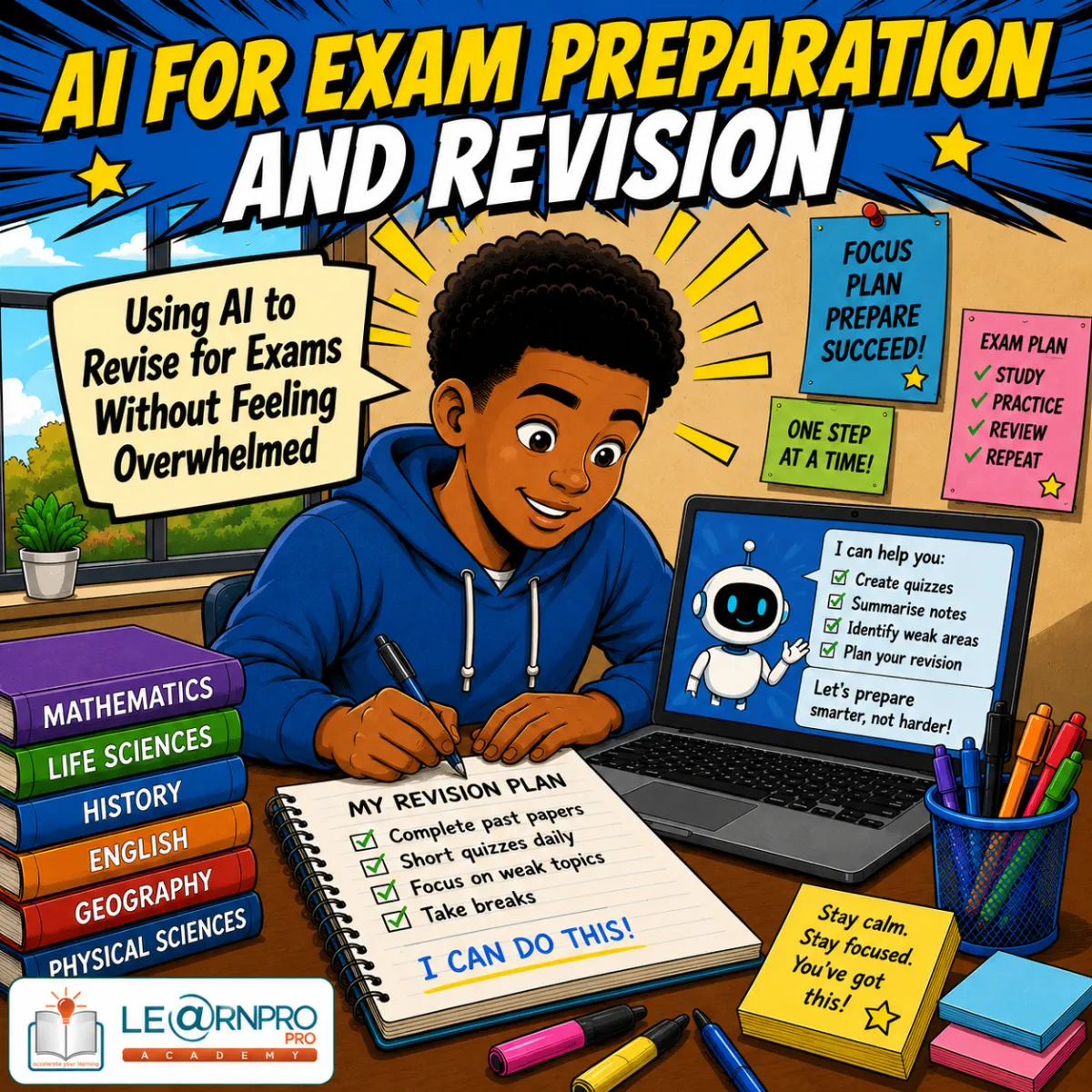
Using AI to Revise for Exams Without Feeling Overwhelmed
This is article #1 of 5 in the AI for Exam Preparation and Revision Series
Introduction
Preparing for exams is one of the biggest challenges that high school learners face. As exam season gets closer, it often feels like there is too much work and too little time. Many learners have several subjects to revise, class tests to complete, assignments to finish, and personal responsibilities at home. It is easy to feel stressed before you even begin studying.
The good news is that you do not have to face exam revision alone. Artificial Intelligence (AI) can help you organise your study time, break large tasks into smaller steps, and create a realistic revision plan that is easier to follow. AI cannot study for you or write your exams, but it can become a personal study assistant that helps you stay calm, focused, and productive.
The purpose of AI is not to replace your teachers or your own hard work. Instead, it helps you study smarter by making revision more organised and less overwhelming.
This article will show you practical ways to use AI during exam season. You will learn how to create manageable revision plans, prioritise subjects, stay motivated, and avoid common mistakes that make exam preparation more stressful than it needs to be.
Why Exam Revision Feels So Overwhelming
Most learners do not struggle because they are lazy or incapable. They struggle because they do not know where to begin.
Imagine opening your school bag and seeing textbooks, workbooks, printed notes, assignments, past papers, and study guides for seven different subjects. Looking at everything at once can make anyone feel anxious.
Many learners experience thoughts like:
"There is too much to study."
"I don't have enough time."
"I don't know which subject to start with."
"What if I forget everything?"
These thoughts increase stress and make it harder to concentrate.
AI helps solve this problem by breaking one huge challenge into many small, achievable tasks.
Instead of trying to study an entire subject in one day, AI can help you focus on one chapter, one topic, or even one concept at a time.
Small progress every day leads to big results by exam day.
Understand That Revision Is Different From Learning
Many learners think revision means learning everything from the beginning again. It does not.
Revision means strengthening what you already know while identifying the areas where you need more practice.
Think of revision like preparing for a sports competition. Athletes do not learn their sport from scratch before every competition. They practise, improve weaknesses, and build confidence.
Your revision should do the same.
AI can help you:
Review important concepts.
Test your understanding.
Explain difficult topics again.
Generate practice questions.
Identify weak areas.
Keep track of your progress.
This makes revision much more effective than simply reading the same notes repeatedly.
Start By Creating A Revision Overview
Before you begin studying, spend some time organising everything. List all your subjects.
For example:
Mathematics
English Home Language
Physical Sciences
Life Sciences
Geography
History
Life Orientation
Then list the major topics for each subject. Once you have your list, ask AI something like:
"Help me organise my Grade 11 Physical Sciences revision into manageable topics."
AI can break the syllabus into smaller sections that feel much easier to complete. Instead of seeing one enormous subject, you now have a checklist of smaller goals.
Completing one small goal gives you confidence to continue with the next one.
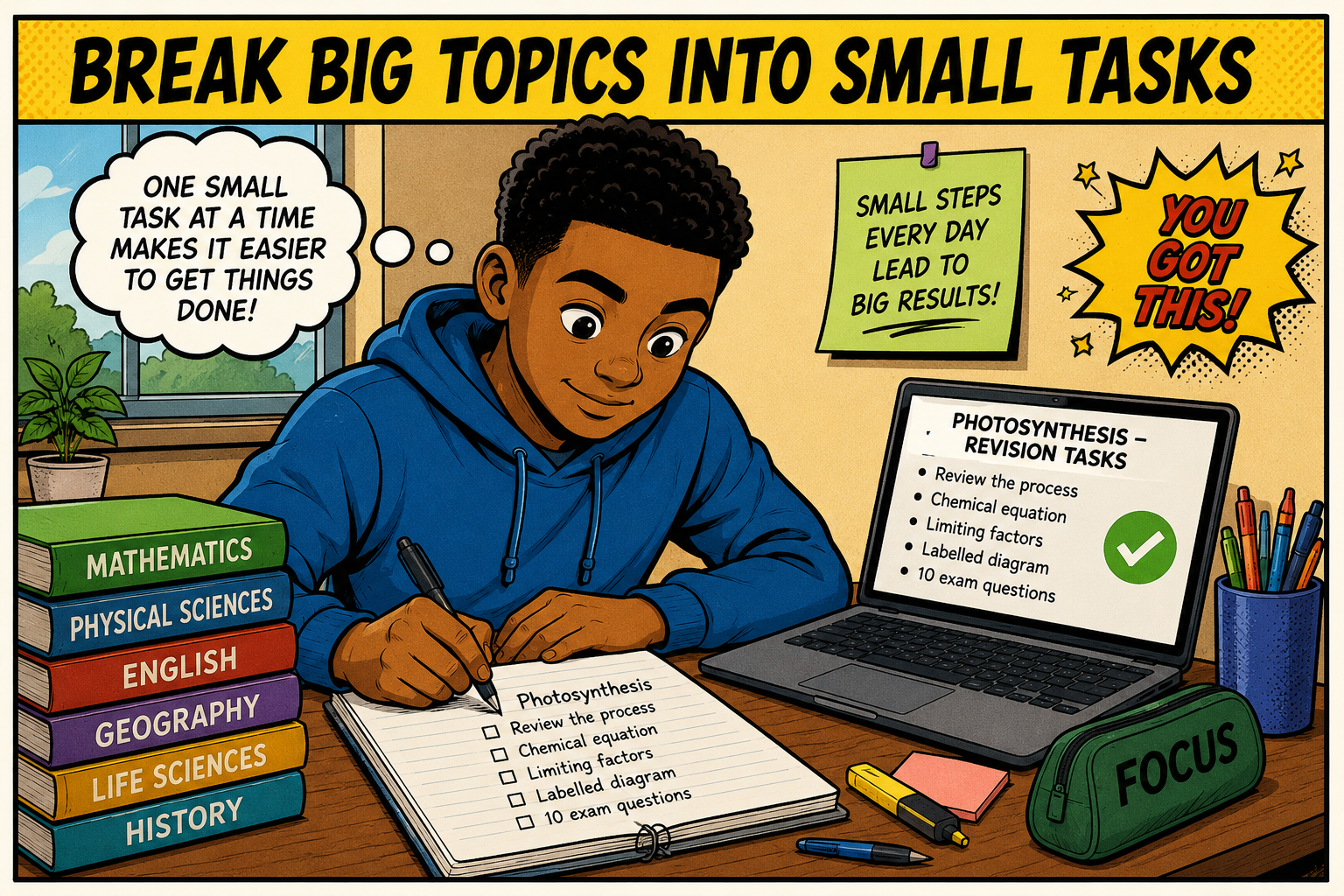
Break Big Topics Into Small Tasks
One of the biggest reasons learners procrastinate is because the task feels too large.
Compare these two goals:
Goal 1
Study Mathematics.
Goal 2
Complete ten algebra questions.
Review quadratic equations.
Practise graph interpretation.
Which one feels easier?
Obviously, Goal 2.
Large goals create stress.
Small goals create action.
AI is excellent at turning large chapters into smaller learning activities.
Instead of studying "Photosynthesis," AI may suggest:
Review the process.
Learn the chemical equation.
Understand limiting factors.
Practise labelled diagrams.
Complete ten exam questions.
Each task feels achievable.
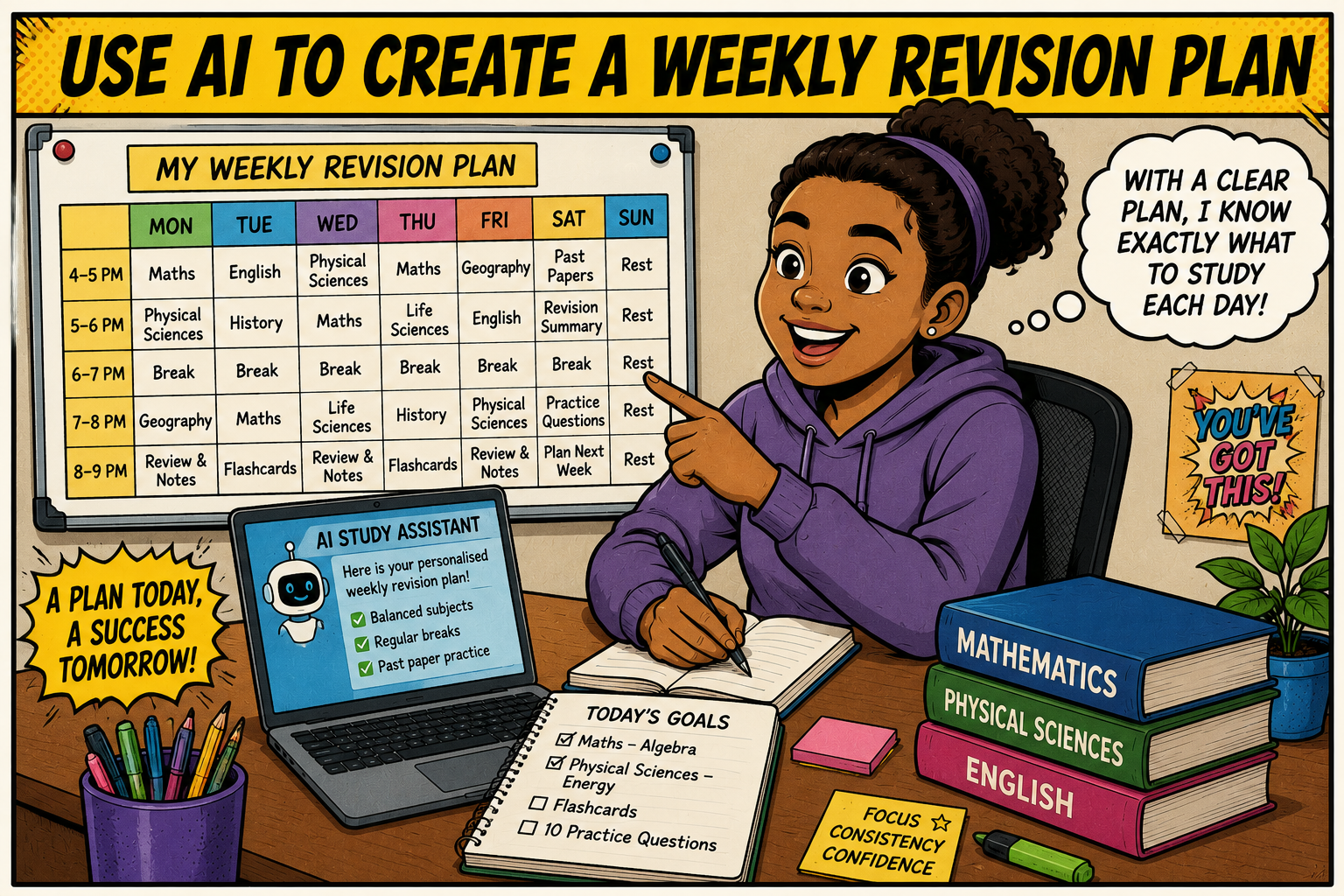
Use AI To Create A Weekly Revision Plan
One mistake learners often make is studying only the subjects they enjoy. Unfortunately, exams include every subject. AI can help you create a balanced timetable.
For example, you can ask:
"Create a one-week revision plan for a Grade 12 learner studying six subjects. I have two hours available every weekday and five hours on Saturday."
AI can produce a realistic schedule that includes:
Study sessions
Break times
Subject rotation
Practice questions
Review sessions
Having a clear plan removes the stress of deciding what to study every day.
Prioritise Difficult Subjects First
Not every subject requires the same amount of revision. Some subjects come naturally. Others require much more effort.
AI can help you rank subjects according to:
Confidence level
Upcoming exam dates
Number of topics remaining
Previous test results
Amount of practice needed
Suppose you feel confident in English but struggle with Mathematics and Physical Sciences. AI might recommend spending more revision time on Mathematics while still reviewing English regularly.
This helps you use your study time wisely.
Build A Daily Study Routine
Consistency is far more important than studying for one extremely long day. Studying for two focused hours every day is usually better than studying twelve hours only once a week. AI can help you create a realistic daily routine.
For example:
After School
Eat a healthy snack.
Rest for 30 minutes.
Study Mathematics for 45 minutes.
Take a 10-minute break.
Revise Geography for 45 minutes.
Review flashcards before bed.
A predictable routine reduces decision fatigue. Eventually, studying becomes a habit instead of a struggle.
Use The Pomodoro Technique With AI
Many learners lose concentration because they try to study for several hours without taking breaks. The Pomodoro Technique is simple.
Study for 25 minutes.
Take a 5-minute break.
Repeat four times.
Then take a longer break.
AI can help you plan study blocks and even suggest what to cover during each session.
Knowing that you only need to concentrate for 25 minutes makes difficult subjects feel less intimidating.
Ask AI To Explain Difficult Topics Again
Every learner has topics that simply refuse to make sense. Instead of becoming frustrated, ask AI for another explanation.
For example:
"Explain chemical bonding as if I am a Grade 10 learner."
Or:
"Explain trigonometry using everyday examples."
AI can explain the same concept in different ways until you understand it better.
Remember to compare explanations with your textbook and your teacher's notes to make sure they match your curriculum.
Turn Revision Into Conversations
Sometimes reading silently becomes boring. Instead, use AI like a study partner.
You can ask:
Quiz me on today's work.
Ask me one question at a time.
Give me hints instead of answers.
Explain why my answer is incorrect.
Ask more difficult questions if I answer correctly.
Active learning improves memory much more than passive reading.
Use AI To Create Revision Checklists
Checklists help you see your progress. Instead of wondering what still needs attention, you have a clear list.
For example:
Mathematics
☐ Algebra
☐ Functions
☐ Probability
☐ Geometry
☐ Statistics
Each completed topic gives you a sense of achievement. Progress builds motivation.
Keep Track Of What You Already Know
Many learners waste valuable time revising topics they already understand well.
AI can help you separate topics into categories such as:
Very confident
Fairly confident
Need more practice
Do not understand yet
This allows you to spend more time where it matters most. Revision becomes more efficient.
Avoid Information Overload
During exam season, learners often collect too many resources. Such as:
One textbook.
Three study guides.
Five YouTube channels.
Ten websites.
Countless AI conversations.
Eventually, there is simply too much information. Choose a few reliable resources. Use AI to organise and simplify — not to create endless new notes.
Sometimes less is more.
Do Not Let AI Replace Your Own Thinking
AI is a helpful assistant. It is not your brain.
Always answer questions yourself before asking AI.
Attempt difficult problems first.
Only ask for help after making a genuine effort.
This develops real understanding.
Remember, AI will not be sitting in the examination room with you.
Use AI To Reduce Stress
Exam stress affects almost every learner. AI cannot remove stress completely, but it can help reduce uncertainty.
It can:
Organise your timetable.
Remind you of deadlines.
Break work into smaller steps.
Suggest relaxation activities.
Encourage healthy study habits.
When you know exactly what you need to do each day, your stress levels often decrease.
Remember To Look After Yourself
Good revision is not only about studying. Your brain works best when your body is healthy.
During exam season:
Sleep 7 to 9 hours every night.
Eat balanced meals.
Drink enough water.
Exercise regularly.
Take short breaks.
Spend some time away from screens.
No AI tool can replace proper rest. Your brain needs time to recover before learning new information.
Common Mistakes Learners Should Avoid
Many learners accidentally make revision harder than necessary.
Avoid these common mistakes:
Trying To Study Everything At Once
Focus on one task at a time.
Ignoring Weak Subjects
Spend more time where improvement is needed.
Studying Without A Plan
Create a timetable before you begin.
Only Reading Notes
Test yourself regularly.
Using AI To Give You All The Answers
Use AI to guide your learning, not replace it.
Studying Late Every Night
Sleep is essential for memory.
Skipping Breaks
Your concentration improves after short rests.
Example Prompts You Can Use With AI
Here are some useful prompts you can try.
Create a two-week revision timetable for my Grade 11 exams.
Break this chapter into smaller revision tasks.
Explain this topic using simple English.
Test me with ten multiple-choice questions.
Ask me exam questions one at a time.
Help me identify the topics I should revise first.
Turn these notes into flashcards.
Summarise this chapter into key points.
Help me plan my revision for this weekend.
Give me a confidence checklist for this subject.
The more specific your prompt, the more useful the AI response is likely to be.
Responsible Use Of AI During Exam Preparation
Using AI responsibly is just as important as using it effectively.
Always remember these guidelines:
Use AI to support learning, not to cheat.
Check important facts with your teacher and textbook.
Think critically about every answer.
Never submit AI-generated work as your own unless your teacher allows it.
Protect your personal information when using online AI tools.
Continue practising without AI so that you are ready for the real examination.
Responsible learners use AI to become more independent—not more dependent.
Final Thoughts
Exam revision does not have to feel overwhelming. The biggest challenge is often knowing where to begin, not the amount of work itself. By breaking large subjects into smaller tasks, creating a realistic timetable, identifying your priorities, and reviewing your progress regularly, you can make revision much more manageable.
AI is a powerful study assistant because it helps you organise your learning, explain difficult concepts, create practice activities, and stay focused throughout exam season. However, your success still depends on your own effort, discipline, and willingness to practise consistently.
Remember that every completed study session brings you one step closer to your goal. You do not need to revise everything perfectly in one day. Small, steady progress is far more effective than last-minute cramming. Use AI wisely, trust the study habits you build, and believe in your ability to improve. With a calm plan, consistent effort, and the right support, you can approach your exams with greater confidence and less stress.
Additional Articles in the AI for Exam Preparation and Revision Series
Using AI to Revise for Exams Without Feeling Overwhelmed
How AI Can Help You Identify Your Weakest Subject Areas
Using AI to Turn Your Notes into FlashcardsUsing AI to Stay Organised During Exam Season and Quizzes
How to Use AI to Practise Long Questions and Written Answers
Disclaimer
AI Tools were used to assist with research. Remember to always cross-check everything that you read.