
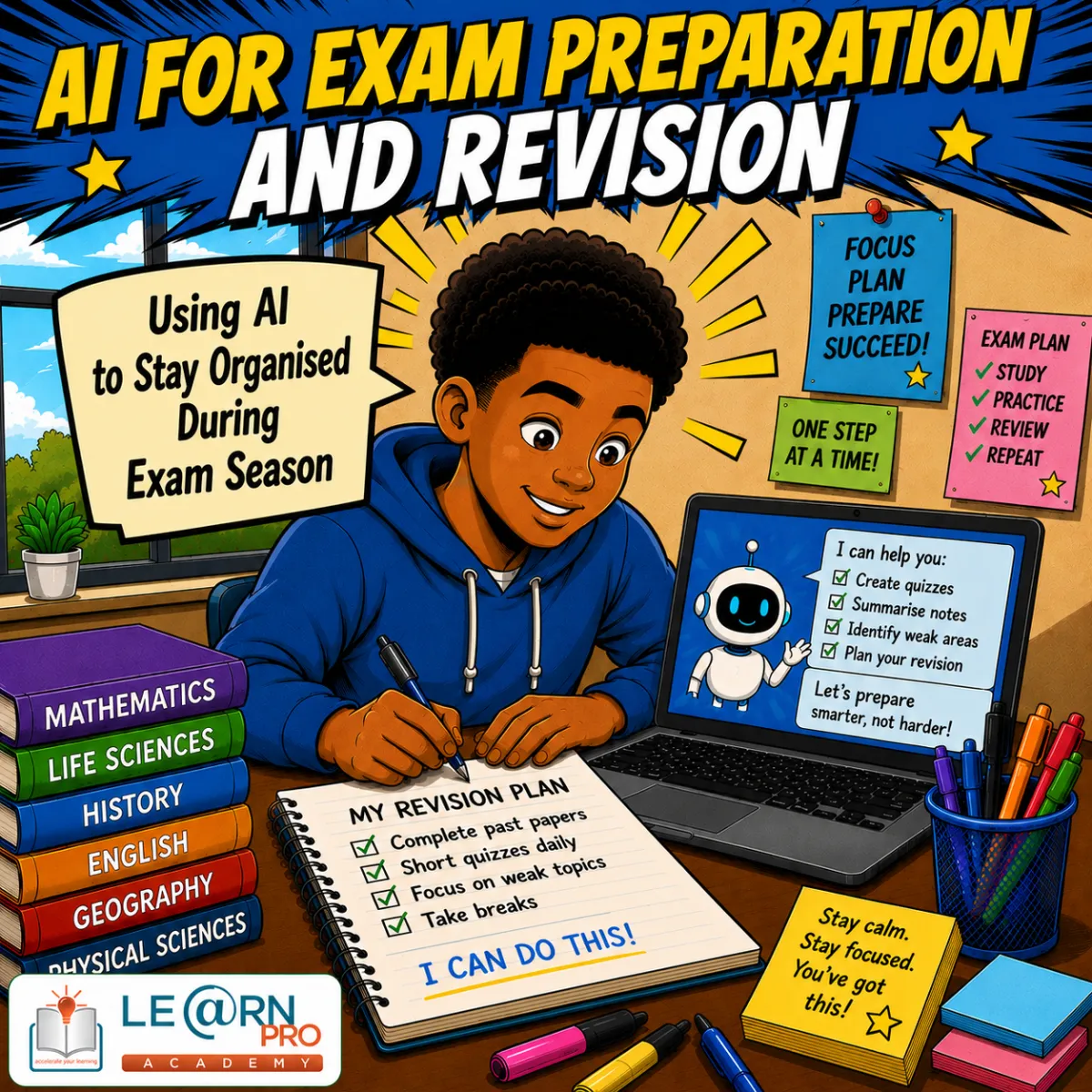
Using AI to Stay Organised During Exam Season
This is article #5 of 5 in the AI for Exam Preparation and Revision Series
Introduction
Exam season is one of the busiest times of the school year. For many Grade 10–12 learners, it can feel as though everything happens at once. There are tests, assignments, projects, revision, extracurricular activities, family responsibilities, and the pressure of preparing for final examinations. On top of all this, learners still need enough sleep, healthy meals, and time to relax.
It is no surprise that many students feel overwhelmed.
Being organised during exam season is not about studying every minute of the day. It is about knowing what needs to be done, when it needs to be done, and how to use your time wisely. Good organisation reduces stress because you always know your next step instead of worrying about everything at once.
This is where Artificial Intelligence (AI) can make a real difference.
AI can help you create revision timetables, manage deadlines, organise your subjects, track your progress, remind you about important tasks, and even suggest healthier study routines. Instead of feeling like exam season is controlling you, AI can help you take control of your schedule.
However, AI is not a replacement for your own discipline or responsibility. You still need to make good decisions, complete your work honestly, and follow through with your study plans. AI simply helps you organise your learning more effectively.
In this article, you will discover practical ways to use AI to stay organised throughout exam season, reduce unnecessary stress, and prepare with confidence.
Why Exam Season Feels So Chaotic
Most learners do not only study one subject. A typical South African Grade 10–12 learner may be preparing for six or seven different subjects at the same time.
Each subject has:
Different chapters to revise.
Different examination dates.
Different assignments.
Different study methods.
Different levels of difficulty.
At the same time, you may also have:
Sports practice.
Cultural activities.
Household responsibilities.
Family commitments.
Personal goals.
Without a proper plan, everything begins to compete for your attention. This often leads to panic, procrastination, and last-minute cramming. Organisation helps prevent this.
Understand The Difference Between Being Busy And Being Productive
Many learners spend hours sitting at a desk but achieve very little. Being busy does not always mean being productive.
For example: You spend three hours "studying."
During that time you:
Check your phone repeatedly.
Rearrange your notes.
Watch unrelated videos.
Worry about other subjects.
Read the same page several times.
Although you were busy, very little learning happened. Being productive means completing meaningful tasks. AI can help you focus on activities that actually improve your exam preparation.
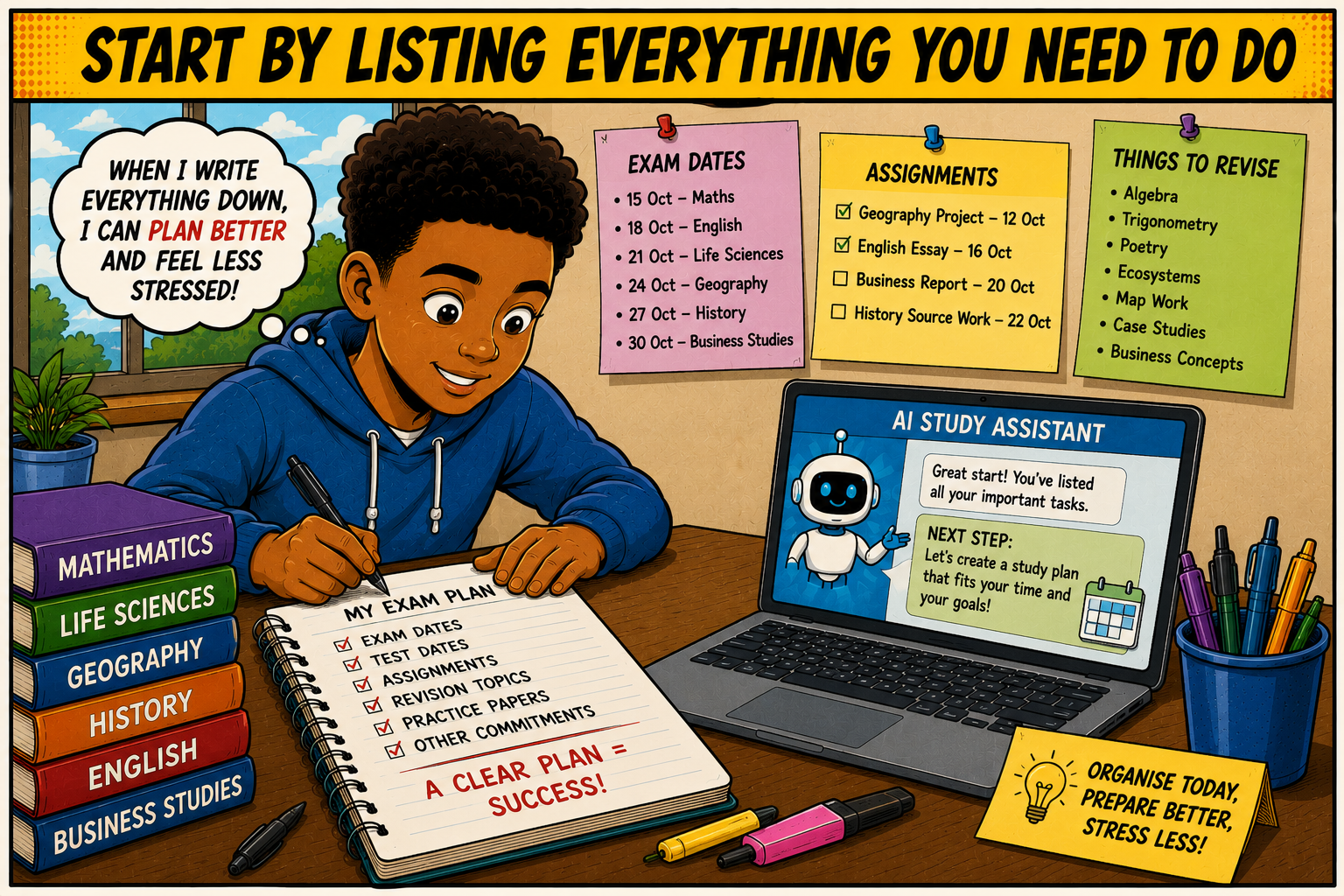
Start By Listing Everything You Need To Do
Before creating a study plan, gather all your information in one place.
Write down:
Examination dates.
Test dates.
Assignment deadlines.
Practical assessments.
Project due dates.
Important school events.
Next, list every topic you still need to revise. This creates a complete overview of your workload. Once everything is visible, it becomes much easier to plan.
Ask AI To Create A Personalised Revision Calendar
Once you know what needs to be done, AI can help organise it into a realistic calendar.
For example, you could ask: "Create a three-week revision calendar for a Grade 12 learner studying Mathematics, English, Physical Sciences, Geography, Life Sciences, and Life Orientation."
AI can divide your work into daily study sessions that are manageable instead of overwhelming.
A good revision calendar includes:
Study sessions.
Practice questions.
Review days.
Rest periods.
Time for unexpected changes.
A realistic plan is far more useful than an impossible one.
Prioritise Your Most Important Tasks
Not every task has the same level of importance. AI can help you decide what should be completed first.
For example:
High Priority
Tomorrow's Mathematics test.
Geography assignment due Friday.
Medium Priority
Life Sciences chapter revision.
Lower Priority
Organising old notes.
Focusing on priorities prevents important tasks from being forgotten.
Break Large Tasks Into Smaller Steps
One reason learners procrastinate is because large tasks seem intimidating.
Instead of writing: "Study History."
Break it into smaller actions.
For example:
Review Chapter 3.
Create flashcards.
Answer ten source-based questions.
Revise key dates.
Complete one past paper question.
AI is excellent at dividing large tasks into smaller, achievable goals. Every completed step builds motivation.
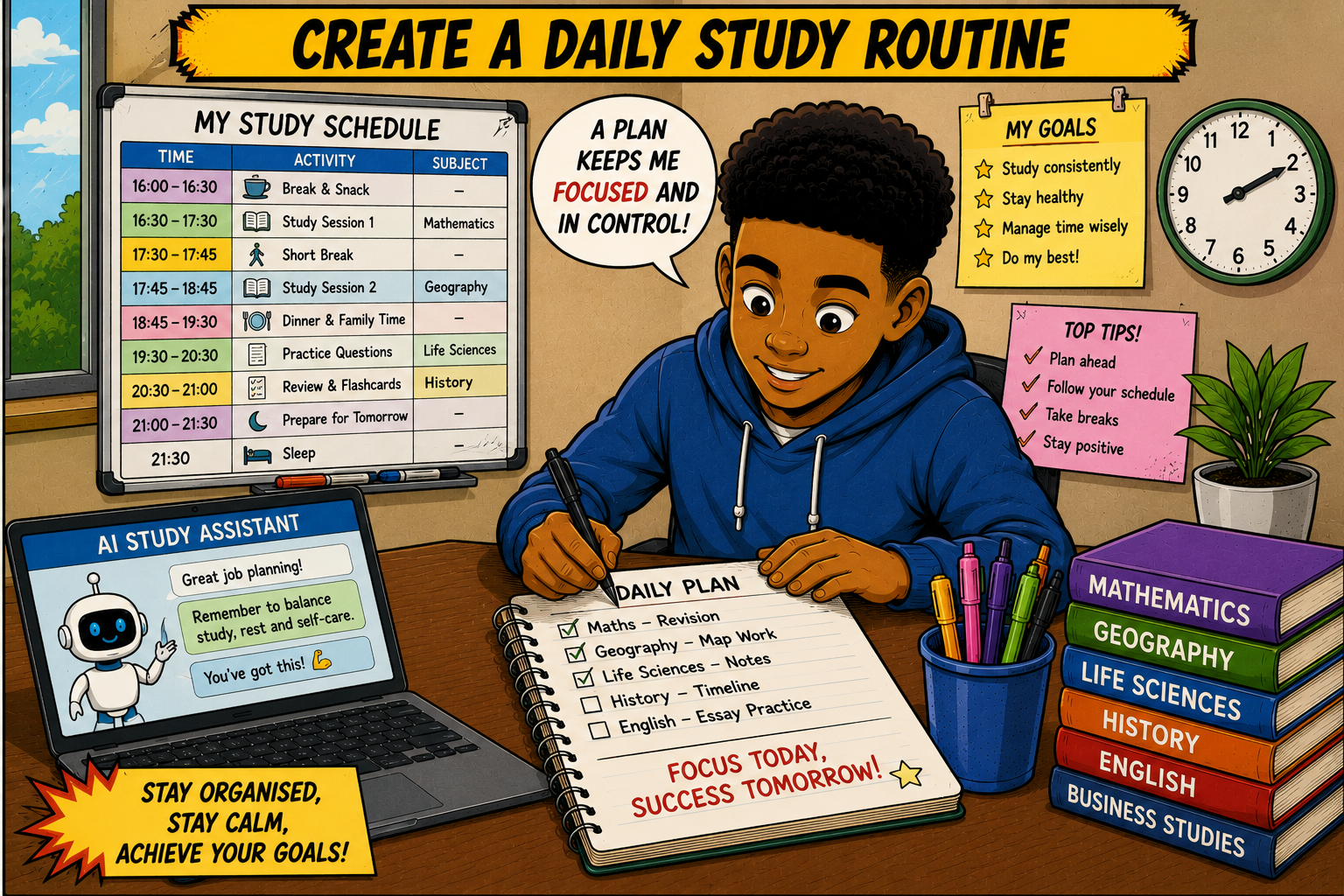
Create A Daily Study Routine
Consistency is more powerful than occasional bursts of studying. AI can help you create a routine that matches your lifestyle.
For example:
After School
4:00–4:30 Rest and snack
4:30–5:15 Mathematics
5:15–5:25 Break
5:25–6:10 Geography
6:10–6:30 Review flashcards
Evening
Family time
Dinner
Prepare for tomorrow
Sleep
Following a routine reduces decision-making and makes studying feel more natural.
Keep Track Of Your Progress
One of the biggest causes of exam stress is uncertainty.
Many learners constantly wonder: "Have I revised enough?" AI can help you keep a progress tracker.
For example:
Mathematics
✔ Algebra
✔ Functions
✔ Geometry
✔ Statistics
English
✔ Poetry
✔ Grammar
✔ Literature
✔ Transactional Writing
Seeing completed topics builds confidence and shows exactly what still needs attention.
Use AI To Manage Deadlines
Forgetting deadlines creates unnecessary pressure.
AI can help you organise:
Assignment due dates.
Practical tasks.
Examination schedules.
Revision targets.
Personal goals.
Instead of relying on memory, keep everything in one organised system. This reduces last-minute surprises.
Plan Around Your Energy Levels
Not everyone studies best at the same time. Some learners concentrate better early in the morning. Others work better after school. AI can help you build a timetable that matches your natural energy levels.
For example:
Morning
Review flashcards.
Afternoon
Complete calculations.
Evening
Read summaries and revise vocabulary.
Working with your natural rhythm often improves concentration.
Balance All Your Subjects
Many learners accidentally spend all their time on one subject. Then they suddenly realise another examination is only two days away. AI can help balance your timetable by rotating subjects throughout the week.
This ensures that every subject receives regular attention. Balanced revision reduces stress.
Include Breaks In Your Study Plan
Studying continuously for several hours usually reduces concentration. Your brain needs short breaks.
AI can help schedule:
Study sessions.
Five- or ten-minute breaks.
Meal times.
Exercise.
Relaxation.
Breaks improve focus and help prevent burnout.
Prepare For Unexpected Changes
Life does not always go according to plan:
You may become sick.
A family event may interrupt your schedule.
A teacher may change a test date.
AI can help adjust your timetable without causing panic. Flexible planning is often more successful than rigid planning.
Organise Digital Notes And Study Materials
Searching through dozens of files wastes valuable study time.
AI can help you organise digital notes into folders such as:
Mathematics
Life Sciences
History
Geography
English
Business Studies
You can also organise:
Flashcards.
Practice papers.
Revision summaries.
Teacher presentations.
Everything becomes easier to find.
Reduce Stress Through Better Planning
Many learners think stress comes from having too much work. Sometimes stress actually comes from not knowing where to begin. A clear plan reduces uncertainty.
Instead of thinking: "I have so much to do."
You think: "Today I need to finish these three tasks."
That feels much more manageable. AI helps transform confusion into clarity.
Use AI To Reflect On Your Progress
Every few days, stop and evaluate your progress.
Ask questions such as:
Which subjects have improved?
Which topics still need attention?
Which goals have I completed?
What should I prioritise next week?
AI can help summarise your progress and suggest realistic next steps.
Regular reflection keeps your revision on track.
Keep Healthy Habits During Exam Season
Organisation is about more than study schedules. Your health matters too.
AI can remind you to:
Sleep 7 to 9 hours each night.
Drink enough water.
Eat balanced meals.
Exercise regularly.
Take short breaks.
Spend time away from screens.
A healthy body supports a healthy mind.
Avoid Common Organisation Mistakes
Many learners unintentionally make exam season harder. Avoid these mistakes.
Trying To Study Everything Every Day
Focus on selected topics.
Ignoring Deadlines
Record important dates immediately.
Creating Unrealistic Timetables
Plan what you can actually achieve.
Studying Without Breaks
Regular breaks improve concentration.
Leaving Difficult Subjects Until Last
Start early while you still have time to improve.
Depending Only On Memory
Write everything down.
Organisation reduces mental pressure.
Example AI Prompts You Can Use
Here are some practical prompts.
Create a revision timetable for my exams.
Help me prioritise my schoolwork.
Break this subject into daily study tasks.
Organise my revision for the next two weeks.
Create a checklist for all my examination topics.
Suggest a balanced daily study routine.
Help me plan around my extracurricular activities.
Which tasks should I complete first this weekend?
Review my revision progress and suggest improvements.
Help me prepare for next week's examinations.
The more specific your prompt, the more personalised your plan will become.
Responsible Use Of AI During Exam Season
AI is a powerful organisational tool, but responsible use is essential.
Remember these important guidelines:
Use AI to organise your work — not to avoid doing it.
Always complete your own assignments unless your teacher allows AI assistance.
Check important dates against your school's official timetable.
Protect your personal information when using online AI tools.
Continue making your own decisions about your learning.
Use AI to become more independent, not more dependent.
The best organisation still depends on your commitment and self-discipline.
Final Thoughts
Exam season will always be busy, but it does not have to feel chaotic. When you know what needs to be done, break large tasks into smaller steps, and follow a realistic study plan, you can approach your exams with much greater confidence.
AI can help you organise your revision timetable, manage deadlines, prioritise important tasks, monitor your progress, and develop healthy study routines. Instead of trying to remember everything at once, you can use AI to create a clear roadmap that guides you through each day of exam preparation.
Remember that organisation is a skill that improves with practice. Every checklist you complete, every timetable you follow, and every goal you achieve helps you become a more confident and independent learner.
Use AI wisely, combine it with good study habits, listen to your teachers, and remain flexible when plans change. With consistent effort, smart planning, and a positive attitude, you can reduce stress, stay organised throughout exam season, and give yourself the best possible opportunity to succeed.
Additional Articles in the AI for Exam Preparation and Revision Series
Using AI to Revise for Exams Without Feeling Overwhelmed
How AI Can Help You Identify Your Weakest Subject Areas
Using AI to Turn Your Notes into Flashcards and Quizzes
How to Use AI to Practise Long Questions and Written Answers
Using AI to Stay Organised During Exam Season
Disclaimer
AI Tools were used to assist with research. Remember to always cross-check everything that you read.