
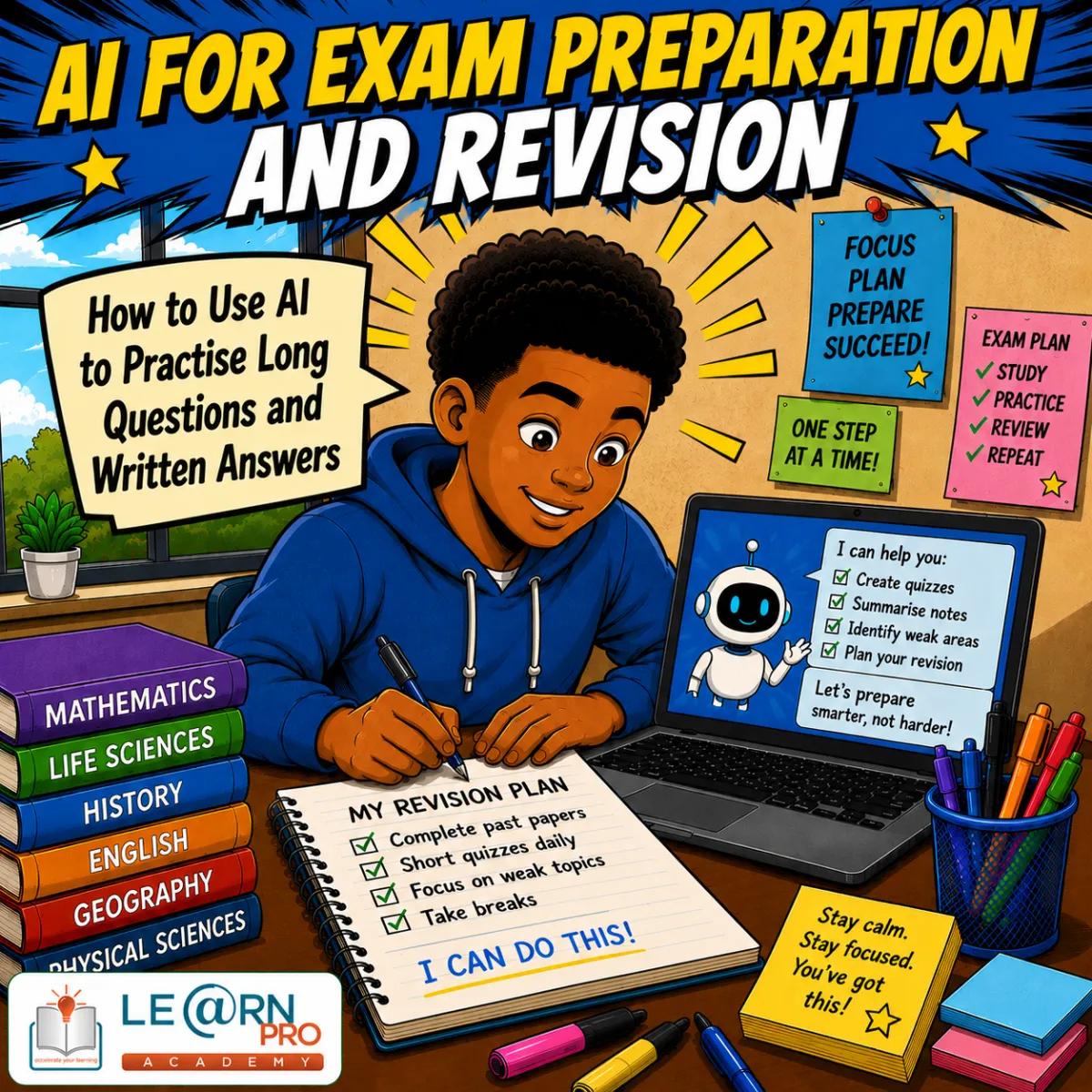
How to Use AI to Practise Long Questions and Written Answers
This is article #4 of 5 in the AI for Exam Preparation and Revision Series
Introduction
When learners think about revision, they often focus on memorising facts, formulas, and definitions. While this is important, many Grade 10–12 subjects require much more than remembering information. Subjects such as English, History, Geography, Life Sciences, Business Studies, Tourism, Economics, and Life Orientation often include questions that require learners to explain, compare, analyse, discuss, evaluate, or justify their answers.
These longer written questions are worth many marks in tests and final examinations. Unfortunately, many learners spend very little time practising them. They know the content but struggle to organise their ideas into clear, well-structured answers.
This is where Artificial Intelligence (AI) can become a valuable revision partner.
AI can generate realistic exam questions, provide writing prompts, explain what examiners are looking for, review the structure of your answers, and suggest ways to improve your writing. It can also help you practise expressing your ideas more clearly and confidently.
However, AI should never write your exam answers for you. The purpose of AI is to help you improve your own thinking and writing skills so that you can perform well when you write your exams independently.
In this article, you will learn practical ways to use AI to practise long questions and written answers while developing stronger exam techniques and greater confidence.
Why Long Questions Are Often Difficult
Many learners perform well in multiple-choice quizzes or short-answer questions but lose marks when they must write longer responses.
This usually happens because long questions require several skills at the same time.
You must:
Understand the question.
Remember the correct information.
Organise your ideas logically.
Explain your thinking clearly.
Use appropriate subject vocabulary.
Stay focused on the question.
Manage your time.
Missing just one of these skills can reduce your marks. The good news is that every one of these skills can be improved through regular practice.
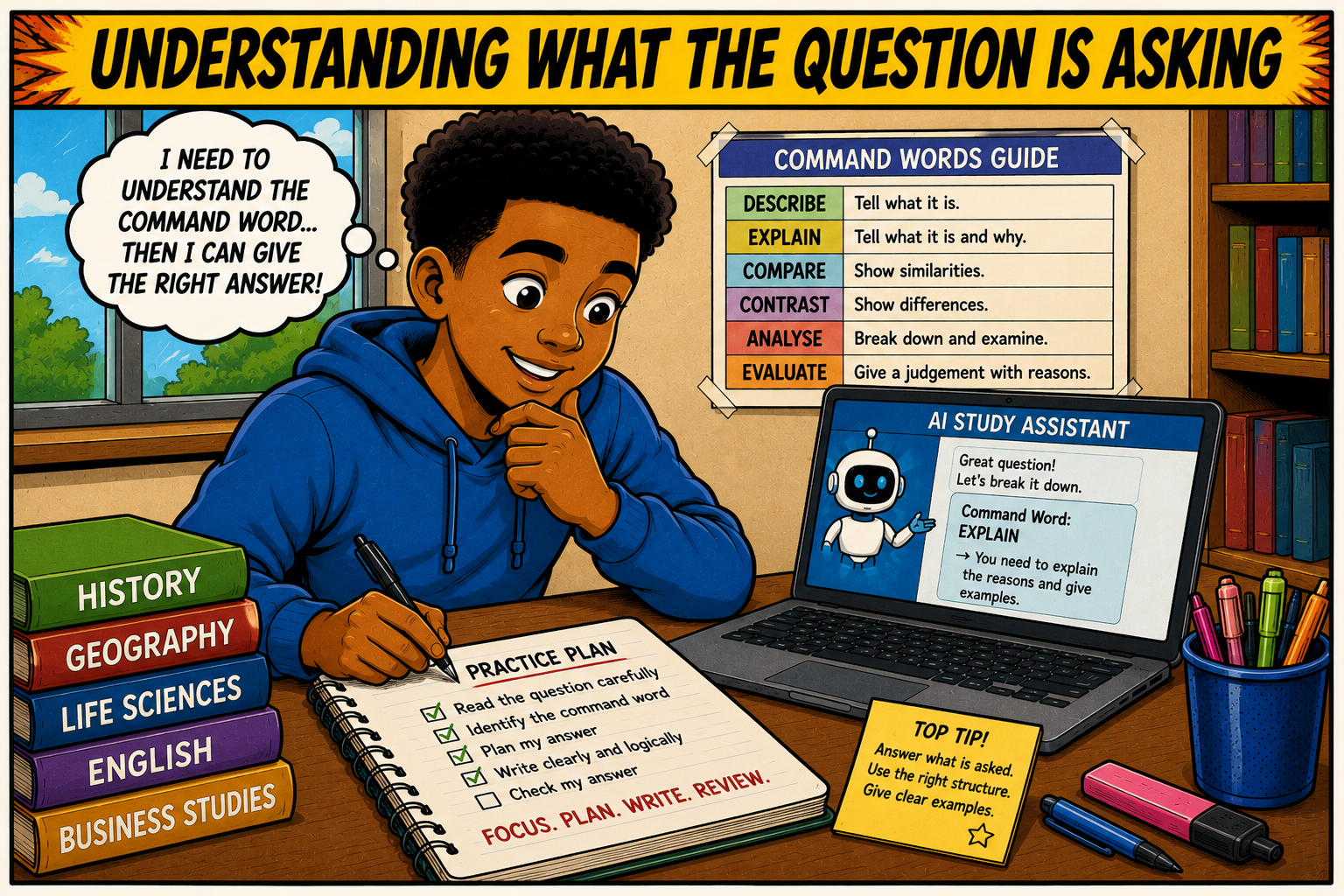
Understanding What The Question Is Asking
One of the biggest mistakes learners make is answering a different question from the one that was asked.
Examination questions often include command words such as:
Explain
Describe
Compare
Contrast
Discuss
Analyse
Evaluate
Justify
Recommend
Each command word requires a different type of answer.
For example:
Describe: Tell what happened.
Explain: Tell what happened and why.
Compare: Show similarities.
Contrast: Show differences.
Evaluate: Give strengths, weaknesses, and a reasoned judgement.
AI can explain these command words and provide examples of what examiners expect.
Ask AI To Generate Practice Questions
One of the easiest ways to prepare is to ask AI to create exam-style questions.
For example: "Create five Grade 11 Geography long-answer questions about climate change."
Or: "Generate three Life Sciences exam questions that require detailed explanations."
Practising with fresh questions helps you prepare for different ways examiners might ask about the same topic.
Write Your Own Answer First
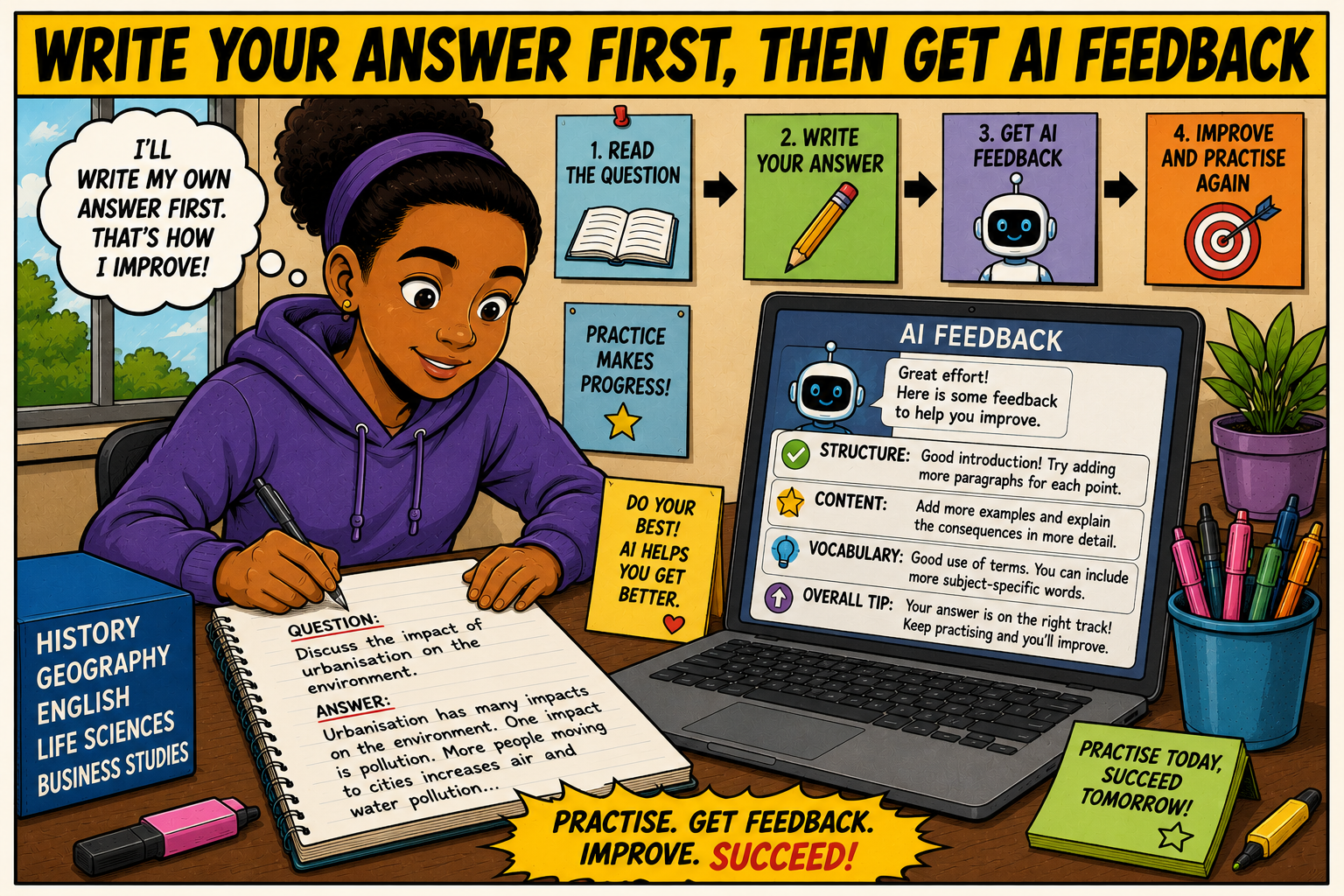
When using AI, always answer the question yourself before asking for help. This is extremely important. If AI writes the answer first, you miss the opportunity to think independently.
Instead:
Read the question.
Plan your answer.
Write your response.
Ask AI to review it.
This approach develops real exam skills.
Ask AI To Review Your Structure
Sometimes learners know the correct information but present it poorly.
AI can review your writing and comment on:
Organisation
Paragraph structure
Flow of ideas
Missing information
Repetition
Clarity
For example, you could ask: "Please review the structure of my answer without rewriting it for me."
This encourages learning instead of copying.
Learn How To Build Strong Paragraphs
Many exam questions require well-organised paragraphs.
A good paragraph usually contains:
A clear opening idea.
Supporting explanation.
Relevant example or evidence.
A concluding sentence.
AI can explain why a paragraph is effective and suggest ways to improve your organisation. The goal is not longer paragraphs. The goal is clearer paragraphs.
Practise Using Subject Vocabulary
Every subject has important terminology.
For example:
Geography
Urbanisation
Migration
Sustainability
Climate
Development
Life Sciences
Photosynthesis
Respiration
Osmosis
Biodiversity
Genetics
Using correct vocabulary demonstrates understanding. AI can identify where stronger subject-specific words could improve your answer.
Improve Your Explanations
Many learners simply list facts. Examiners usually want explanations.
For example:
Instead of writing: "Pollution affects rivers."
A stronger answer might explain: "Pollution reduces water quality, harms aquatic life, and makes clean drinking water more difficult to obtain."
AI can help you practise expanding simple ideas into fuller explanations.
Learn To Support Your Ideas
Long answers become stronger when they include examples.
For instance:
Instead of saying: "Technology improves learning."
Support the idea: "Technology improves learning by giving students access to online lessons, educational videos, interactive quizzes, and AI-powered study tools."
AI can suggest where examples would strengthen your writing.
Practise Different Types Of Questions
Exams include different writing tasks.
AI can generate:
Explanations
Comparisons
Case studies
Essays
Source-based questions
Data interpretation
Opinion questions
Evaluations
The more question styles you practise, the better prepared you become.
Learn To Plan Before You Write
Good writing starts with good planning. Before writing, spend a few minutes organising your ideas. AI can help you create simple answer plans.
For example:
Introduction
Main Point 1
Main Point 2
Main Point 3
Conclusion
Planning reduces repetition and keeps your writing focused.
Use AI To Improve Without Copying
One of the best ways to use AI is by asking for feedback instead of complete answers.
Try prompts like:
Which paragraph is weakest?
What information is missing?
How could I explain this more clearly?
Does my answer stay focused on the question?
Which sentences are confusing?
This helps you become a stronger writer.
Learn From Model Answers Carefully
AI can generate model answers for comparison. However, do not memorise them word for word.
Instead, study:
Structure
Organisation
Vocabulary
Use of examples
Logical flow
Ask yourself: "What makes this answer effective?"
Then apply those techniques in your own writing.
Time Yourself During Practice
Many learners write good answers when there is no time limit. Exams are different. AI can help you practise under realistic conditions.
For example: "Give me one Geography question and allow me 15 minutes to answer it."
Timing yourself builds confidence and improves exam readiness.
Ask AI To Mark Against A Rubric
Many written questions use marking guidelines or rubrics. AI can explain how marks are awarded.
For example, it can evaluate:
Accuracy
Organisation
Evidence
Explanation
Use of terminology
Relevance
This helps you understand what examiners are looking for.
Keep A Writing Improvement Journal
After each practice session, record:
What went well.
What needs improvement.
New vocabulary learned.
Common mistakes.
Goals for next time.
AI can help summarise your progress and identify recurring patterns. Over time, you will clearly see your improvement.
Common Writing Mistakes Learners Make
Many learners lose marks for simple mistakes.
These include:
Not Answering The Actual Question
Stay focused on what is being asked.
Writing Everything You Know
Only include information that answers the question.
Poor Paragraph Structure
Organise your ideas clearly.
Repeating The Same Point
Add new information in each paragraph.
Using Informal Language
Write in clear academic language where appropriate.
Ignoring Keywords
Always include important subject terminology.
Not Checking Your Work
Leave a few minutes to review your answer before finishing.
Combine AI With Teacher Feedback
Your teacher understands your curriculum and assessment standards.
If your teacher comments: "Use more evidence."
Ask AI: "Help me practise adding evidence to History answers."
If your teacher says: "Your conclusions are too weak."
Ask AI: "Teach me how to write stronger conclusions."
This combines classroom learning with personalised practice.
Example AI Prompts You Can Use
Here are some useful prompts.
Generate five Grade 12 History long-answer questions.
Review my paragraph structure without rewriting my answer.
Explain where my argument becomes unclear.
Suggest better subject vocabulary.
Mark my answer using a typical examination rubric.
Create a comparison question about ecosystems.
Help me improve my conclusion.
Tell me which parts of my answer are irrelevant.
Give me feedback on my explanation.
Ask me one essay question at a time.
Specific prompts usually produce the most helpful feedback.
Responsible Use Of AI When Practising Written Answers
AI should always support honest learning.
Remember these important guidelines:
Write your own answer before asking AI for feedback.
Do not memorise AI-generated essays.
Verify facts using your textbook and teacher's notes.
Never submit AI-generated work as your own unless your teacher has specifically allowed it.
Protect your personal information when using online AI tools.
Continue practising without AI so that you are confident during your real examination.
The purpose of AI is to improve your writing skills — not replace them.
Final Thoughts
Long-answer questions can seem intimidating, but they become much easier with regular practice and the right study techniques. Success is not only about knowing the correct information. It is also about organising your ideas, explaining concepts clearly, using appropriate subject vocabulary, and answering exactly what the examiner has asked.
AI provides an excellent opportunity to practise these skills. It can generate realistic exam questions, review your paragraph structure, explain marking criteria, suggest improvements, and help you recognise common writing mistakes. Most importantly, it allows you to receive immediate feedback while you are still learning.
Remember that the strongest learners are not those who simply copy perfect answers. They are the learners who think independently, learn from feedback, and continue improving with every piece of writing they complete.
Use AI wisely, combine it with guidance from your teachers, practise consistently, and treat every written answer as an opportunity to become a stronger communicator. By doing this, you will not only improve your exam results but also develop writing skills that will benefit you throughout your education and future career.
Additional Articles in the AI for Exam Preparation and Revision Series
Using AI to Revise for Exams Without Feeling Overwhelmed
How AI Can Help You Identify Your Weakest Subject Areas
Using AI to Turn Your Notes into Flashcards and Quizzes
How to Use AI to Practise Long Questions and Written Answers
Using AI to Stay Organised During Exam Season
Disclaimer
AI Tools were used to assist with research. Remember to always cross-check everything that you read.