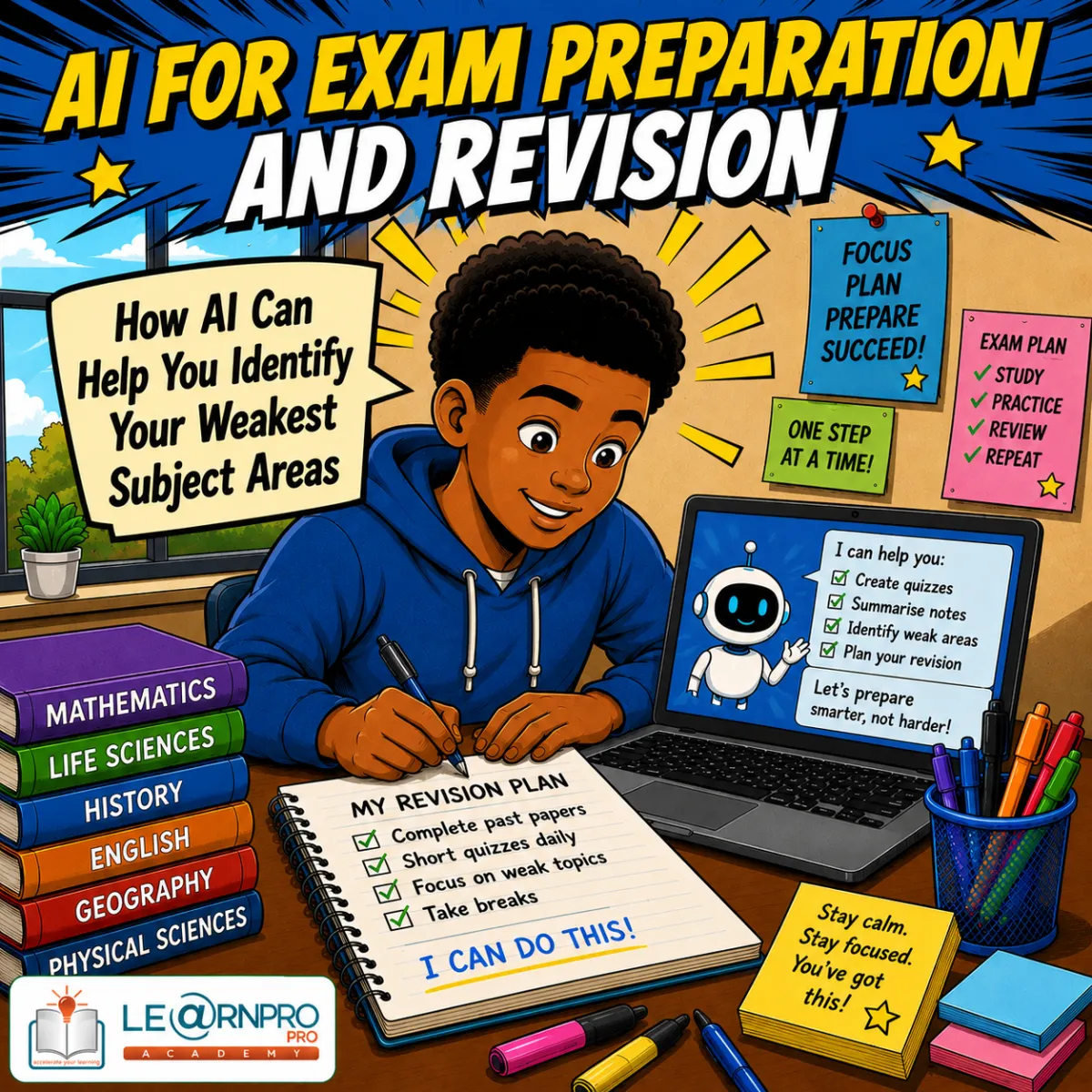
How AI Can Help You Identify Your Weakest Subject Areas
This is article #2 of 5 in the AI for Exam Preparation and Revision Series
Introduction
Every learner wants to do well in tests and exams, but studying hard does not always mean studying effectively. Many students spend hours revising subjects they already understand because those topics feel comfortable and familiar. At the same time, they often avoid the topics they find difficult because they seem confusing or frustrating.
This is one of the biggest reasons learners do not reach their full potential during exams.
Successful revision is not about studying everything equally. It is about identifying the areas where you need the most improvement and spending your time wisely.
This is where Artificial Intelligence (AI) can become a valuable study partner.
AI can analyse your answers, review your notes, create practice questions, identify patterns in your mistakes, and help you focus on the topics that need the most attention. Instead of guessing what to study next, you can use AI to make informed decisions about your revision.
However, AI is not a replacement for your teacher or your own effort. It is a tool that helps you become a smarter, more organised learner.
In this article, you will learn how to use AI to identify your weakest subject areas, improve your revision strategy, and prepare for exams with greater confidence.
Why Many Learners Study The Wrong Topics
Imagine you have a Mathematics exam in two weeks.
You enjoy Algebra, so you spend three evenings solving algebra problems. It feels productive because you can answer most of the questions correctly.
However, your previous test showed that you struggled with Geometry and Probability.
Although you spent many hours studying, you focused on your strengths instead of improving your weaknesses.
Many learners make this mistake because studying familiar topics feels rewarding. Difficult topics require more effort, and it is natural to avoid them.
Unfortunately, exams do not reward learners for revising only what they already know.
The learners who improve the most are those who honestly identify their weak areas and work on them consistently.
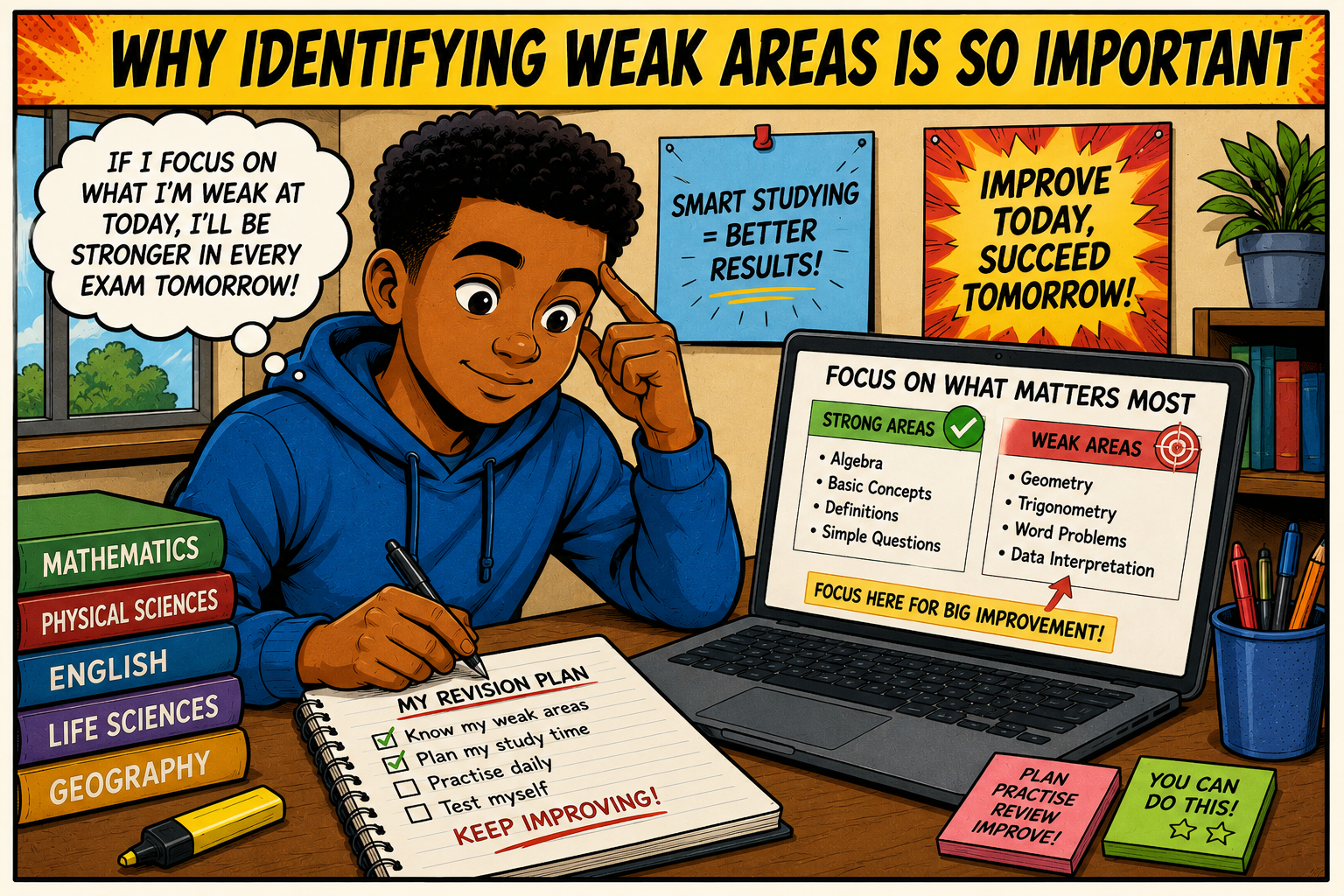
Why Identifying Weak Areas Is So Important
Think about a soccer team preparing for an important match.
If the coach notices that the defence is weak, the team spends more time practising defending. If the goalkeeper struggles with high balls, they practise catching crosses.
The team does not spend all its training time on skills it already performs well. Studying works exactly the same way.
If you already understand one topic well, it needs less revision than a topic that still confuses you.
Finding your weak areas allows you to:
Improve marks more quickly.
Use your study time efficiently.
Build confidence.
Reduce exam stress.
Avoid unpleasant surprises during exams.
AI makes this process much easier because it can analyse your work objectively.
How AI Can Help Identify Weak Subject Areas
AI is very good at recognising patterns.
When you answer questions, complete quizzes, or upload notes, AI can identify:
Topics you answer correctly.
Topics where you hesitate.
Questions you often get wrong.
Common mistakes you repeat.
Skills that need more practice.
Instead of relying on memory alone, AI gives you evidence about where your attention is needed. This helps you make smarter decisions about your revision.
Start With Your Previous Test Results
One of the easiest ways to identify weak areas is to look at your previous assessments.
Gather:
Class tests
Assignments
Controlled tests
Exams
Practice papers
Then ask AI something like:
"Help me analyse my Mathematics test. Which topics do I seem to struggle with based on these results?"
AI can group mistakes into categories such as:
Algebra
Functions
Geometry
Trigonometry
Probability
This gives you a clear picture of where improvement is needed.
Always remember to remove personal information before uploading school documents to online AI tools.
Analyse Mistakes Instead Of Marks
Many learners only look at the final mark.
For example: "I got 62%." That number tells you very little.
A much better question is: "Why did I lose 38%?" AI can help you identify the reasons.
Perhaps you:
Misread questions.
Forgot formulas.
Made calculation errors.
Did not understand certain concepts.
Ran out of time.
Understanding your mistakes is far more valuable than simply knowing your mark.
Ask AI To Find Patterns
One mistake does not always reveal a weakness. However, repeating the same mistake several times usually does. AI is excellent at spotting patterns.
For example, you might discover:
Every graph question causes difficulty.
Every essay loses marks for poor structure.
Every science calculation contains unit errors.
Every Geography map question is incorrect.
These repeated patterns tell you exactly what to practise next.
Create A Subject Strength Checklist
After reviewing your work, create a simple checklist. For each topic, rate yourself honestly.
For example:
Mathematics
✅ Very Confident
Basic Algebra
Linear Graphs
🟡 Fairly Confident
Functions
Trigonometry
🔴 Need More Practice
Geometry
Probability
AI can help organise this list and suggest which topics should become your highest priorities.
Use AI To Quiz You
One of the fastest ways to discover weaknesses is through self-testing.
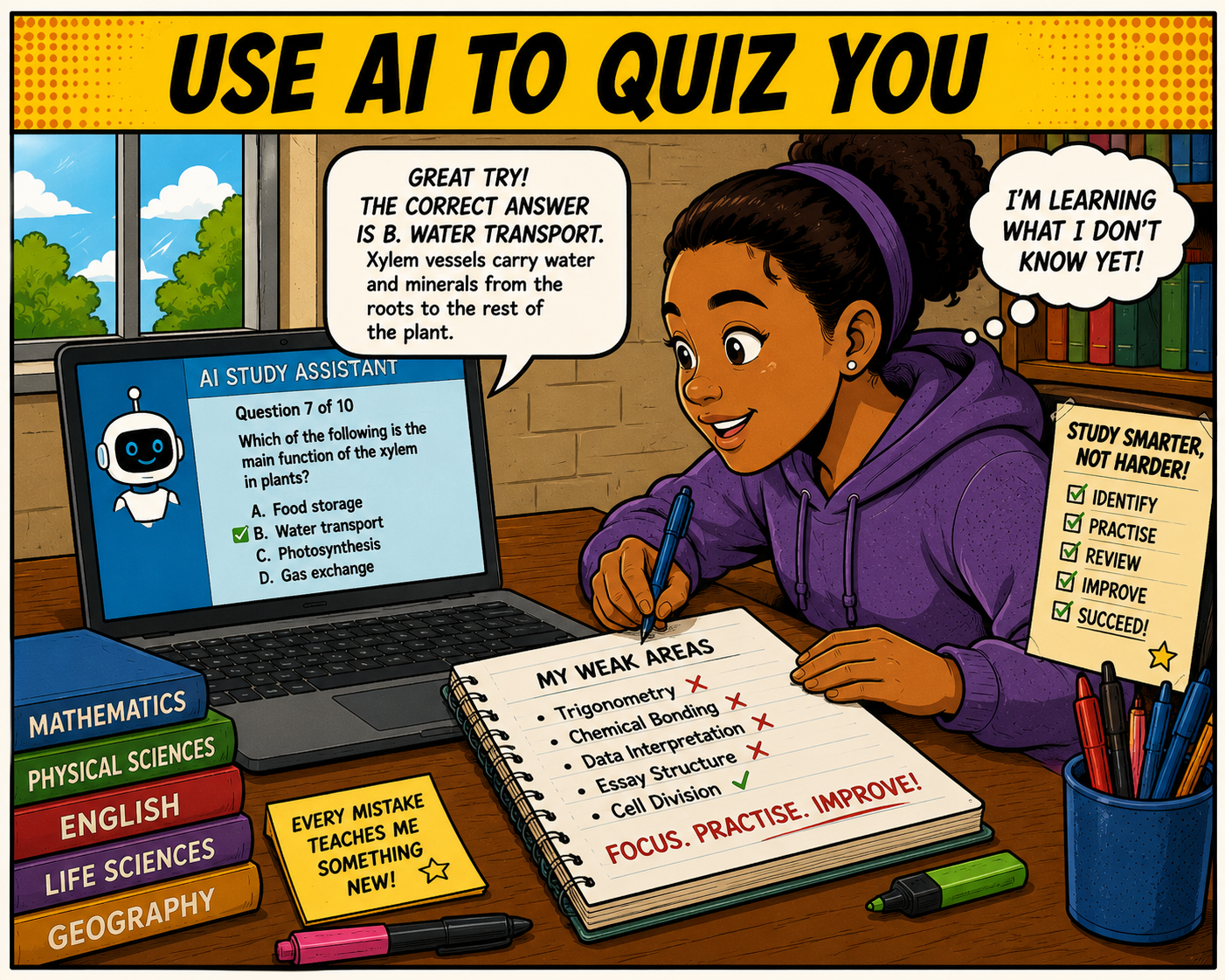
Instead of rereading notes, ask AI to quiz you.
For example:
"Ask me 20 Grade 11 Life Sciences questions. Do not tell me the answers until I have attempted every question."
When you finish, AI can:
Mark your answers.
Explain mistakes.
Identify weak topics.
Suggest revision activities.
This provides immediate feedback and helps you focus your studies.
Turn Mistakes Into Learning Opportunities
Many learners become discouraged when they answer questions incorrectly. Instead, think differently. Every mistake is useful.
Every incorrect answer shows you exactly what still needs attention.
AI can explain:
Why your answer was incorrect.
Which concept you misunderstood.
How to solve similar questions.
What you should revise next.
Mistakes become stepping stones towards improvement.
Compare Confidence With Reality
Sometimes learners think they understand a topic until they write a test. AI can help compare: "What I think I know." Versus "What I can actually answer."
For example, you may feel confident about Photosynthesis.
After completing twenty AI-generated questions, you realise you struggle with limiting factors and chemical equations.
Now you know exactly where to focus your revision.
Review Notes With AI
Your class notes contain valuable information.
AI can help organise them by asking:
Which topics appear most often?
Which sections need more detail?
Which concepts connect together?
Which ideas should I revise first?
AI can also summarise lengthy notes into shorter revision guides.
However, always compare summaries with your textbook to ensure nothing important has been omitted.
Practise Using Past Exam Questions
Past papers remain one of the best revision tools available.
AI can help by:
Grouping questions by topic.
Explaining difficult questions.
Marking practice answers.
Identifying repeated mistakes.
Suggesting similar questions.
This gives you a realistic picture of your exam readiness.
Focus On Understanding Instead Of Memorising
Some learners memorise facts without understanding them.
This often causes problems when exam questions are asked differently.
AI encourages deeper learning by explaining:
Why something happens.
How ideas connect.
When to apply different methods.
How to recognise similar problems.
Understanding lasts much longer than memorisation.
Use AI To Build Personalised Revision Plans
After identifying your weak areas, AI can help you create a personalised study plan.
For example:
Week 1
Geometry
Chemical Bonding
Essay Writing
Week 2
Probability
Electricity
Mapwork
Week 3
Past Papers
Mixed Revision
Weak Topic Review
Instead of guessing what to study, you follow a clear roadmap.
Keep Updating Your Progress
Weak areas change as you improve.
A topic that seemed impossible two weeks ago may now feel much easier.
Continue asking AI to test your knowledge regularly.
As your results improve, your revision priorities should change too.
Learning is a continuous process.
Avoid Comparing Yourself To Other Learners
Your friend may struggle with English while you struggle with Mathematics.
That is perfectly normal.
AI creates personalised support based on your own learning.
It focuses on your progress rather than someone else's marks.
The goal is not to become the best learner in your class overnight.
The goal is to become a better learner than you were yesterday.
Ask Better Questions
The quality of your AI responses depends on the quality of your prompts.
Instead of asking:
"Help me with Science."
Try asking:
"I struggle with calculating electrical circuits in Grade 11 Physical Sciences. Please explain the process step by step and give me five practice questions."
Specific prompts produce more useful answers.
Combine AI With Teacher Feedback
Your teachers know your curriculum, your classwork, and your learning progress.
AI should support—not replace—their guidance.
If your teacher comments:
"You need to improve your paragraph structure."
Ask AI:
"Help me practise writing Geography paragraphs using the PEEL structure."
This combines expert classroom feedback with personalised AI practice.
Build Confidence Through Small Improvements
Many learners think they must become experts overnight.
That is unrealistic.
Confidence grows one improvement at a time.
Today you may improve Geometry.
Tomorrow you improve essay writing.
Next week your graph interpretation becomes stronger.
Small improvements eventually lead to big changes in your overall marks.
Common Mistakes To Avoid
Using AI effectively also means avoiding common errors.
Only Studying Favourite Subjects
Spend extra time on weak topics.
Ignoring Teacher Feedback
Always include classroom feedback in your revision.
Believing AI Is Always Correct
Check important facts using textbooks and trusted learning resources.
Giving Up After One Poor Test
One test does not define your ability.
Use mistakes to guide improvement.
Memorising Without Understanding
Focus on concepts, not just facts.
Avoiding Difficult Questions
Challenging questions often teach you the most.
Example AI Prompts To Identify Weak Areas
Here are some useful prompts you can try.
Analyse my test and identify my weakest topics.
Which questions do I keep answering incorrectly?
Create ten practice questions based on my weakest chapter.
Explain why I made these mistakes.
Which Mathematics topic should I revise first?
Test my understanding of chemical reactions.
Help me improve my essay structure.
Which topics appear most often in this set of past papers?
Create a revision checklist based on my weak areas.
Ask me increasingly difficult questions until you find my knowledge gaps.
These prompts help AI provide more personalised support.
Responsible And Safe Use Of AI
AI is an excellent learning assistant, but it should always be used responsibly.
Remember these important guidelines:
Use AI to improve your understanding, not to complete work dishonestly.
Never submit AI-generated answers as your own unless your teacher allows it.
Verify important information with your teacher and school textbooks.
Protect your privacy by removing personal information from documents before uploading them.
Continue solving questions on your own so that you are fully prepared for your exams.
The more independently you learn, the more confident you will become.
Final Thoughts
The smartest learners are not always the ones who study the longest. They are often the ones who study the right topics at the right time.
AI can help you identify your weakest subject areas by analysing your answers, reviewing your notes, marking practice questions, and highlighting patterns in your mistakes. Instead of wasting time on topics you already understand, you can focus your energy where it will make the biggest difference.
Remember that finding a weakness is not something to fear. It is actually good news because it tells you exactly what to improve. Every difficult topic you master today becomes one less problem on exam day.
Use AI as a guide, continue listening to your teachers, practise regularly, and stay honest about the areas where you need help. With consistent effort, thoughtful revision, and the smart use of AI, you can build stronger knowledge, increase your confidence, and achieve better results in every subject.
Additional Articles in the AI for Exam Preparation and Revision Series
Using AI to Revise for Exams Without Feeling Overwhelmed
How AI Can Help You Identify Your Weakest Subject Areas
Using AI to Turn Your Notes into Flashcards and Quizzes
How to Use AI to Practise Long Questions and Written Answers
Using AI to Stay Organised During Exam Season
Disclaimer
AI Tools were used to assist with research. Remember to always cross-check everything that you read.