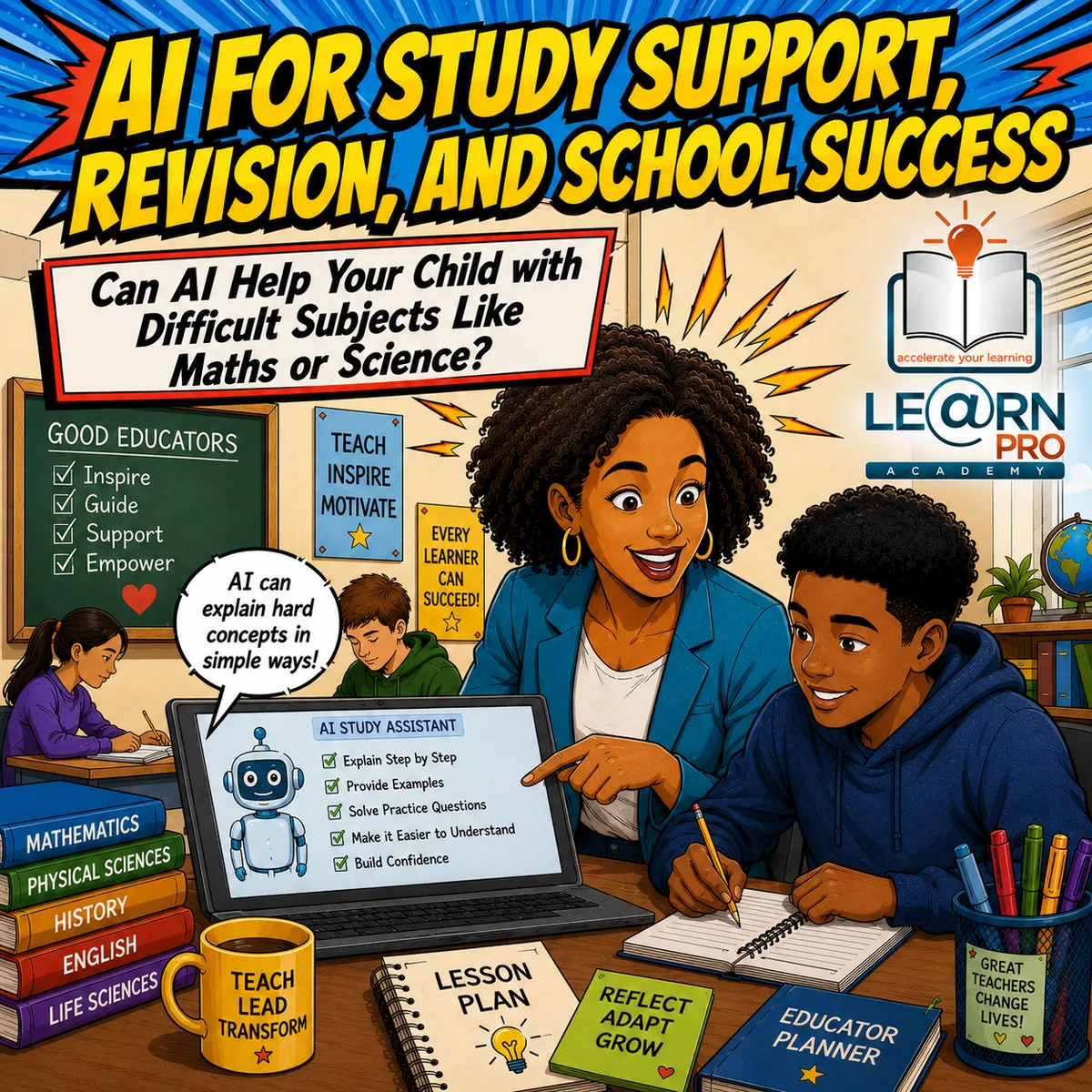
Can AI Help Your Child with Difficult Subjects Like Maths or Science?
This is article #3 of 5 in the AI for Study, Support, Revision, and School Success Series
Introduction
For many South African high school learners, subjects such as Mathematics and Physical Sciences can feel intimidating. A single difficult lesson can quickly become a source of frustration, and if learners fall behind, catching up often becomes even harder. It is not unusual for learners to lose confidence after struggling with one concept, especially if the next lesson builds on what they did not fully understand.
Parents often want to help but may feel limited by their own knowledge. Some have not studied these subjects for many years, while others learned them differently from the way they are taught today. This can leave parents wondering how they can support their child without giving incorrect guidance.
Artificial intelligence (AI) offers a practical way to support learners who are finding certain subjects difficult. It can explain concepts in different ways, provide additional examples, break complex problems into smaller steps, and offer unlimited practice opportunities. However, AI is most effective when it supports real learning rather than replacing independent thinking and problem-solving.
This article explains how parents can encourage responsible AI use that builds confidence, strengthens understanding, and helps learners tackle challenging subjects without becoming dependent on technology.
Why Some Subjects Feel More Difficult Than Others
Every learner has strengths and weaknesses.
Some naturally enjoy essay writing and languages, while others feel more comfortable solving calculations and equations.
Subjects like Mathematics and Physical Sciences are often considered difficult because they require learners to:
Understand concepts before applying them.
Follow logical sequences of steps.
Build new knowledge on previous lessons.
Solve unfamiliar problems independently.
Practise regularly rather than memorise information.
Missing just one important idea can make future lessons much more confusing.
This is why learners sometimes say they "do not understand anything anymore," even though the real problem may have started with one concept several weeks earlier.
Confidence And Understanding Go Together
Many parents notice that their child loses confidence after getting poor marks. Confidence and understanding are closely connected.
When learners understand a topic:
They answer questions more confidently.
They attempt more difficult problems.
They become willing to learn from mistakes.
They participate more actively in class.
When they do not understand:
They avoid practising.
They become anxious.
They believe they are "bad" at the subject.
They give up more easily.
AI cannot create confidence by itself, but it can help learners rebuild confidence by making difficult work feel more manageable.
How AI Explains Concepts Differently
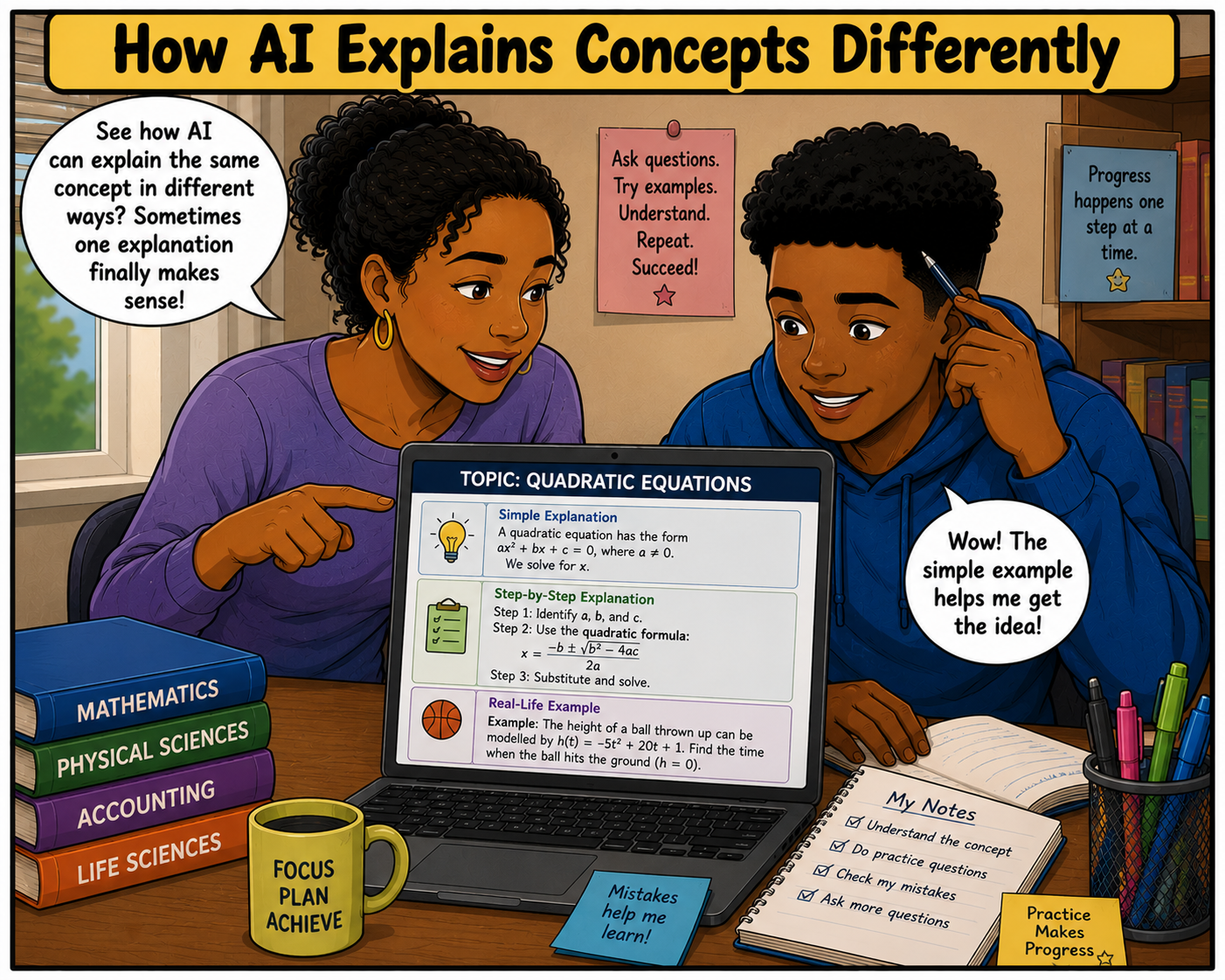
One of AI's biggest strengths is that it can explain the same concept in multiple ways.
For example, if a learner struggles to understand Newton's Laws or quadratic equations, AI can explain the topic:
Using simpler language.
Step by step.
With everyday examples.
With diagrams or descriptions.
At different levels of difficulty.
As many times as needed.
Unlike a classroom lesson, AI never becomes impatient when learners ask for another explanation.
Parents can encourage children to keep asking questions until the explanation makes sense.
Breaking Difficult Problems Into Smaller Steps
Complex questions often feel overwhelming because learners only see the final answer they need to reach.
AI can divide a problem into smaller, manageable parts.
Instead of solving everything at once, it can explain:
What information is given.
Which formula is needed.
Why that formula applies.
What the first step should be.
How each calculation follows from the previous one.
How to check the final answer.
Breaking work into smaller steps reduces anxiety and helps learners understand the reasoning behind the solution.
Showing More Worked Examples
Many learners only receive a limited number of examples in class. Sometimes they need much more practice before a concept feels familiar. AI can generate additional examples on demand.
For instance, a learner can ask for:
Easier examples.
More challenging examples.
Similar questions.
Real-life applications.
Exam-style questions.
Step-by-step solutions.
Parents can remind learners that seeing many examples often builds understanding more effectively than reading the same explanation repeatedly.
Encouraging Learners To Solve Problems First
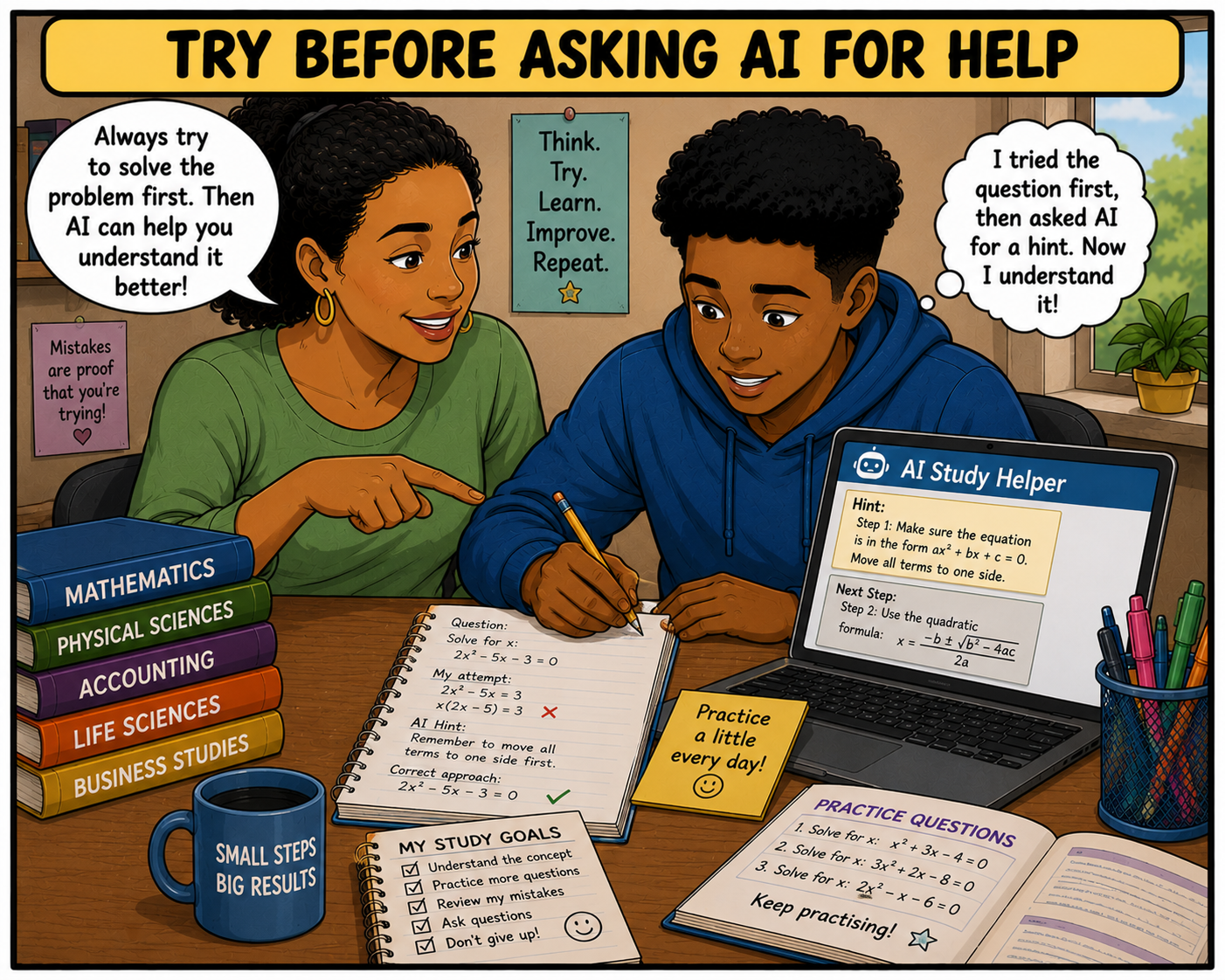
One important rule for responsible AI use is simple: Try before asking for help. Instead of immediately requesting the answer, learners should first attempt the problem themselves.
If they become stuck, AI can then explain:
Where the mistake happened.
Why that step was incorrect.
Which concept needs review.
How to continue.
This approach protects independent thinking while still providing valuable support.
Mathematics: Learning Through Practice
Mathematics improves through regular practice.
Reading about Mathematics is not enough.
Learners need to:
Solve problems.
Make mistakes.
Correct errors.
Try different question types.
Repeat important concepts.
AI can generate unlimited practice questions covering topics such as:
Algebra
Functions
Trigonometry
Geometry
Statistics
Financial Mathematics
Calculus (where applicable)
Parents should encourage steady practice instead of trying to complete large amounts of work in one sitting.
Physical Sciences: Understanding Before Memorising
Physical Sciences combines scientific understanding with calculations.
Many learners try to memorise formulas without understanding what they mean.
AI can help explain:
Scientific principles.
Formula selection.
Practical applications.
Experimental procedures.
Graph interpretation.
Problem-solving strategies.
Understanding why a formula works usually produces better long-term results than memorising it without context.
Life Sciences: Making Complex Processes Easier To Understand
Life Sciences often requires learners to understand detailed biological systems.
AI can simplify topics such as:
Photosynthesis
Cellular respiration
Genetics
Human body systems
Ecology
Evolution
It can also create diagrams, summaries, quizzes, and revision questions that make complex information easier to remember.
Other Challenging Subjects Can Benefit Too
Although Mathematics and Physical Sciences are often mentioned first, AI can support many difficult subjects.
Examples include:
Accounting
Explaining financial statements.
Working through calculations.
Providing transaction practice.
Business Studies
Explaining business concepts.
Generating case studies.
Clarifying terminology.
Geography
Simplifying climate processes.
Practising mapwork.
Explaining physical geography.
History
Creating timelines.
Explaining causes and consequences.
Comparing historical events.
AI adapts its explanations to many different subjects.
Learning At Your Own Pace
One advantage of AI is that learners control the speed.
In class, the teacher must continue with the lesson because many learners need to complete the curriculum.
At home, AI allows learners to:
Pause.
Repeat explanations.
Ask follow-up questions.
Spend more time on difficult sections.
Move ahead when they are ready.
This personalised pace reduces frustration.
Parents Do Not Need To Be Subject Experts
Many parents worry because they cannot solve Grade 11 or Grade 12 Mathematics themselves. Fortunately, this is not necessary. Your role is not to teach every concept.
Instead, you can ask questions such as:
What are you learning today?
Which step is confusing?
How did AI explain it?
Can you explain it back to me?
What have you understood now?
If your child can explain the concept in their own words, it usually shows that learning has taken place.
Protecting Independent Problem-Solving
The greatest danger is allowing AI to become a shortcut.
Parents should encourage children to avoid prompts like: "Solve everything for me."
Instead, suggest prompts such as:
Explain the next step.
Give me a hint.
Show me a similar example.
Tell me why my answer is incorrect.
Help me understand this formula.
These questions encourage thinking instead of copying.
Mistakes Are Part Of Learning
Many learners become discouraged when they answer questions incorrectly. In reality, mistakes provide valuable learning opportunities.
AI can help learners:
Identify incorrect reasoning.
Understand why mistakes happened.
Learn alternative methods.
Practise similar questions.
Build confidence gradually.
Parents can remind children that every mistake corrected today reduces the chance of repeating it in the examination.
Encouraging Curiosity
Some learners stop asking questions because they worry about looking embarrassed in class. AI provides a private space where learners can ask:
Basic questions.
Follow-up questions.
"Why?" questions.
"What if?" questions.
Requests for simpler explanations.
Curiosity strengthens understanding.
Parents can encourage children to ask as many questions as they need.
Avoiding Overdependence On AI
Although AI is extremely helpful, learners still need to think independently.
Signs of healthy AI use include:
Attempting questions first.
Using AI for explanations.
Completing additional practice.
Using textbooks alongside AI.
Reviewing teacher feedback.
Signs of unhealthy dependence include:
Copying solutions without understanding.
Never attempting questions independently.
Avoiding classroom notes.
Becoming unable to solve questions without AI.
Parents should encourage balance.
Working Together With Teachers
AI should complement classroom teaching — not replace it.
Teachers remain responsible for:
Teaching the curriculum.
Explaining examination requirements.
Assessing learner progress.
Providing professional guidance.
Parents should encourage learners to:
Ask teachers questions.
Complete homework honestly.
Use teacher feedback.
Combine classroom learning with AI support.
This partnership produces the strongest results.
Helping Learners Stay Calm
Subjects like Mathematics often create emotional pressure. When learners panic, they struggle to think clearly.
Parents can help by:
Encouraging regular practice.
Praising effort.
Avoiding comparisons with other learners.
Celebrating improvement.
Maintaining realistic expectations.
AI reduces frustration by providing immediate support, but emotional encouragement from parents remains equally important.
Practical Tips For Parents
You can support your child by:
Encouraging daily practice.
Asking them to explain concepts aloud.
Reminding them to attempt problems before using AI.
Encouraging questions rather than copying.
Supporting healthy study routines.
Ensuring enough sleep during exam preparation.
Celebrating steady improvement.
Talking positively about learning from mistakes.
These habits build resilience as well as academic skills.
AI Is A Tutor, Not A Replacement For Learning
Perhaps the most important message for parents is this: AI works best when it behaves like a patient tutor. A good tutor does not simply provide answers.
Instead, a good tutor:
Explains.
Encourages.
Questions.
Demonstrates.
Guides.
Supports.
The learner still needs to:
Think.
Practise.
Solve.
Make mistakes.
Learn independently.
When AI is used this way, it strengthens learning rather than replacing it.
Conclusion
Difficult subjects such as Mathematics and Physical Sciences often test a learner's confidence as much as their academic ability. Falling behind by just one topic can make future lessons feel increasingly difficult, leaving learners frustrated and unsure of themselves. Parents naturally want to help, even if they no longer remember every formula or scientific principle.
AI provides valuable support by explaining concepts in different ways, breaking difficult problems into smaller steps, generating additional examples, and creating unlimited opportunities for practice. Used responsibly, it helps learners build understanding, strengthen problem-solving skills, and regain confidence in subjects they once found intimidating.
The key is ensuring that AI remains a learning partner rather than an answer machine. Learners should continue attempting problems independently, asking thoughtful questions, using their school textbooks and class notes, and learning from their mistakes. Parents do not need to become subject experts. Their encouragement, interest, and support create the positive environment that allows learning to flourish.
When combined with consistent effort, quality teaching, and healthy study habits, AI can become a powerful tool that helps learners overcome difficult subjects while developing the confidence and resilience they will need throughout their education.
Additional Articles in the AI for Study, Support, Revision, and School Success Series
How AI Can Help Your Child Revise More Effectively
Using AI to Build a Study Plan for Exams and Tests
Can AI Help Your Child with Difficult Subjects Like Maths or Science?
Helping Your Child Use AI to Practise for Exams Instead of Panic Before Them
How Parents Can Use AI Conversations to Check Understanding at Home
Disclaimer
AI Tools were used to assist with research. Remember to always cross-check everything that you read.