How AI Can Help Educators Create Better Test and Exam Questions
This is article #1 of 5 in the AI for Assessment, Marketing, and Feedback Series
Introduction
Assessment is one of the most important responsibilities of every educator. Well-designed questions do more than measure what learners remember. They help teachers understand what learners know, how they think, where misunderstandings exist, and what support may still be needed. Good assessments also guide future teaching by showing whether learning outcomes have been achieved.
However, writing high-quality test and exam questions takes time. Educators need to ensure that questions are accurate, fair, aligned with the curriculum, suitable for the learners' level, and capable of assessing genuine understanding rather than simple memorisation. For many South African educators, this work happens alongside lesson planning, marking, administrative duties, extracurricular activities, and classroom management.
Artificial Intelligence (AI) is beginning to change how educators approach assessment design. AI cannot replace the professional knowledge and judgment of experienced teachers, but it can serve as a valuable assistant during the planning process. It can suggest question ideas, generate different question formats, produce revision activities, and help educators create balanced assessments more efficiently.
The key is understanding that AI should create a starting point — not the finished assessment. Every question should still be reviewed, edited, and approved by the educator before learners ever see it.
This article explores practical ways educators can use AI to create better tests and examinations while maintaining high academic standards and keeping full control of the assessment process.
Why Writing Good Questions Matters
Many people assume that assessment simply measures learning. In reality, assessment also influences learning.
Learners often study according to the types of questions they expect to face. If assessments only ask learners to memorise facts, they may spend less time developing understanding, problem-solving skills, or critical thinking.
Well-designed questions can assess:
Knowledge and recall
Understanding of concepts
Application of knowledge
Analysis and interpretation
Evaluation and judgement
Creativity and problem-solving
When assessments include a variety of question types, educators obtain a clearer picture of learner progress.
AI can assist educators by generating ideas across these different levels rather than focusing only on simple recall questions.
The Biggest Challenges Educators Face When Creating Assessments
Most educators know what good assessment looks like, but creating it consistently can be difficult because of limited time.
Common challenges include:
Writing enough quality questions
Avoiding repetitive wording
Creating questions at different difficulty levels
Matching CAPS learning outcomes
Producing revision papers
Preparing parallel tests
Differentiating assessments for mixed-ability classes
Checking for ambiguity
Ensuring fairness
AI cannot solve every challenge, but it can significantly reduce the time needed to produce a strong first draft.
AI Is A Planning Partner, Not An Examiner
One of the most important ideas to remember is that AI should support the educator — not replace them.
AI does not know:
Your learners
Your classroom
Your school's assessment policies
What you have already taught
Which misconceptions your learners commonly have
Which topics received more classroom attention
Only the educator understands these important details.
Think of AI as an assistant who provides suggestions while the educator remains responsible for every final decision.
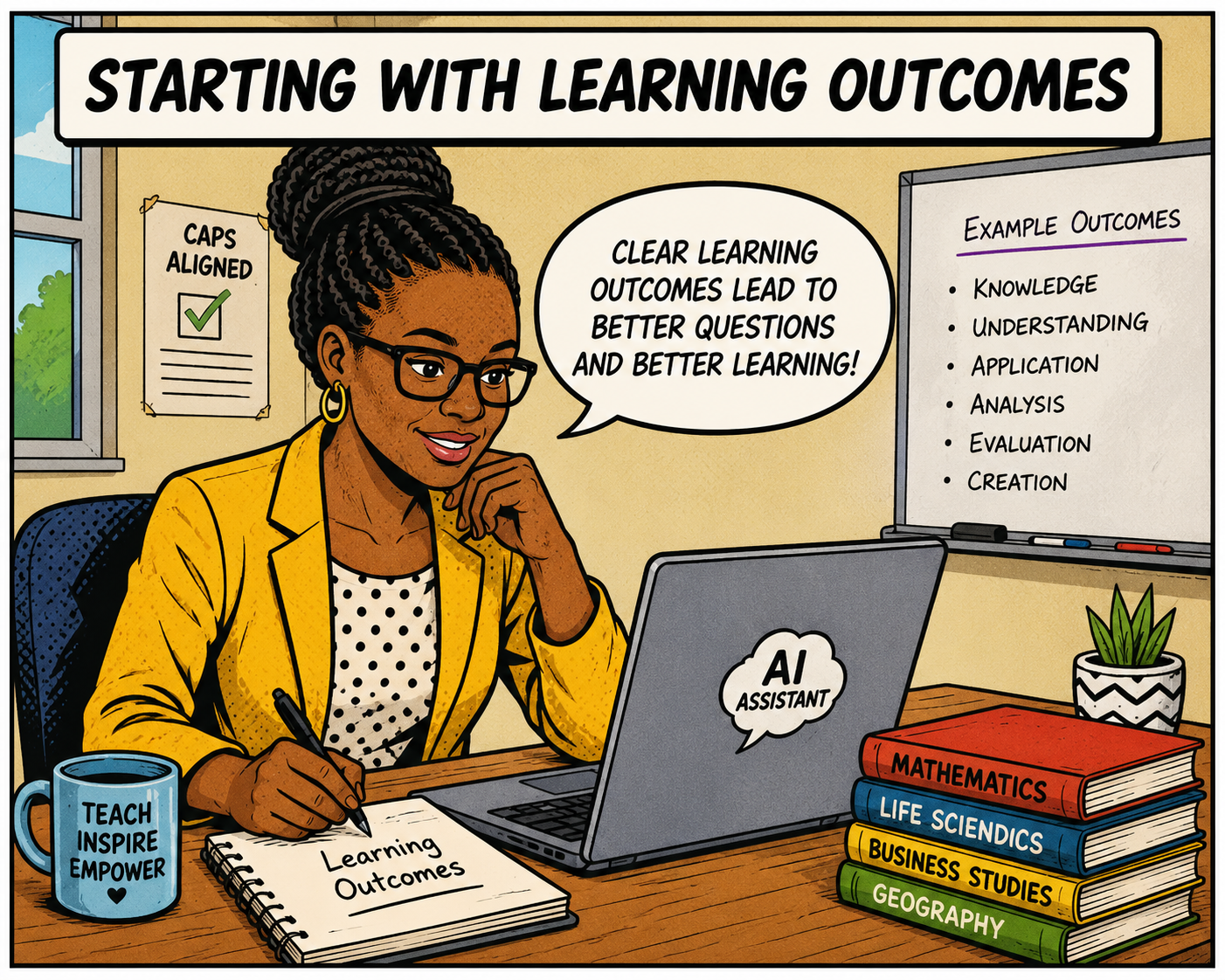
Starting With Learning Outcomes
Before asking AI to generate questions, educators should clearly identify what learners are expected to know or demonstrate.
Instead of prompting AI with: "Write a Geography test."
A much stronger prompt would be: "Create ten Grade 11 Geography questions that assess learners' understanding of river processes according to CAPS. Include questions that assess knowledge, interpretation, application, and evaluation."
Providing learning outcomes produces much better results than asking for general questions.
Creating Different Types Of Questions
One of AI's greatest strengths is generating multiple question formats quickly.
These may include:
Multiple Choice Questions
AI can draft plausible answer options, helping educators create questions that test understanding rather than obvious guessing.
Example prompt: Create ten multiple-choice questions about photosynthesis with four answer options each. Include one correct answer and three realistic distractors.
The educator should still check that every distractor is scientifically accurate and does not accidentally create multiple correct answers.
Short Answer Questions
These assess understanding without requiring lengthy responses.
AI can generate questions such as:
Define...
Explain...
Describe...
Compare...
Identify...
Give reasons for...
These questions are useful for quizzes, revision activities, and formal assessments.
Structured Questions
Many South African examinations include structured questions with several parts. AI can assist by producing questions that gradually increase in complexity.
For example:
Question 1
1.1 Define inflation.
1.2 Explain one cause of inflation.
1.3 Describe how inflation affects consumers.
1.4 Evaluate how government policies can reduce inflation.
This progression allows learners to demonstrate different levels of understanding.
Case Studies
Subjects such as Business Studies, Economics, Geography, History, and Life Sciences often include source-based questions.
AI can help generate:
Newspaper-style articles
Business scenarios
Case studies
Data tables
Short passages
Graph interpretation activities
Educators should always verify that the information is accurate and suitable for their curriculum.
Essay Questions
Essay questions require careful wording. AI can suggest topics, but educators should ensure that essays encourage analysis rather than copying information.
For example:
Instead of: Explain climate change.
A stronger question might be: Evaluate how climate change affects water security in South Africa and discuss possible long-term solutions.
This encourages deeper thinking.
Adjusting Question Difficulty
Every class contains learners with different ability levels.
AI can quickly rewrite questions to make them:
Easier
More challenging
More suitable for revision
More suitable for examinations
Example prompt: Rewrite these Grade 10 Mathematics questions at three different difficulty levels.
This helps educators differentiate learning without writing every version from scratch.
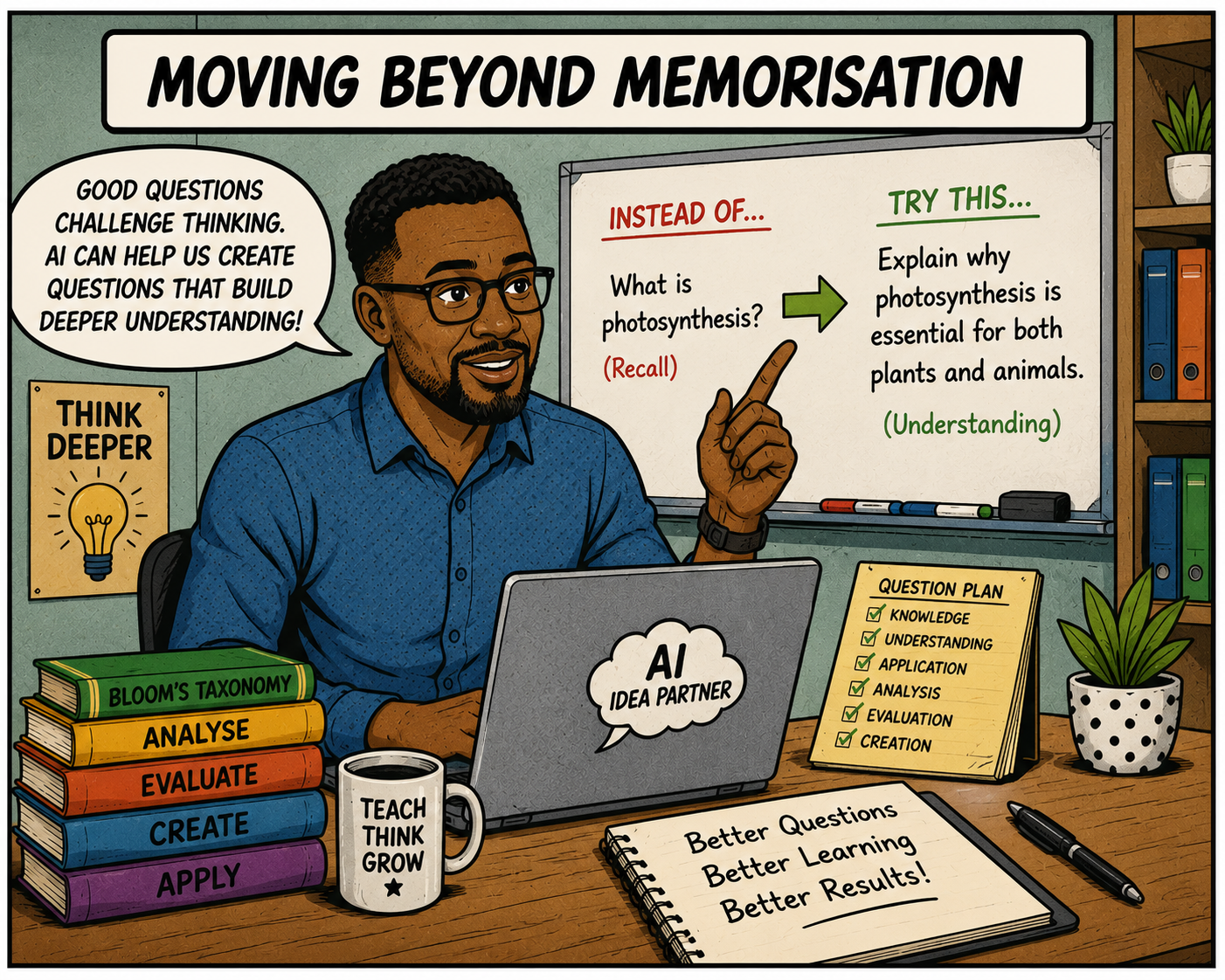
Moving Beyond Memorisation
One common weakness of assessments is relying too heavily on recall. AI can help educators develop questions that require learners to think more deeply.
Instead of asking: What is photosynthesis?
AI may suggest: Explain why photosynthesis is essential for both plants and animals.
Or: Predict what would happen if photosynthesis stopped occurring on Earth.
These questions assess understanding rather than simple memory.
Using Bloom's Taxonomy With AI
Many educators already use Bloom's Taxonomy when designing assessments.
AI can generate questions at different cognitive levels, including:
Remember
Understand
Apply
Analyse
Evaluate
Create
For example, an educator could ask: Generate one question at each level of Bloom's Taxonomy for Grade 12 Accounting on cash flow statements.
This produces a balanced range of assessment opportunities.
Creating Balanced Tests
Good assessments include different question types and varying levels of difficulty.
AI can help educators create balanced papers by suggesting:
Recall questions
Application questions
Problem-solving activities
Scenario-based questions
Higher-order thinking questions
Educators can then adjust the balance according to CAPS requirements and school policies.
Generating Revision Questions
Revision often requires dozens of additional practice questions.
Rather than repeatedly writing new questions manually, educators can ask AI to produce:
Weekly quizzes
Homework questions
Revision worksheets
Flashcard questions
Practice tests
Topic summaries with questions
This saves considerable preparation time while giving learners more opportunities to practise.
Creating Parallel Tests
Sometimes educators need two versions of the same assessment to reduce copying or accommodate learners writing at different times.
AI can assist by generating alternative questions that assess the same learning outcomes.
Instead of simply changing numbers, AI can create fresh scenarios while maintaining similar difficulty.
Educators should compare both versions carefully to ensure they remain equally fair.
Generating Marking Guidelines
Many educators spend almost as much time writing memoranda as they do creating assessments.
AI can generate draft marking guides that include:
Suggested answers
Key concepts
Mark allocations
Alternative acceptable responses
These drafts should always be reviewed and adapted to school standards before use.
Improving Question Wording
Sometimes educators know exactly what they want to assess but struggle to phrase the question clearly.
AI can rewrite questions to make them:
Shorter
Clearer
Easier to understand
More age appropriate
More consistent
This is especially valuable when teaching learners whose first language is not English.
Simple, clear wording helps ensure assessments measure knowledge rather than language complexity.
Avoiding Ambiguous Questions
Poorly worded questions can confuse learners.
AI can help identify:
Double negatives
Unclear instructions
Vague wording
Multiple interpretations
Overly complex sentences
Educators should still read every question from a learner's perspective before finalising the assessment.
Checking Curriculum Alignment
One of the biggest risks when using AI is assuming that generated questions automatically match the curriculum.
They do not.
Educators should always verify that every question aligns with:
CAPS learning outcomes
Annual Teaching Plans
School pacing
Grade level expectations
Assessment guidelines
AI does not automatically know exactly where learners are in the syllabus.
Professional review remains essential.
Considering The South African Classroom
South African classrooms are incredibly diverse.
Learners differ in:
Language backgrounds
Access to technology
Prior educational experiences
Cultural perspectives
Learning needs
Assessment questions should reflect this diversity.
Educators should check that AI-generated examples:
Use familiar contexts where possible
Avoid cultural bias
Include relevant South African examples when appropriate
Use inclusive language
Avoid unnecessary complexity
For example, Business Studies questions may include local businesses, while Geography questions can reference South African landscapes or environmental issues.
Protecting Assessment Integrity
Educators should also think carefully about how AI is used during assessment creation.
Good practice includes:
Reviewing every question personally.
Never copying AI output without checking it.
Verifying all facts and calculations.
Ensuring originality.
Editing wording to match classroom needs.
Following school assessment policies.
Maintaining confidentiality where required.
The educator remains fully responsible for the final assessment.
Helpful Prompt Examples
The quality of AI output depends heavily on the quality of the prompt.
Useful prompts include:
Create ten Grade 10 Life Sciences questions assessing understanding of photosynthesis at different Bloom's Taxonomy levels.
Generate a 50-mark Business Studies revision test aligned with CAPS on entrepreneurship.
Rewrite these History questions using clearer language suitable for English second-language learners.
Create three alternative versions of these Mathematics questions with similar difficulty.
Draft a marking memorandum for this Geography assessment.
Providing clear instructions usually produces much stronger results than asking AI for general assessments.
Common Mistakes To Avoid
When using AI for assessment design, educators should avoid several common mistakes.
These include:
Using AI questions without checking them.
Assuming every fact is correct.
Ignoring CAPS alignment.
Creating assessments that only test recall.
Using questions that are too difficult or too easy.
Forgetting to adapt questions for the specific learners.
Allowing AI to replace professional judgment.
AI works best when educators remain actively involved throughout the process.
Building Confidence Through Practice
Like any educational tool, AI becomes more useful with experience. Educators do not need to transform every assessment immediately.
Instead, they might begin by using AI to:
Generate a few revision questions.
Suggest alternative wording.
Create additional practice activities.
Draft marking guides.
Produce parallel assessments.
Over time, educators learn which prompts produce the best results and where AI adds the greatest value.
Small improvements made consistently can save many hours across an academic year.
Final Thoughts
Creating meaningful assessments remains one of the most valuable professional skills an educator possesses. Good questions reveal understanding, encourage critical thinking, identify learning gaps, and help learners grow beyond simple memorisation.
Artificial Intelligence does not replace this expertise. It cannot understand a class, recognise individual learner needs, or make professional decisions about curriculum standards. Those responsibilities remain firmly with the educator.
What AI can do is reduce the time spent generating first drafts, exploring question ideas, varying assessment formats, and preparing revision materials. Used thoughtfully, it becomes a practical assistant that helps educators work more efficiently while maintaining high standards of teaching and assessment.
The most successful educators will not be those who allow AI to design assessments independently, but those who combine professional experience with AI's ability to generate ideas quickly. By reviewing every question carefully, aligning assessments with CAPS requirements, and keeping learners' needs at the centre of every decision, educators can use AI to create assessments that are both efficient and educationally sound.
Ultimately, the goal is not simply to produce more questions. It is to create better questions — questions that challenge learners, measure genuine understanding, and support meaningful learning in every classroom.
Additional Articles in the AI for Assessment, Marketing, and Feedback Series
How AI Can Help Educators Create Better Test and Exam Questions
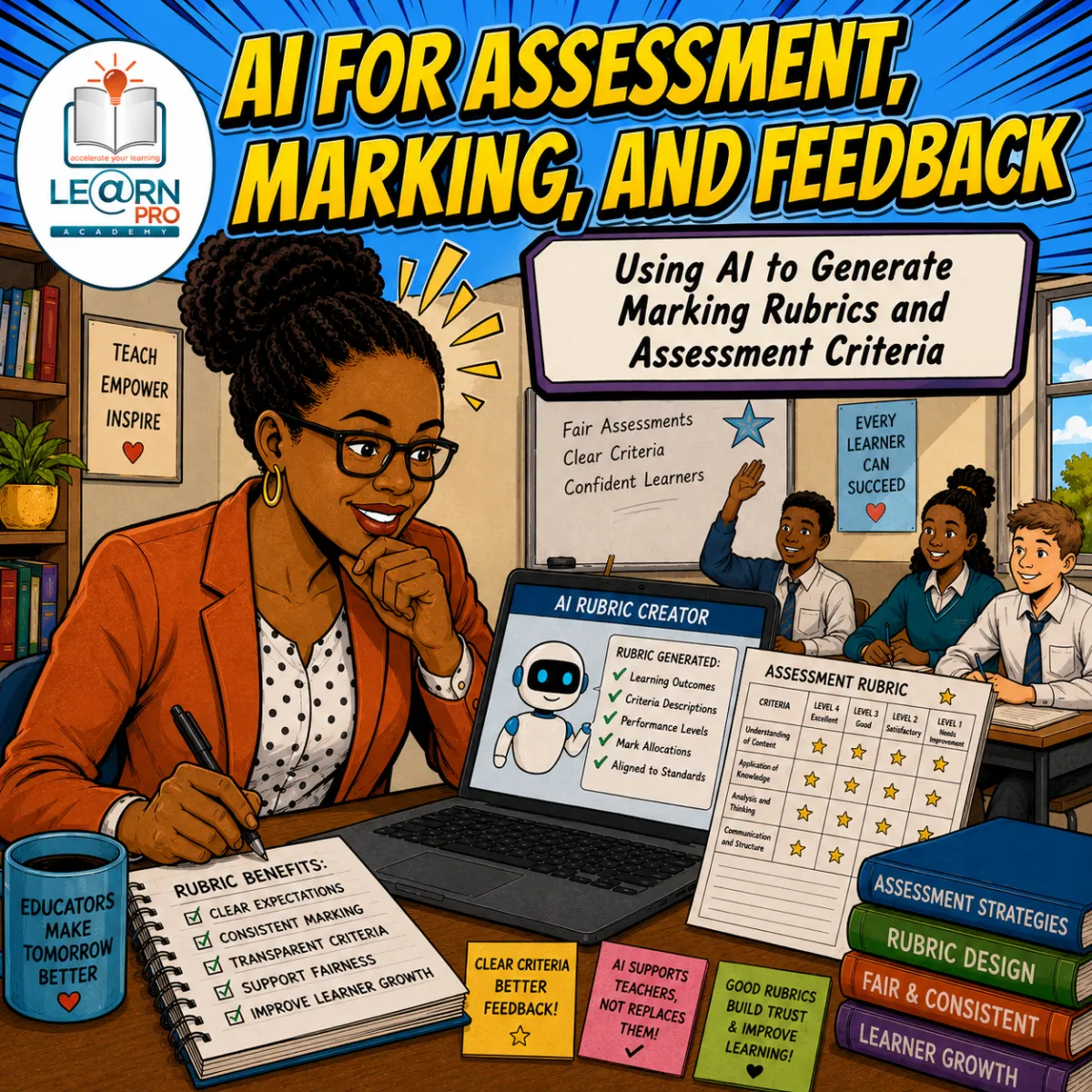
Using AI to Generate Marking Rubrics and Assessment Criteria
Can AI Help With Marking? What Educators Need to Know
Using AI to Give Faster, More Useful Learner Feedback
How AI Can Support Exam Preparation in the Classroom
Disclaimer
AI Tools were used to assist with research. Remember to always cross-check everything that you read.