How AI Can Support Exam Preparation in the Classroom
This is article #5 of 5 in the AI for Assessment, Marketing, and Feedback Series
Introduction
For many educators, exam season is one of the busiest and most demanding times of the school year. Alongside teaching the remaining curriculum, teachers often need to prepare revision materials, create practice assessments, answer learner questions, identify learning gaps, and support anxious learners who are preparing for important examinations.
In South Africa, this pressure is especially noticeable in Grades 11 and 12, where learners prepare for examinations that can significantly influence their academic futures. Educators are expected to balance curriculum coverage with meaningful revision while ensuring that learners feel prepared rather than overwhelmed.
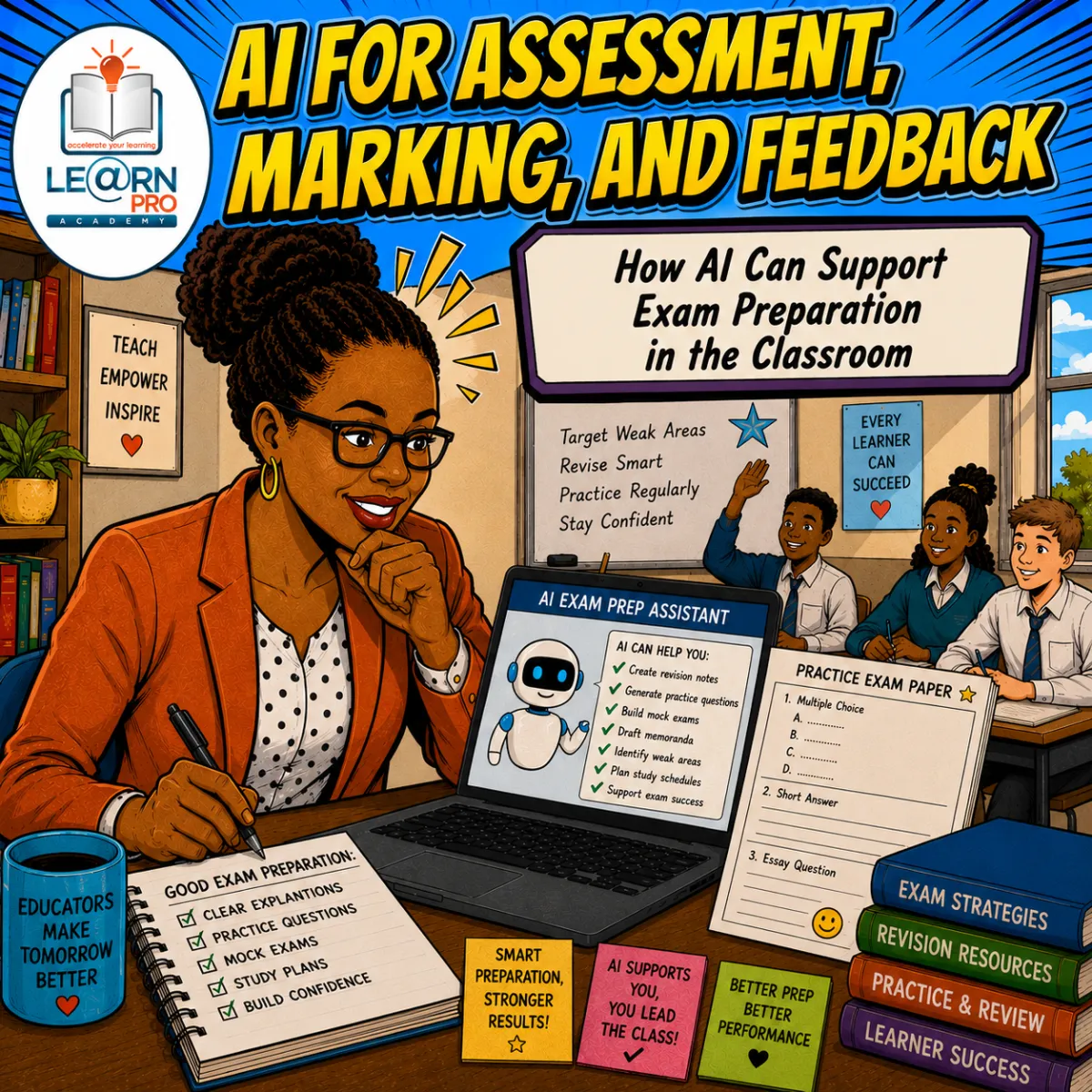
Artificial Intelligence (AI) offers practical ways to reduce some of this workload. AI can help educators generate revision resources, create practice questions, summarise topics, organise study plans, and identify areas that require additional attention. Used responsibly, AI becomes a valuable planning assistant that allows teachers to spend more time supporting learners and less time creating repetitive materials.
However, AI should never replace the educator's professional expertise. Teachers understand their learners, know which topics have proved difficult during the year, and recognise where additional support is needed. AI can generate ideas and resources, but educators remain responsible for ensuring that every revision activity aligns with CAPS requirements, school expectations, and learner needs.
This article explores practical ways educators can use AI to improve classroom exam preparation while keeping teaching, professional judgment, and learner success at the centre of the process.
Why Effective Exam Preparation Matters
Examinations are not simply about testing memory.
Well-planned exam preparation helps learners:
Consolidate knowledge.
Identify learning gaps.
Practise applying concepts.
Build confidence.
Improve time management.
Reduce unnecessary stress.
Good revision also helps educators identify topics that may require additional teaching before the final examination.
AI can support each of these goals when used thoughtfully.
The Challenges Educators Face During Exam Season
Exam preparation often requires educators to complete many additional tasks within a short period.
These may include:
Preparing revision notes.
Creating practice papers.
Developing memoranda.
Answering learner questions.
Revising difficult concepts.
Supporting struggling learners.
Organising revision schedules.
Providing additional resources.
Managing learner anxiety.
These responsibilities are added to normal teaching, marking, and administrative duties. AI can reduce preparation time for many of these repetitive tasks.
AI Is A Revision Assistant, Not A Teacher
One of the most important principles is understanding the role AI should play.
AI can:
Generate revision ideas.
Draft summaries.
Create practice questions.
Organise learning resources.
Suggest study activities.
Produce quizzes.
AI cannot:
Understand your individual learners.
Know what has already been taught.
Recognise classroom misconceptions automatically.
Replace classroom teaching.
Decide what learners need most.
The educator remains responsible for selecting, adapting, and approving every revision resource.
Creating Topic Summaries
Many learners feel overwhelmed because they face large amounts of content before examinations.
AI can help educators create concise topic summaries.
For example:
Instead of asking: Summarise photosynthesis.
An educator might ask: Create a Grade 11 CAPS-aligned summary of photosynthesis highlighting the most important concepts learners should revise before examinations.
The result becomes a useful starting point that educators can edit before sharing.
Preparing Revision Notes
AI can organise revision notes into clear sections such as:
Key concepts.
Definitions.
Important formulas.
Diagrams.
Examples.
Common mistakes.
Examination tips.
Structured revision material is often easier for learners to understand than lengthy textbook chapters.
Generating Practice Questions
Practice is one of the most effective ways to prepare for examinations.
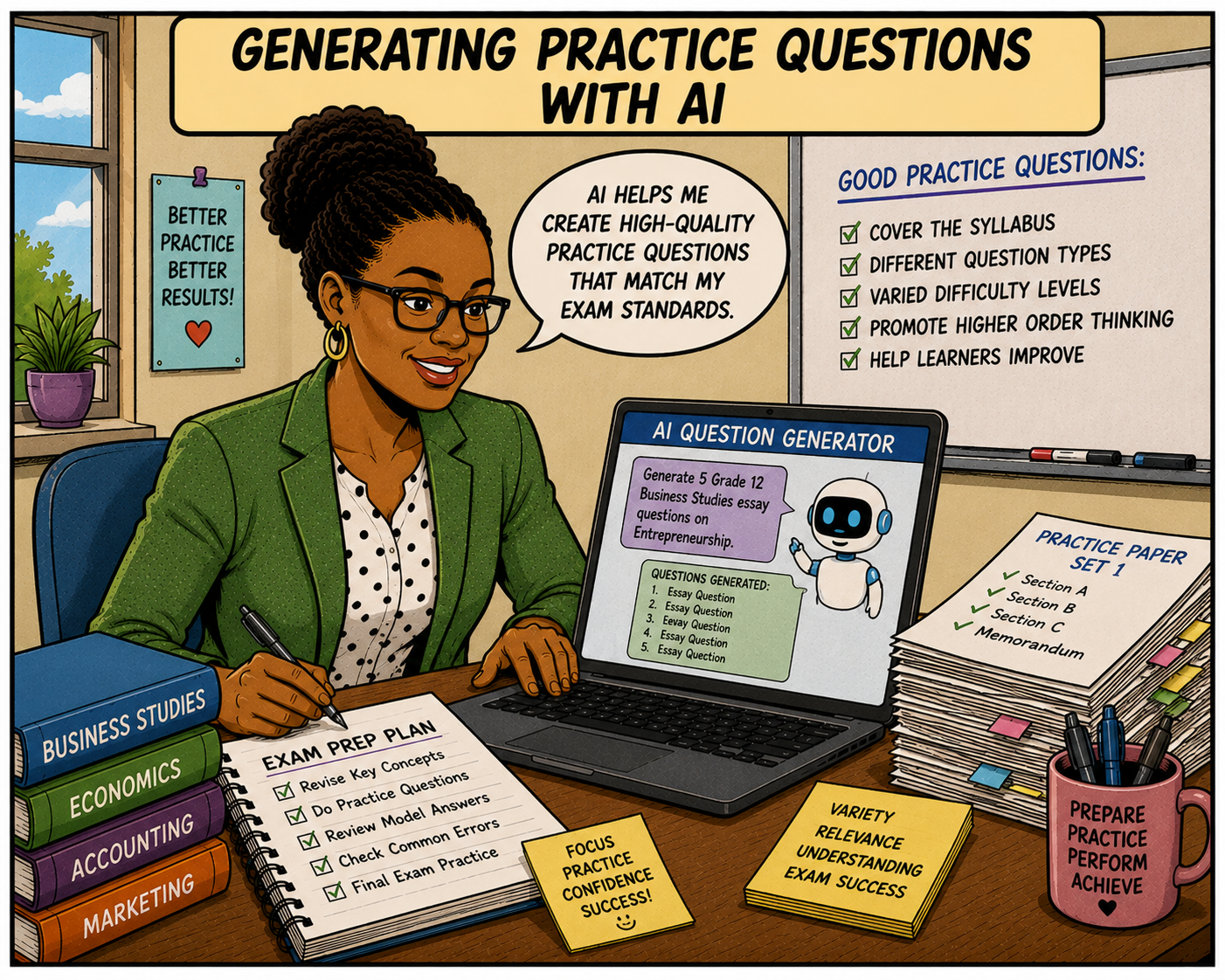
AI can quickly generate:
Multiple-choice questions.
Short-answer questions.
Structured questions.
Source-based activities.
Case studies.
Essay questions.
Calculation exercises.
Educators should review every question to ensure it aligns with CAPS requirements and reflects the expected examination standard.
Creating Questions At Different Difficulty Levels
Not every learner requires the same level of challenge.
AI can generate questions that are:
Easy.
Moderate.
Challenging.
Extension activities.
This allows educators to differentiate revision according to learner ability while encouraging continuous improvement.
Supporting Bloom's Taxonomy
Revision should include more than factual recall.
AI can generate questions that assess different cognitive levels, including:
Remember.
Understand.
Apply.
Analyse.
Evaluate.
Create.
This helps learners prepare for examinations that assess higher-order thinking rather than memorisation alone.
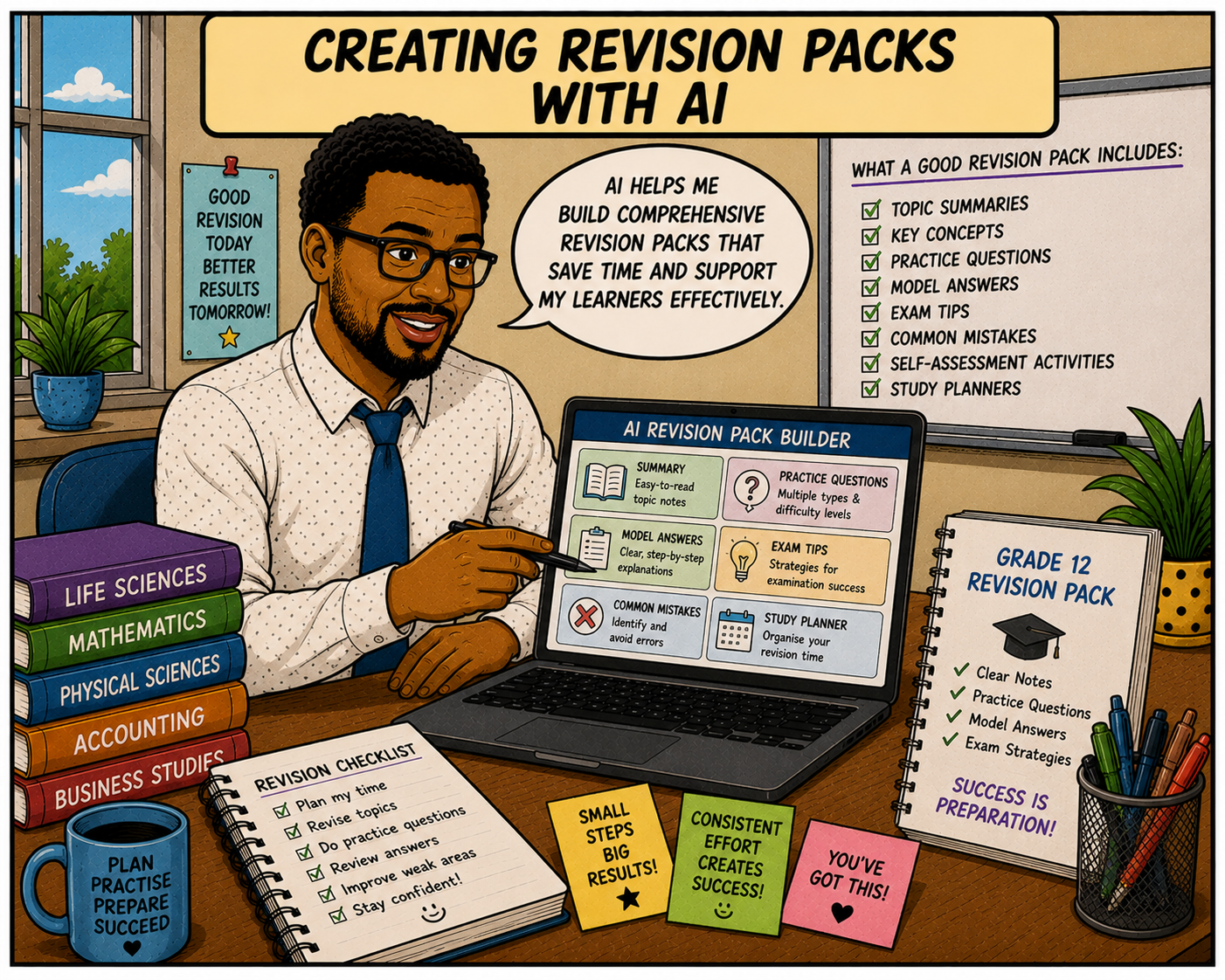
Building Revision Packs
Many educators prepare revision packs before examinations.
AI can assist by generating:
Topic summaries.
Practice questions.
Worked examples.
Model answers.
Reflection questions.
Revision checklists.
Educators can combine these into comprehensive learner revision packs.
Creating Practice Examination Papers
Mock examinations help learners become familiar with examination conditions.
AI can assist by drafting practice papers that include:
Appropriate mark allocations.
Mixed question types.
Balanced difficulty.
Curriculum coverage.
Teachers should always review these papers carefully before use.
Drafting Memoranda
Every practice paper requires a memorandum.
AI can help draft:
Suggested answers.
Mark allocations.
Alternative responses.
Worked calculations.
Key terminology.
These drafts save preparation time but should always be checked by the educator.
Identifying Learning Gaps
After learners complete practice assessments, AI can help analyse class performance.
For example:
Which topics caused difficulty?
Which questions were most frequently answered incorrectly?
Which misconceptions appeared repeatedly?
This information helps educators focus revision on the areas learners need most.
Planning Revision Lessons
Revision lessons should focus on understanding rather than repeating previous teaching.
AI can help educators organise revision sessions by:
Prioritising difficult topics.
Sequencing activities logically.
Suggesting discussion questions.
Creating classroom revision games.
Generating recap activities.
The educator decides which activities best suit the class.
Supporting Independent Learning
Many learners study independently at home.
AI can help educators prepare resources that encourage self-directed revision.
Examples include:
Revision checklists.
Self-assessment quizzes.
Flashcards.
Topic summaries.
Practice schedules.
Reflection questions.
These resources help learners take greater responsibility for their own preparation.
Helping Learners Manage Time
Exam success depends partly on effective time management.
AI can assist educators by generating sample revision timetables.
For example:
Daily study schedules.
Weekly revision plans.
Subject rotation timetables.
Topic checklists.
Goal-setting templates.
Teachers can adapt these to suit their learners' needs.
Reducing Learner Stress
Examination anxiety affects many learners.
AI can help educators create resources that encourage confidence.
Examples include:
Positive study reminders.
Revision planning guides.
Frequently asked questions.
Study habit checklists.
Motivation strategies.
These materials complement the emotional support provided by teachers.
Supporting English Second-Language Learners
Many South African learners prepare for examinations in English even though it is not their home language.
AI can help educators produce:
Simplified revision summaries.
Clear definitions.
Easier explanations.
Vocabulary lists.
Glossaries.
Language support activities.
This improves accessibility without lowering academic expectations.
Creating Visual Revision Resources
Many learners understand information more easily through visual learning.
AI can help generate ideas for:
Mind maps.
Flowcharts.
Comparison tables.
Timelines.
Summary diagrams.
Concept maps.
Educators should review visual accuracy before using these resources.
Supporting Collaborative Revision
Revision does not always have to be individual.
AI can suggest classroom activities such as:
Quiz competitions.
Group discussions.
Peer teaching.
Revision stations.
Team problem-solving.
Collaborative case studies.
These activities encourage active learning.
Considering The South African Classroom
South African classrooms are diverse.
Learners differ in:
Language.
Educational background.
Access to technology.
Home study environments.
Learning confidence.
When reviewing AI-generated revision materials, educators should ensure they:
Use inclusive language.
Reflect CAPS terminology.
Include relevant South African examples where appropriate.
Remain accessible to English second-language learners.
Support learners from varying academic backgrounds.
Professional review remains essential.
Protecting Assessment Integrity
Exam preparation should strengthen learning — not encourage memorisation of likely examination questions.
Educators should avoid using AI to:
Predict actual examination papers.
Reproduce confidential assessments.
Generate misleading guarantees.
Instead, AI should support broader understanding and skill development.
Helpful Prompt Examples
The quality of AI-generated revision materials depends on the quality of the prompt.
Useful prompts include:
Create a Grade 12 CAPS-aligned revision summary for Business Studies entrepreneurship.
Generate twenty Geography examination-style questions covering river systems.
Create a revision checklist for Grade 11 Physical Sciences chemical reactions.
Draft a two-hour Mathematics practice paper with a memorandum.
Rewrite these History revision notes using simpler English for English second-language learners.
Detailed prompts produce stronger results.
Common Mistakes To Avoid
Educators should avoid several common mistakes when using AI during exam preparation.
These include:
Sharing AI-generated material without checking it.
Ignoring CAPS alignment.
Creating revision activities that only test memorisation.
Providing learners with too much information.
Assuming AI-generated answers are always correct.
Neglecting higher-order thinking skills.
Allowing AI to replace classroom teaching.
Professional judgment remains essential.
Building Confidence Gradually
Educators do not need to redesign their entire revision programme immediately.
A practical approach may include:
Generating one revision summary.
Creating a practice quiz.
Drafting a memorandum.
Producing revision checklists.
Preparing one mock examination.
As confidence grows, educators can expand their use of AI while maintaining full control over quality.
The Future Of AI In Exam Preparation
AI technology continues to develop rapidly.
Future systems may become better at:
Personalised revision planning.
Adaptive practice questions.
Learning gap analysis.
Progress tracking.
Individual study recommendations.
Even with these improvements, successful exam preparation will always depend on educators who understand their learners and guide them through the learning process.
Technology can support preparation, but it cannot replace effective teaching.
Final Thoughts
Exam preparation is one of the most important responsibilities educators undertake each year. It requires careful planning, high-quality resources, meaningful revision activities, and ongoing encouragement to help learners approach assessments with confidence rather than anxiety.
Artificial Intelligence provides valuable support by helping educators create revision notes, topic summaries, practice questions, mock examinations, memoranda, study schedules, and classroom activities more efficiently. These tools reduce repetitive preparation work and allow teachers to spend more time addressing learner misconceptions, answering questions, and providing individual support.
However, AI should remain exactly what it is intended to be — a professional assistant rather than a replacement for the educator. Only teachers truly understand their learners' progress, classroom experiences, curriculum priorities, and the areas where additional revision is most needed. Every AI-generated resource should therefore be reviewed, adapted, and aligned with CAPS requirements before it reaches learners.
The most effective exam preparation combines AI's speed and organisational abilities with the experience, judgment, and care of skilled educators. Together, they create revision programmes that are accurate, engaging, learner-focused, and academically meaningful.
Ultimately, successful exam preparation is not about generating more worksheets or practice papers. It is about giving learners the knowledge, confidence, and strategies they need to demonstrate what they have learned — and helping every learner walk into the examination room ready to succeed.
Additional Articles in the AI for Assessment, Marketing, and Feedback Series
How AI Can Help Educators Create Better Test and Exam Questions
Using AI to Generate Marking Rubrics and Assessment Criteria
Can AI Help With Marking? What Educators Need to Know
Using AI to Give Faster, More Useful Learner Feedback
How AI Can Support Exam Preparation in the Classroom
Disclaimer
AI Tools were used to assist with research. Remember to always cross-check everything that you read.