
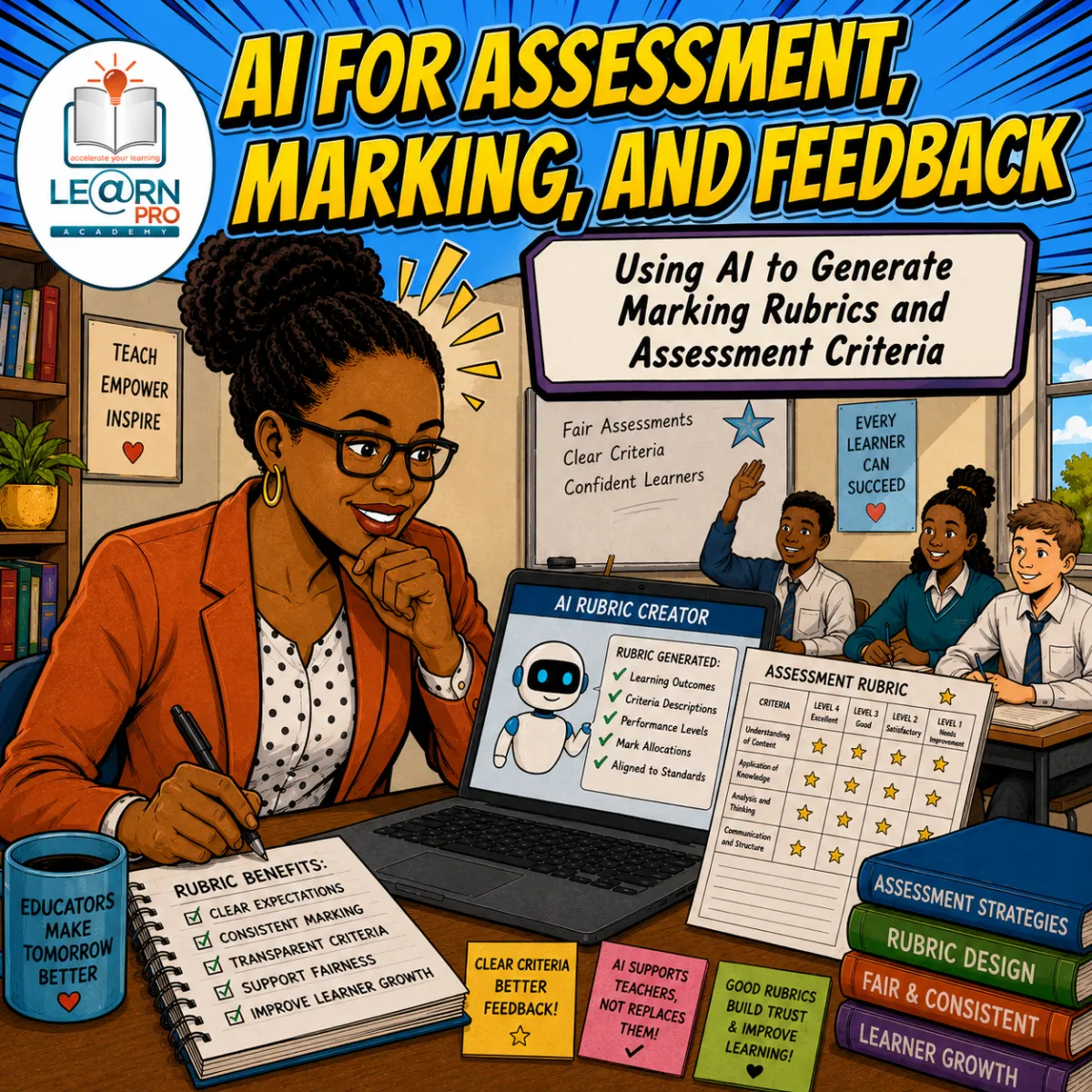
Using AI to Generate Marking Rubrics and Assessment Criteria
This is article #2 of 5 in the AI for Assessment, Marketing, and Feedback Series
Introduction
Assessment is about more than awarding marks. It is about helping learners understand what quality work looks like, measuring progress fairly, and providing meaningful guidance for improvement. One of the best tools educators have for achieving this is a well-designed marking rubric.
Rubrics make expectations clear before learners begin an assignment. They also help educators mark consistently across different learners, classes, and even multiple markers. Whether assessing essays, presentations, practical tasks, research projects, or group work, a good rubric creates fairness and transparency.
However, designing effective rubrics takes time. Educators need to identify assessment criteria, describe different performance levels, allocate marks, and ensure that everything aligns with curriculum outcomes and school policies. For busy teachers already balancing lesson planning, marking, administration, and classroom management, this process can feel overwhelming.
Artificial Intelligence (AI) offers a practical solution. AI can generate first-draft rubrics, suggest assessment criteria, describe performance levels, and help educators organise marking standards more efficiently. It cannot replace the educator's professional judgment, but it can significantly reduce the time needed to create high-quality assessment tools.
This article explores how educators can use AI to generate better marking rubrics and assessment criteria while maintaining fairness, consistency, and alignment with South African curriculum standards.
Why Rubrics Matter
A marking rubric is much more than a marking sheet.
It tells learners:
What is expected.
How marks will be awarded.
Which skills are being assessed.
What excellent work looks like.
Where improvement is needed.
For educators, rubrics help by:
Increasing marking consistency.
Reducing subjectivity.
Speeding up marking.
Supporting constructive feedback.
Making moderation easier.
Providing evidence of fair assessment.
When learners understand the assessment criteria before they begin a task, they are more likely to produce work that meets expectations.
Common Challenges When Creating Rubrics
Many educators appreciate the value of rubrics but struggle to create them because they require careful planning.
Common challenges include:
Identifying suitable assessment criteria.
Writing clear performance descriptions.
Allocating marks fairly.
Avoiding vague wording.
Ensuring consistency across different tasks.
Aligning criteria with CAPS outcomes.
Creating rubrics for new project types.
AI can assist with each of these challenges by producing structured first drafts that educators can refine.
AI Is A Starting Point, Not The Final Rubric
One of the most important principles when using AI is understanding its role.
AI should never make assessment decisions independently.
Instead, it serves as:
A brainstorming partner.
A drafting assistant.
A wording helper.
An organisational tool.
The educator remains responsible for:
Curriculum alignment.
Fairness.
Appropriate mark allocation.
School assessment policies.
Final approval.
Professional judgment remains essential throughout the process.
Start With The Learning Outcomes
Every good rubric begins with clear learning outcomes.
Before asking AI to create a rubric, educators should identify exactly what learners are expected to demonstrate.
Instead of asking: "Create a rubric for an essay."
A much stronger prompt would be: "Create a Grade 11 English Home Language essay rubric aligned with CAPS. Assess content, structure, language use, evidence, critical thinking, and presentation. Include four performance levels."
Providing this level of detail produces much more useful results.
Generating Assessment Criteria
Assessment criteria identify the specific areas learners will be judged on.
Depending on the task, AI may suggest criteria such as:
For essays:
Understanding of the topic
Organisation
Argument development
Grammar
Vocabulary
Referencing
For presentations:
Subject knowledge
Communication skills
Visual aids
Confidence
Audience engagement
Time management
For practical projects:
Planning
Technical skills
Accuracy
Creativity
Problem-solving
Final product
Educators can then adjust these criteria according to the task requirements.
Creating Performance Levels
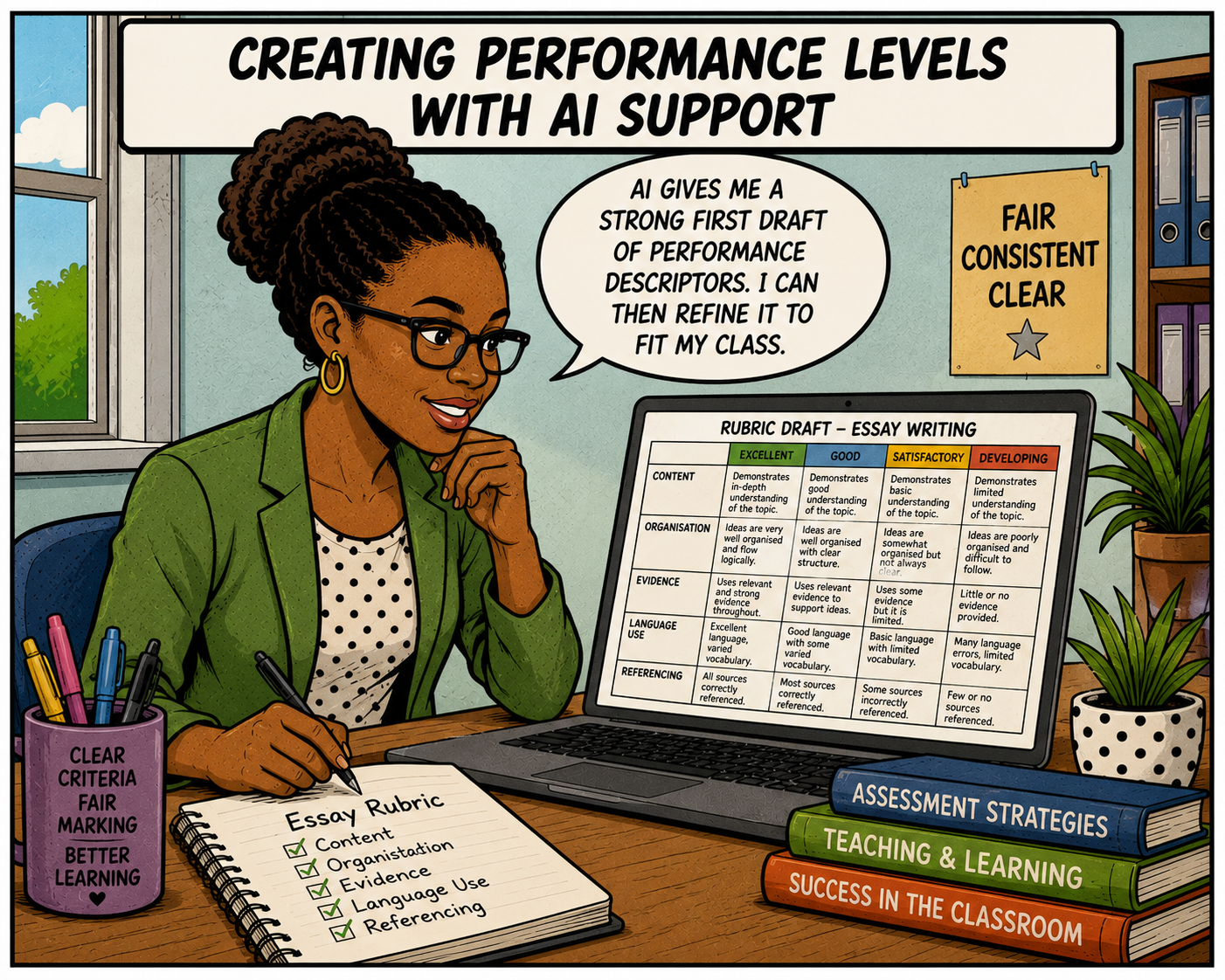
One of the most time-consuming parts of rubric design is writing performance descriptors.
AI can draft descriptions for levels such as:
Excellent
Good
Satisfactory
Developing
Beginning
Or numerical levels such as:
Level 7
Level 6
Level 5
Level 4
Level 3
Level 2
Level 1
Each descriptor should clearly explain what learner performance looks like at that level.
For example:
Excellent
Demonstrates comprehensive understanding with accurate information, logical organisation, and excellent supporting evidence.
Developing
Demonstrates partial understanding with several inaccuracies and limited supporting evidence. These descriptions give learners clear expectations.
Using Clear Language
Rubrics should be easy for learners to understand.
AI can rewrite technical language into simpler English that is suitable for learners whose first language is not English.
Instead of: Demonstrates exemplary synthesis of multiple theoretical perspectives.
AI can suggest: Combines ideas from different sources clearly and explains how they connect.
Simple language improves transparency without lowering standards.
Creating Rubrics For Different Subjects
AI can generate rubrics for almost any subject area.
Examples include:
English
Essays
Oral presentations
Creative writing
Literature responses
Poetry analysis
Mathematics
Problem-solving process
Accuracy
Working shown
Method selection
Interpretation of answers
Life Sciences
Scientific knowledge
Investigation skills
Data interpretation
Practical reports
Scientific reasoning
Business Studies
Business knowledge
Analysis
Evaluation
Application
Recommendations
Geography
Map skills
Data interpretation
Case study analysis
Environmental understanding
History
Source analysis
Historical interpretation
Argument construction
Evidence use
Critical thinking
Because AI adapts quickly, educators can create subject-specific rubrics much faster than starting from a blank page.
Designing Rubrics For Projects
Projects often assess multiple skills simultaneously. AI can help organise complex rubrics into manageable sections.
For example:
Research Quality
Accuracy
Depth of research
Use of sources
Presentation
Layout
Visual appearance
Organisation
Understanding
Explanation
Application
Analysis
Communication
Grammar
Language
Clarity
Each section can receive its own weighting.
Supporting Group Assessments
Group projects can be difficult to assess fairly. AI can help educators create separate criteria for:
Group performance:
Collaboration
Planning
Time management
Team communication
Individual contribution:
Participation
Responsibility
Initiative
Reflection
This allows educators to recognise individual effort while still assessing teamwork.
Allocating Marks More Consistently
AI can also suggest mark distributions.
For example, a 50-mark project may include:
Research – 15 marks
Analysis – 10 marks
Presentation – 10 marks
Communication – 10 marks
Referencing – 5 marks
These allocations should always be reviewed by the educator to ensure they reflect the learning priorities.
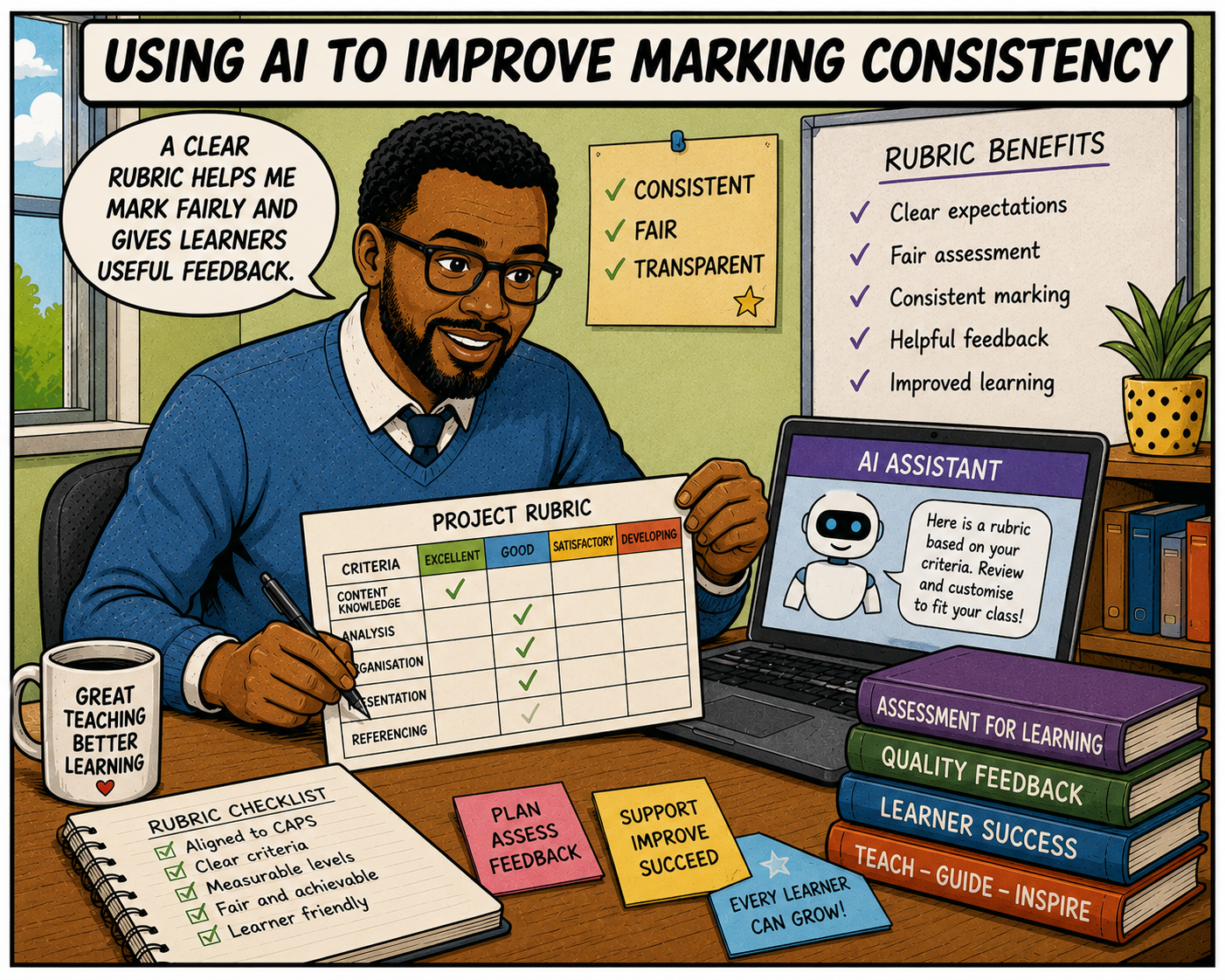
Improving Marking Consistency
Consistency is one of the greatest advantages of using rubrics. When multiple teachers mark the same assessment, rubrics reduce differences between markers.
AI can help improve consistency by:
Standardising wording.
Reducing overlap between criteria.
Clarifying performance descriptions.
Making descriptors more measurable.
Moderation becomes easier because expectations are clearly documented.
Supporting Constructive Feedback
Rubrics do more than assign marks. They also provide structured feedback. AI can generate feedback statements linked to each criterion.
For example:
If a learner scores highly for organisation: Your ideas are presented in a clear, logical sequence that makes your argument easy to follow.
If improvement is needed: Consider organising your ideas into clearer paragraphs with stronger links between points.
Educators can personalise these comments before sharing them.
Creating Rubrics For Practical Assessments
Practical subjects often require observation rather than written answers.
Examples include:
Visual Arts
Design
Hospitality Studies
Consumer Studies
Engineering Graphics and Design
Physical Sciences practical investigations
AI can suggest observable behaviours such as:
Safe equipment use
Correct procedures
Accuracy
Technical skill
Creativity
Final quality
These descriptors help educators assess practical work more consistently.
Adapting Rubrics For Different Grade Levels
A Grade 8 rubric should not look identical to a Grade 12 rubric. AI can adjust language and expectations for different ages.
For example:
Grade 8: Explains ideas clearly using simple examples.
Grade 12: Critically analyses ideas using evidence to justify conclusions.
The same skill can be assessed with different expectations.
Reviewing AI-Generated Rubrics Carefully
Although AI can produce impressive drafts, educators should always review them carefully.
Check for:
Curriculum alignment
Appropriate terminology
Correct mark allocation
Missing criteria
Overlapping descriptors
Unclear wording
Fairness
Practicality
Editing the rubric before use ensures higher quality assessment.
Aligning Rubrics With CAPS
South African educators should ensure every rubric aligns with:
CAPS learning outcomes
Assessment guidelines
Annual Teaching Plans
Subject requirements
School moderation policies
AI does not automatically understand every CAPS requirement.
Professional review remains essential.
Considering Learner Diversity
South African classrooms include learners from many different language and cultural backgrounds.
When reviewing AI-generated rubrics, educators should ensure that descriptors:
Use inclusive language.
Avoid unnecessary complexity.
Focus on demonstrated learning.
Do not disadvantage English second-language learners.
Reflect the classroom context.
Clear assessment supports equity.
Protecting Fairness
Good rubrics help remove bias from assessment. AI can assist by creating objective descriptors based on observable evidence rather than personal opinion.
Instead of: Shows excellent effort.
A better descriptor would be: Provides accurate explanations supported by relevant evidence.
Observable performance is much easier to assess consistently.
Helpful Prompt Examples
The quality of AI output depends on the quality of the prompt.
Useful prompts include:
Create a Grade 10 Geography project rubric aligned with CAPS using four performance levels.
Generate a marking rubric for a Grade 12 Business Studies presentation worth 50 marks.
Rewrite this rubric using simpler English suitable for English second-language learners.
Create assessment criteria for a Life Sciences practical investigation.
Draft performance descriptors for Levels 1 to 7 for a History source analysis task.
Detailed prompts usually produce much stronger results.
Common Mistakes To Avoid
Educators should avoid several common mistakes when using AI.
These include:
Accepting AI-generated rubrics without editing.
Using vague assessment criteria.
Including overlapping descriptors.
Ignoring CAPS alignment.
Making descriptors too subjective.
Writing language learners cannot understand.
Using identical rubrics for every assessment.
AI should simplify the drafting process — not replace thoughtful assessment design.
Building Confidence Over Time
Educators do not need to redesign every rubric immediately. A practical approach is to begin with one assignment or project.
For example:
Ask AI to draft the assessment criteria.
Edit the wording.
Adjust the mark allocation.
Review curriculum alignment.
Use the rubric.
Reflect on what worked well.
Improve future versions.
As educators gain experience, AI becomes a reliable assistant that speeds up preparation while maintaining professional standards.
Final Thoughts
High-quality rubrics are one of the most effective tools for improving both teaching and learning. They provide clarity, fairness, consistency, and meaningful guidance for learners while helping educators mark more efficiently and confidently.
Artificial Intelligence makes rubric creation faster by generating first drafts, suggesting assessment criteria, writing performance descriptors, and organising marking structures. These capabilities can save valuable preparation time, especially when educators are designing new assignments, projects, presentations, or practical tasks.
However, AI should never become the final decision-maker. It does not understand individual learners, school expectations, or the specific teaching context in which assessments take place. Every rubric should be reviewed, adapted, and approved by the educator to ensure it aligns with CAPS, reflects school standards, and measures the intended learning outcomes accurately.
The greatest value of AI lies not in replacing professional expertise but in supporting it. When educators combine their classroom experience with AI's ability to generate ideas quickly, they can create assessment rubrics that are clear, consistent, learner-friendly, and educationally meaningful.
Ultimately, well-designed rubrics do more than make marking easier. They help learners understand success, encourage higher-quality work, and create assessment practices that are fair, transparent, and focused on genuine learning.
Additional Articles in the AI for Assessment, Marketing, and Feedback Series
How AI Can Help Educators Create Better Test and Exam Questions
Using AI to Generate Marking Rubrics and Assessment Criteria
Can AI Help With Marking? What Educators Need to Know
Using AI to Give Faster, More Useful Learner Feedback
How AI Can Support Exam Preparation in the Classroom
Disclaimer
AI Tools were used to assist with research. Remember to always cross-check everything that you read.