
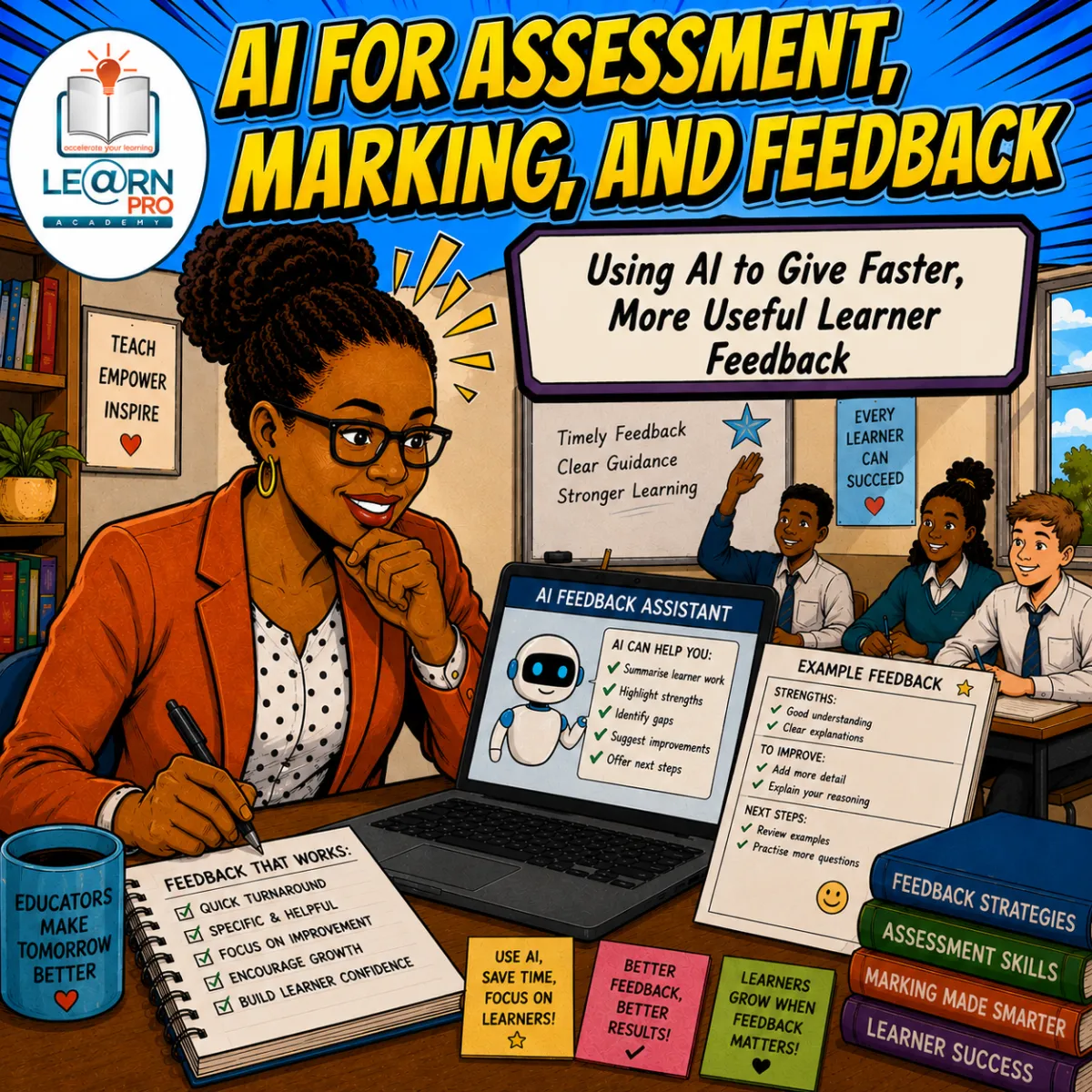
Using AI to Give Faster, More Useful Learner Feedback
This is article #4 of 5 in the AI for Assessment, Marketing, and Feedback Series
Introduction
One of the most valuable things an educator can give a learner is meaningful feedback. A mark tells learners how they performed, but feedback tells them how to improve. Well-written feedback encourages learners, corrects misunderstandings, highlights strengths, and provides practical guidance for future learning.
Unfortunately, giving high-quality feedback also requires a great deal of time. After marking a class set of assignments, projects, tests, or examinations, educators often need to write individual comments for every learner. During busy assessment periods, this can become overwhelming, especially for teachers with large classes or multiple subjects.
Artificial Intelligence (AI) offers a practical way to reduce this workload. AI can draft feedback comments, identify common learner errors, organise observations, and help educators communicate improvement strategies more clearly. Rather than replacing teacher feedback, AI can help educators prepare better first drafts, allowing them to personalise comments more efficiently.
The most important principle remains unchanged: AI should assist the educator — not replace the educator. Meaningful feedback depends on professional judgment, knowledge of individual learners, and an understanding of classroom context. These are qualities that technology cannot fully replicate.
This article explores how educators can use AI to prepare clearer, quicker, and more constructive learner feedback while maintaining the personal and professional value that effective teaching requires.
Why Feedback Matters
Assessment is not complete when marks are recorded.
The greatest educational value comes from helping learners understand:
What they did well.
Where mistakes occurred.
Why those mistakes matter.
How they can improve next time.
Good feedback turns assessment into a learning opportunity rather than simply a grading exercise.
Research consistently shows that learners improve more when they receive timely, specific, and constructive feedback than when they only receive marks.
The Difference Between Marks And Feedback
Many learners focus only on the percentage they achieved. However, two learners with exactly the same mark may need completely different guidance.
For example:
Learner A may understand the content well but struggle with written expression.
Learner B may write fluently but misunderstand the underlying concepts.
Both may score 65%, but their feedback should be very different.
AI can help educators prepare personalised comments more efficiently while ensuring that feedback addresses individual learning needs.
Why Writing Feedback Takes So Long
Providing quality feedback requires educators to:
Read learner work carefully.
Identify strengths.
Identify weaknesses.
Explain mistakes.
Suggest improvements.
Encourage continued effort.
Adapt comments for different learners.
When multiplied across dozens or even hundreds of learners, this becomes one of the largest time commitments in teaching.
AI helps reduce repetitive writing while allowing educators to retain control over the final message.
AI Is A Feedback Assistant
One of the biggest misconceptions about AI is that it should generate final learner feedback automatically.
Instead, AI works best as:
A drafting assistant.
A wording helper.
A comment generator.
A pattern recogniser.
A communication tool.
The educator remains responsible for reviewing, editing, and personalising every comment before it is shared with learners.
Starting With Clear Assessment Criteria
Effective feedback begins with clear assessment expectations.
When educators provide AI with:
The assessment task.
The rubric.
The marking criteria.
The learner's strengths.
Areas needing improvement.
AI produces far more useful feedback.
For example: Draft feedback for a Grade 10 Geography assignment using these assessment criteria. The learner demonstrated strong map-reading skills but provided limited explanation of environmental impacts.
Specific information leads to better suggestions.
Drafting Individual Feedback Comments
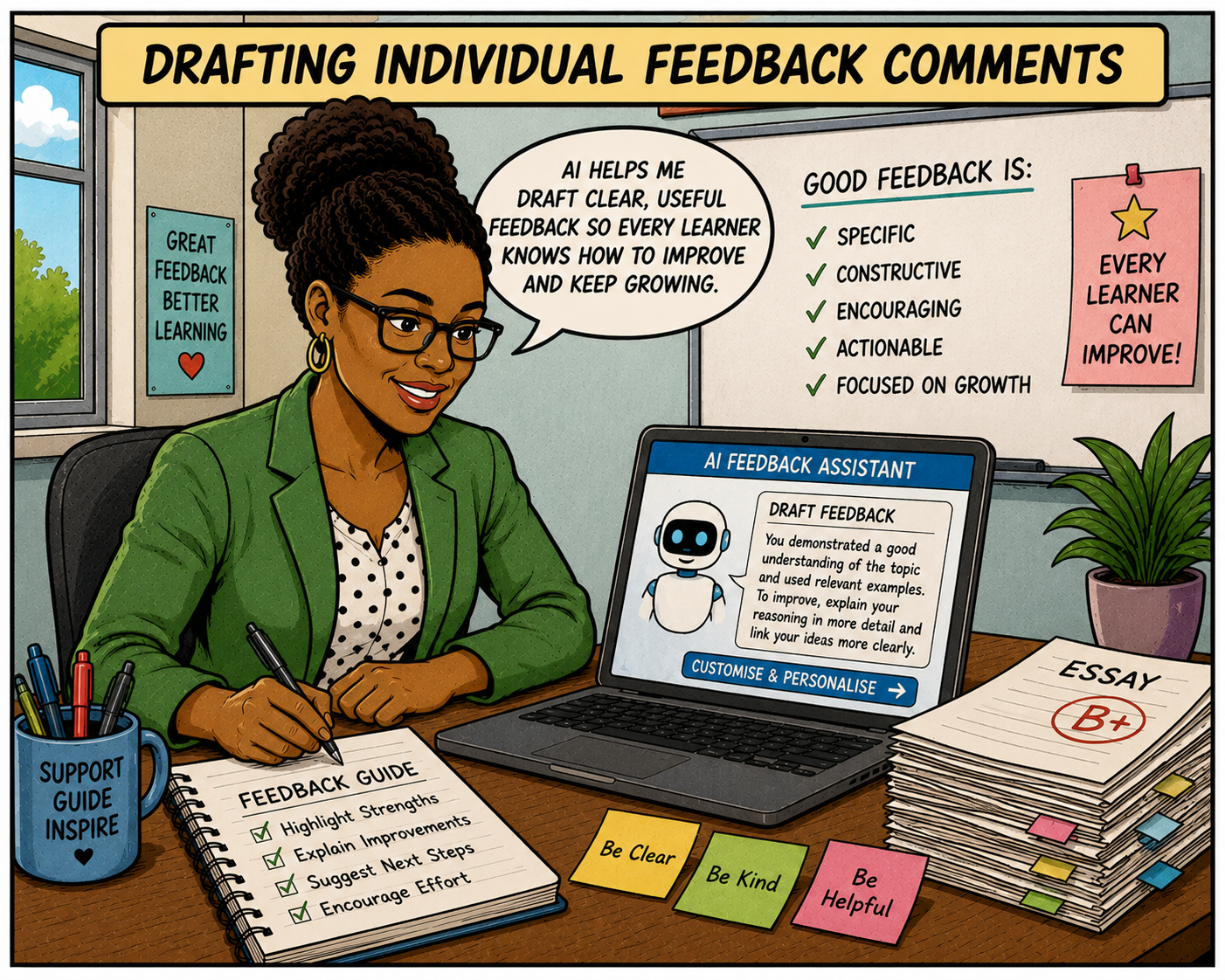
AI can help draft personalised comments for individual learners.
For example:
Instead of writing: Good work.
AI may suggest: You demonstrated a good understanding of the topic and organised your ideas clearly. To improve further, explain your reasoning in greater detail and support your answers with additional evidence.
This provides learners with practical next steps.
Creating Feedback Banks
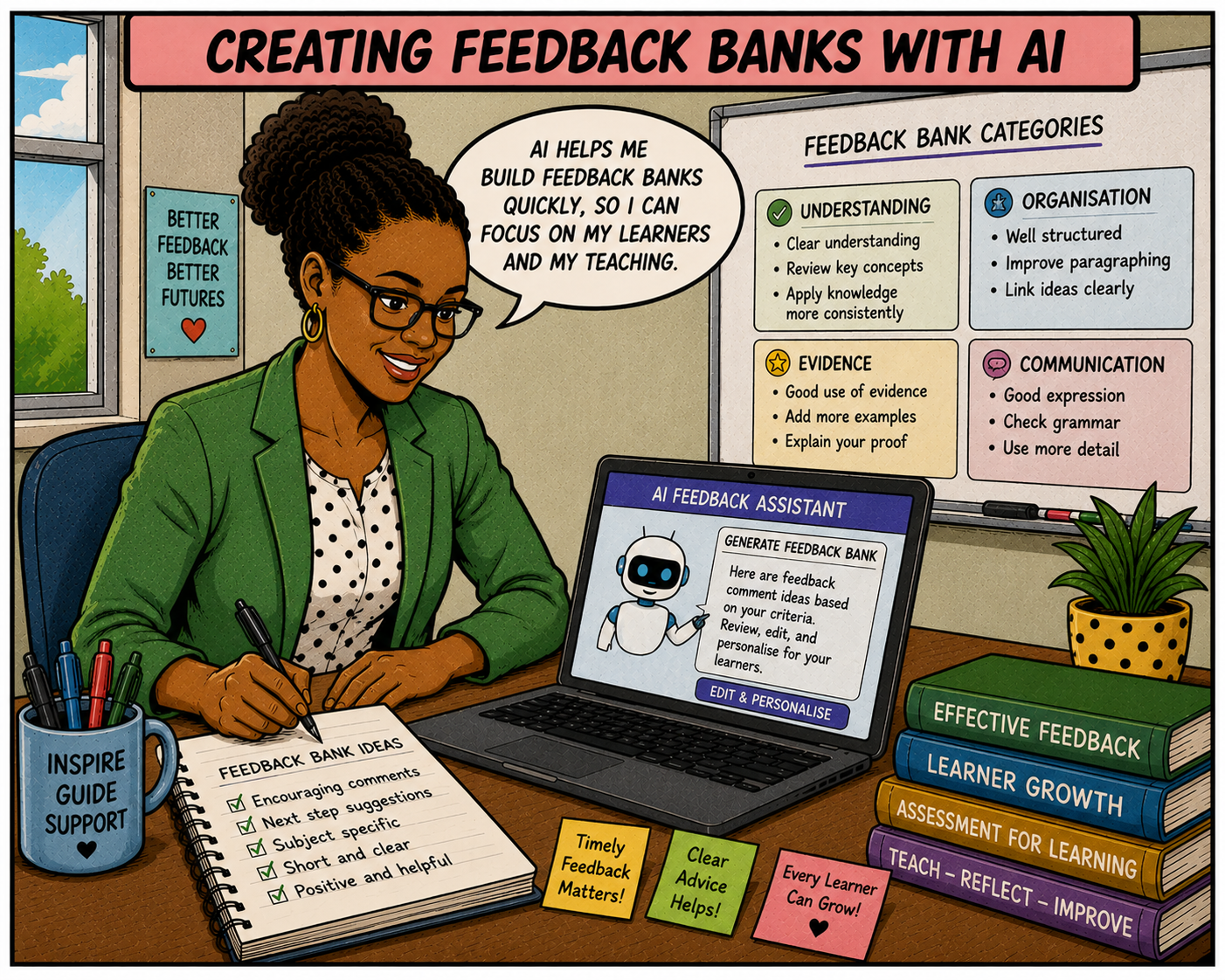
Many educators write similar comments repeatedly. AI can generate reusable comment banks organised into categories.
Examples include:
Understanding
Excellent understanding of the concepts.
Continue reviewing key terminology.
Focus on applying concepts more consistently.
Organisation
Your work follows a clear structure.
Improve paragraph organisation.
Link ideas more effectively.
Evidence
Excellent use of supporting evidence.
Include more examples.
Explain how your evidence supports your argument.
Communication
Clear writing throughout.
Check grammar carefully.
Improve sentence variety.
These comment banks save time throughout the school year.
Making Feedback More Specific
Learners benefit from specific guidance rather than general praise.
Instead of: You need to improve.
AI may suggest: Review the difference between renewable and non-renewable resources and include examples to strengthen your explanation.
Specific advice is much easier for learners to apply.
Balancing Positive And Constructive Feedback
Good feedback should recognise success while encouraging improvement.
A useful structure is:
Identify a strength.
Explain one area for improvement.
Suggest a practical next step.
For example: Your introduction clearly explains the topic and captures the reader's attention. To strengthen your essay, develop each paragraph with more supporting evidence from the source material.
AI can generate balanced comments using this structure.
Identifying Common Errors Across A Class
After marking many assessments, educators often notice repeated mistakes.
AI can analyse marking notes to identify patterns such as:
Grammar errors.
Incorrect calculations.
Weak evidence.
Misunderstood concepts.
Poor paragraph structure.
Missing key terminology.
This helps teachers plan revision lessons that target the needs of the entire class.
Supporting English Second-Language Learners
Many South African learners complete assessments in English even though it is not their first language.
AI can help educators rewrite feedback using:
Simpler vocabulary.
Shorter sentences.
Clear instructions.
Encouraging language.
This improves learner understanding without lowering academic expectations.
Preparing Whole-Class Feedback
Not every piece of feedback needs to be individual.
AI can help prepare whole-class summaries.
For example: Most learners demonstrated a good understanding of photosynthesis. However, many struggled to explain the role of chlorophyll and the importance of sunlight in the process. We will revise these concepts during the next lesson.
This saves time while supporting the entire class.
Supporting Parent Communication
Parents often appreciate clear information about learner progress.
AI can help educators draft:
Progress summaries.
Report comments.
Parent meeting notes.
Improvement suggestions.
For example: Your child participates well in class and demonstrates good understanding during discussions. Continued attention to written explanations and revision of key terminology will support further improvement.
Teachers should always review these comments before sharing them.
Encouraging Learner Motivation
Feedback should not discourage learners. AI can help educators use positive language that encourages continued effort.
Examples include:
Keep building on this progress.
Your understanding is improving.
Continue practising this skill.
Your effort is showing positive results.
You are developing greater confidence in this topic.
Motivating learners helps create a growth mindset.
Supporting Self-Reflection
Feedback becomes more powerful when learners reflect on it. AI can generate reflection questions such as:
What did you do well?
Which part was most difficult?
What will you do differently next time?
Which skill needs the most improvement?
What support would help you succeed?
Reflection encourages learners to take ownership of their learning.
Improving Consistency Across Classes
Educators teaching several classes often want feedback to remain consistent.
AI can help standardise:
Tone.
Language.
Structure.
Level of detail.
Terminology.
Consistency improves fairness while reducing workload.
Saving Time Without Losing Quality
The greatest advantage of AI is not simply writing faster. It is reducing repetitive work while allowing educators to focus on meaningful interaction with learners.
Instead of spending hours writing similar comments repeatedly, teachers can spend more time:
Planning interventions.
Supporting struggling learners.
Preparing lessons.
Meeting with parents.
Reflecting on teaching.
AI frees educators to focus on higher-value professional work.
Considering The South African Classroom
South African educators work with learners from diverse linguistic, cultural, and educational backgrounds.
When reviewing AI-generated feedback, teachers should ensure it:
Uses respectful language.
Is easy to understand.
Avoids unnecessary technical vocabulary.
Reflects classroom context.
Supports learner confidence.
Encourages continued learning.
The educator understands the learners far better than any AI system.
Protecting Learner Privacy
Whenever AI is used during assessment, educators should protect confidential information.
Good practice includes:
Removing learner names.
Avoiding personal details.
Following school policies.
Using trusted educational platforms.
Reviewing privacy settings.
Confidential learner information should never be uploaded carelessly.
Helpful Prompt Examples
The quality of AI feedback depends on the prompt.
Useful prompts include:
Draft encouraging feedback for a Grade 11 Business Studies project where the learner demonstrated good knowledge but weak analysis.
Rewrite this feedback using simpler English suitable for English second-language learners.
Create a bank of positive feedback comments for Geography essays.
Summarise the common mistakes made by this Grade 10 Mathematics class.
Generate whole-class feedback for this Life Sciences practical investigation.
Specific prompts usually produce better results.
Common Mistakes To Avoid
Educators should avoid several common mistakes.
These include:
Copying AI feedback without reviewing it.
Giving identical comments to every learner.
Writing feedback that is too general.
Ignoring learner strengths.
Focusing only on mistakes.
Using language learners cannot understand.
Allowing AI to replace teacher judgment.
Feedback should always reflect the educator's professional understanding.
Building Confidence Gradually
Educators do not need to use AI for every assessment immediately.
A practical starting point might include:
Creating comment banks.
Drafting report comments.
Summarising class performance.
Rewriting feedback more clearly.
Generating reflection questions.
As confidence grows, teachers can gradually expand how they use AI to support assessment.
The Future Of Feedback
AI systems continue to improve.
Future developments may include:
Better personalised feedback.
Improved language support.
Stronger curriculum alignment.
Faster identification of learning gaps.
More effective learner progress tracking.
Even with these advances, meaningful feedback will continue to depend on teacher expertise, empathy, encouragement, and professional judgment.
Technology can improve efficiency, but it cannot replace the relationships that effective educators build with their learners.
Final Thoughts
Meaningful feedback is one of the most powerful tools available to educators. It helps learners recognise their strengths, understand their mistakes, and develop the confidence to improve. While marks measure performance, thoughtful feedback supports learning, motivation, and long-term academic growth.
Artificial Intelligence offers practical ways to make this process more efficient. It can draft feedback comments, create reusable comment banks, identify common learner errors, summarise class performance, and improve the clarity of written communication. These capabilities save valuable time while helping educators provide more consistent and constructive guidance.
However, AI should always remain a support tool rather than the voice of the educator. Every learner is different, and only the teacher truly understands the classroom context, individual progress, learning challenges, and personal circumstances that influence achievement. Reviewing and personalising AI-generated feedback ensures that comments remain accurate, relevant, and encouraging.
The most effective approach combines AI's speed with the educator's professional expertise. Together, they create feedback that is timely, meaningful, and focused on helping every learner continue to grow. Ultimately, successful feedback is not about writing more comments—it is about providing the right guidance at the right time so that every learner has the opportunity to succeed.
Additional Articles in the AI for Assessment, Marketing, and Feedback Series
How AI Can Help Educators Create Better Test and Exam Questions
Using AI to Generate Marking Rubrics and Assessment Criteria
Can AI Help With Marking? What Educators Need to Know
Using AI to Give Faster, More Useful Learner Feedback
How AI Can Support Exam Preparation in the Classroom
Disclaimer
AI Tools were used to assist with research. Remember to always cross-check everything that you read.