Can AI Help With Marking? What Educators Need to Know
This is article #3 of 5 in the AI for Assessment, Marketing, and Feedback Series
Introduction
For many educators, marking is one of the most time-consuming parts of teaching. A single assignment, class test, project, or examination can require hours of careful reading, evaluating, commenting, and recording marks. During busy assessment periods, teachers often spend evenings, weekends, and holidays catching up on marking while still preparing lessons, managing classrooms, and completing administrative responsibilities.
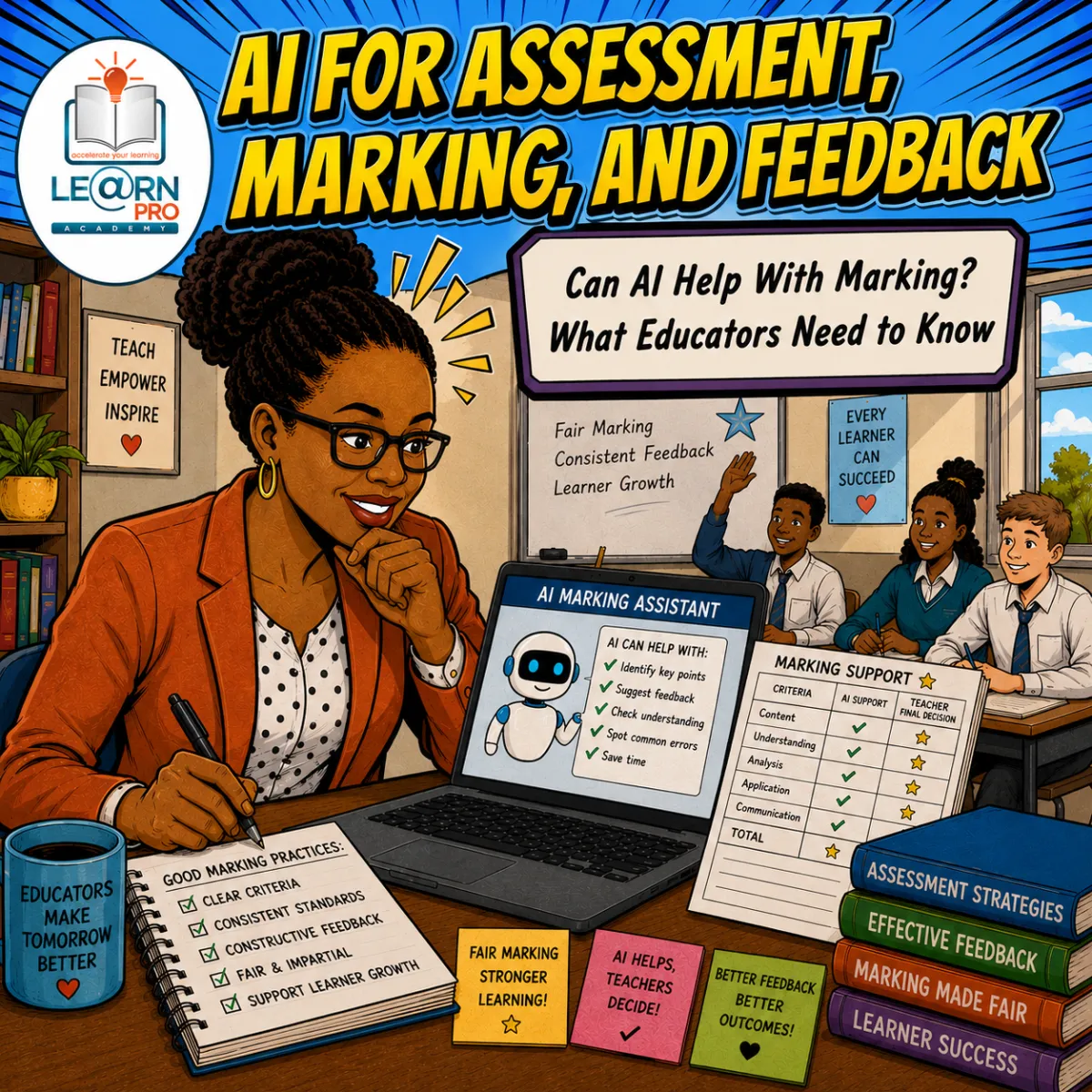
It is therefore understandable that many educators are asking an important question: Can Artificial Intelligence (AI) help with marking?
The answer is both yes and no.
AI has become increasingly capable of supporting educators during the marking process. It can organise information, identify patterns, draft feedback comments, summarise learner performance, and assist with repetitive administrative tasks. These capabilities can save valuable time and help educators work more efficiently.
However, AI cannot replace the professional judgment, subject knowledge, experience, and understanding that teachers bring to assessment. It does not truly understand learner thinking, classroom context, curriculum priorities, or the individual progress of each learner. It can support educators, but it should never become the final decision-maker.
This article explores where AI can genuinely help with marking, where its limitations lie, and how educators can use it responsibly while maintaining fair, accurate, and meaningful assessment practices.
Why Marking Takes So Much Time
Marking involves far more than assigning a score.
Educators often need to:
Read learner responses carefully.
Compare answers with marking guidelines.
Apply assessment criteria consistently.
Consider alternative correct answers.
Write constructive comments.
Identify misconceptions.
Record marks accurately.
Prepare feedback for learners.
Moderate assessments where required.
Each of these tasks requires concentration and professional judgment.
For subjects with extended written responses, such as English, History, Business Studies, Geography, and Life Orientation, marking can become particularly demanding because every learner expresses ideas differently.
AI can assist with some of these tasks — but not all of them.
Understanding What AI Can And Cannot Do
Before using AI in marking, it is important to understand its role. AI is best viewed as a marking assistant, not a marker.
AI can:
Draft comments.
Organise information.
Suggest feedback.
Identify repeated mistakes.
Summarise trends.
Help create marking guides.
Assist with administrative tasks.
AI cannot reliably:
Judge creativity.
Understand learner intent.
Recognise context.
Assess effort.
Evaluate unusual but valid answers.
Apply school assessment policies independently.
Replace teacher professionalism.
The educator remains responsible for every final mark.
Marking Objective Questions
AI performs best when marking questions that have clear right or wrong answers.
Examples include:
Multiple-choice questions
True or false questions
Matching exercises
Fill-in-the-blank activities
Simple calculations
Basic factual recall
Because these questions have predetermined answers, AI can often assist accurately. Even then, educators should still review results before releasing marks.
Marking Short Structured Responses
AI may also help with structured responses where expected answers are clearly defined.
Examples include:
Definitions
Lists
Short explanations
Formula-based calculations
Scientific terminology
When educators provide a detailed memorandum, AI can compare learner responses against expected answers and suggest possible marks.
However, teachers should review any responses that fall outside standard wording.
The Challenge Of Longer Answers
Long-answer questions require much greater professional judgment.
For example:
Essays
Source-based questions
Case studies
Literature analysis
Research assignments
Project reports
Different learners may produce equally valid answers using different reasoning or evidence.
AI may struggle to recognise:
Original thinking
Creative arguments
Alternative interpretations
Contextual understanding
Nuanced explanations
These assessments still require careful human evaluation.
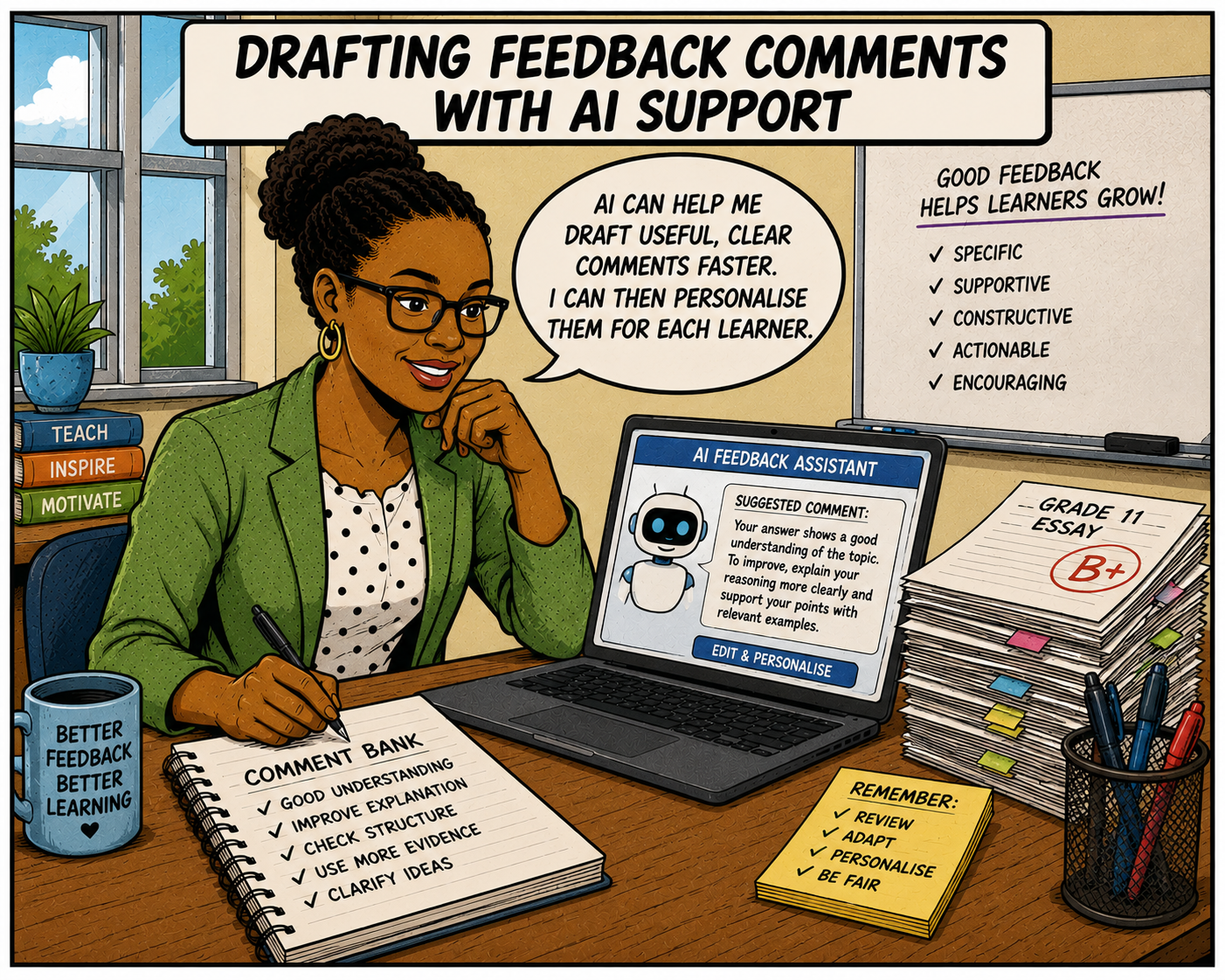
Drafting Feedback Comments
One area where AI can provide significant value is drafting feedback.
Rather than writing similar comments repeatedly, educators can ask AI to generate comment banks based on common strengths and weaknesses.
For example:
Strong performance: Your explanation is clear, well organised, and supported with relevant evidence. Continue developing your analytical thinking.
Needs improvement: Review the key concepts and provide more detailed explanations supported by examples from the lesson.
These comments should always be personalised before being shared with learners.
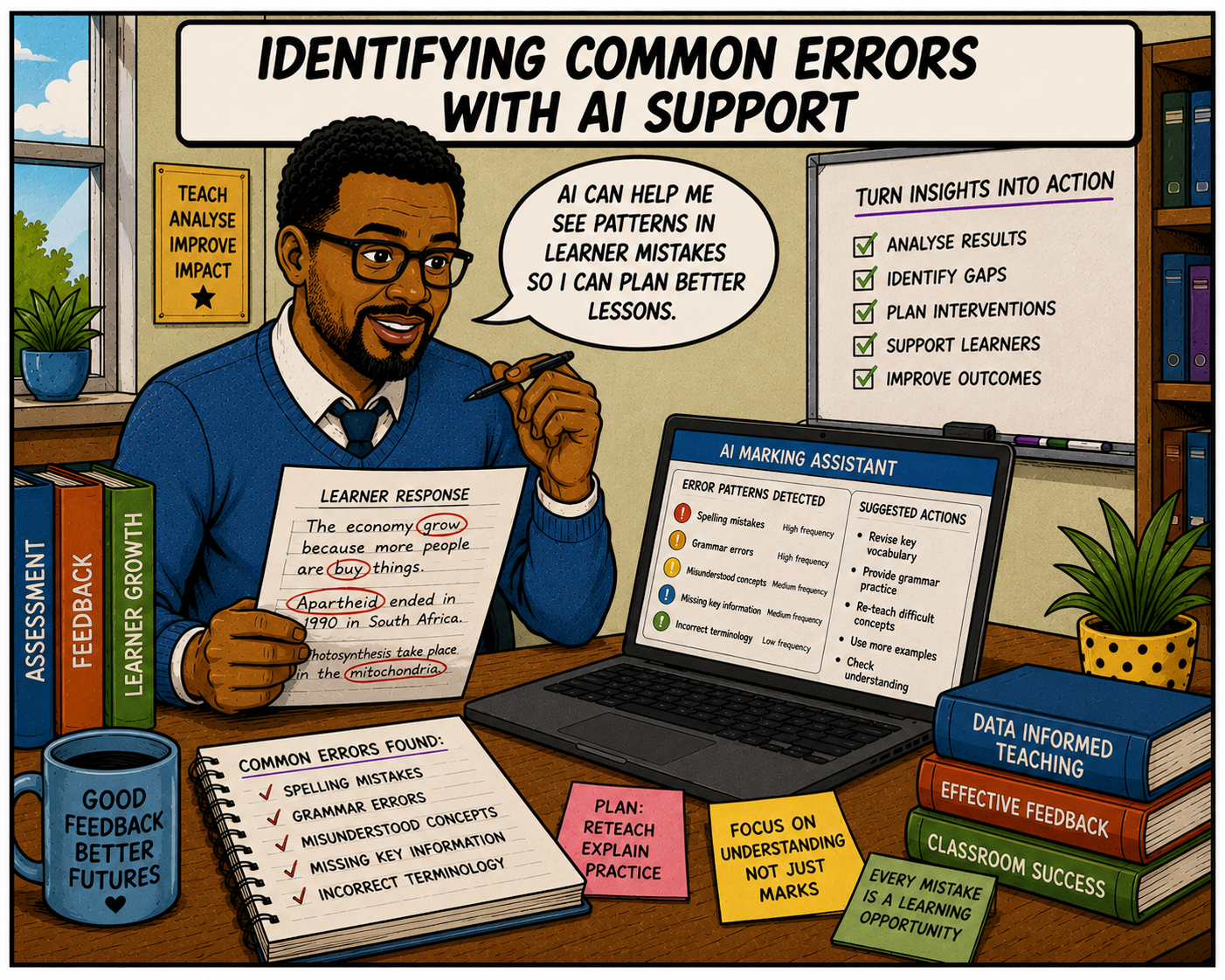
Identifying Common Errors
After marking several assessments, educators often notice recurring mistakes.
AI can help identify patterns such as:
Frequently misunderstood concepts.
Common calculation errors.
Grammar problems.
Weak paragraph structure.
Missing evidence.
Incorrect terminology.
This information allows teachers to plan follow-up lessons that address class-wide learning gaps.
Summarising Class Performance
Instead of reviewing dozens of marked scripts individually to identify trends, educators can ask AI to summarise class performance.
For example:
Which questions caused the most difficulty?
Which learning outcomes were well understood?
What misconceptions appeared most often?
Which topics need reteaching?
These summaries support data-informed teaching decisions.
Supporting Moderation
Moderation helps ensure fairness and consistency.
AI can assist moderators by:
Comparing marking patterns.
Identifying inconsistent scoring.
Highlighting unusually high or low marks.
Organising assessment data.
Summarising moderation findings.
However, moderation decisions should always remain with experienced educators.
Creating Personalised Feedback Faster
Learners benefit from feedback that explains how they can improve.
AI can help educators produce personalised feedback more efficiently by using marking notes to draft individual comments.
For example:
Instead of writing: Good work.
AI may suggest: Your answer shows a good understanding of the concept. To improve further, explain your reasoning more fully and support your answer with additional evidence.
Educators can then edit the wording to reflect each learner's work.
Using AI To Build Feedback Banks
Many educators repeatedly write similar comments. AI can generate reusable feedback banks organised by themes such as:
Knowledge
Excellent understanding.
Review key terminology.
Revise the main concepts.
Writing
Improve paragraph structure.
Check grammar.
Develop stronger introductions.
Analysis
Support ideas with evidence.
Explain reasoning more clearly.
Compare viewpoints more effectively.
These banks save considerable time throughout the school year.
Helping With Administrative Tasks
Marking involves many administrative responsibilities beyond assessing learner work.
AI may assist with:
Organising mark sheets.
Summarising assessment results.
Preparing parent feedback.
Drafting learner progress reports.
Producing class performance summaries.
Reducing administrative workload gives educators more time for teaching.
Protecting Professional Judgment
One of the greatest risks when using AI is allowing it to make decisions independently.
Professional judgment includes considering:
Learner progress over time.
Individual learning needs.
Contextual understanding.
Alternative correct approaches.
Curriculum expectations.
Classroom experiences.
AI does not possess this understanding. Every suggested mark should remain subject to educator review.
Being Careful With Creative Subjects
Creative subjects require careful human evaluation.
Examples include:
Creative writing.
Visual Arts.
Dramatic Arts.
Music.
Design projects.
AI may recognise technical features, but it cannot reliably assess originality, emotional impact, creativity, or artistic quality in the same way experienced educators can.
These assessments depend heavily on professional expertise.
Considering The South African Classroom
South African classrooms are diverse.
Learners vary in:
Home language.
Educational background.
Access to learning resources.
Cultural experiences.
English proficiency.
Educators understand how these factors influence learner responses. AI does not naturally understand these classroom realities unless educators provide clear context.
Teachers should therefore review AI-generated feedback carefully to ensure it remains appropriate, respectful, and supportive.
Protecting Learner Privacy
Whenever educators use AI during marking, learner privacy must remain a priority.
Good practice includes:
Removing learner names.
Avoiding personal information.
Following school data protection policies.
Checking whether AI platforms store uploaded information.
Using approved educational technology where available.
Confidential learner information should never be shared carelessly.
Avoiding Bias
AI systems learn from large collections of data. As a result, they may occasionally produce biased or inconsistent responses.
Educators should check whether AI-generated feedback:
Treats learners fairly.
Uses respectful language.
Avoids assumptions.
Focuses on demonstrated performance.
Supports learner growth.
Professional review helps reduce these risks.
Reviewing AI Suggestions Carefully
Never assume AI is always correct. Educators should always review:
Marks.
Comments.
Suggested feedback.
Performance summaries.
Assessment analysis.
Errors can occur because AI sometimes misunderstands instructions or produces inaccurate information.
Teacher oversight remains essential.
Helpful Prompt Examples
The quality of AI support depends greatly on the prompt provided.
Useful examples include:
Draft constructive feedback comments for learners who struggled with source analysis in Grade 11 History.
Identify common misconceptions from these Biology assessment responses.
Create a bank of encouraging feedback comments for Business Studies projects.
Summarise class performance based on these assessment results.
Rewrite these marking comments using simpler English suitable for English second-language learners.
Specific prompts generally produce more useful results.
Common Mistakes To Avoid
Educators should avoid several common mistakes when using AI during marking.
These include:
Allowing AI to assign final marks independently.
Accepting feedback without checking it.
Uploading confidential learner information unnecessarily.
Ignoring school assessment policies.
Assuming AI understands curriculum standards automatically.
Using AI to replace professional judgment.
Forgetting to personalise learner feedback.
AI should strengthen teaching practice—not replace educator expertise.
Building Confidence Gradually
Educators do not need to transform their marking process overnight.
A sensible approach is to begin with low-risk tasks.
For example:
Generate feedback comments.
Summarise class results.
Create comment banks.
Identify common errors.
Draft parent report comments.
As confidence grows, educators can explore additional ways AI supports assessment while maintaining full professional control.
The Future Of AI In Marking
AI technology is improving rapidly.
Future systems may become better at:
Recognising complex answers.
Supporting personalised feedback.
Analysing learner progress over time.
Identifying curriculum gaps.
Suggesting differentiated interventions.
Even as technology advances, educators will continue to play the central role in interpreting learner performance and making professional assessment decisions.
Teaching involves human relationships, encouragement, fairness, and educational understanding—qualities that cannot be fully automated.
Final Thoughts
Artificial Intelligence has the potential to make marking more efficient, but it is not a replacement for the professional judgment of educators. Its greatest strengths lie in supporting repetitive tasks, organising information, drafting feedback, identifying learning patterns, and reducing administrative workload.
When used responsibly, AI allows teachers to spend less time on routine processes and more time focusing on what matters most: helping learners understand their strengths, overcome their challenges, and continue growing academically.
However, every mark awarded represents a professional decision. It reflects not only what a learner has written but also the educator's understanding of the curriculum, classroom context, assessment standards, and individual learner progress. These responsibilities cannot simply be delegated to technology.
The most effective approach is to view AI as a capable assistant rather than an independent assessor. By combining AI's efficiency with the experience, fairness, and expertise of skilled educators, schools can improve assessment practices while maintaining the high standards that learners deserve.
Ultimately, successful marking is about more than calculating scores. It is about recognising learning, encouraging improvement, and supporting every learner on their educational journey — and that remains a distinctly human responsibility.
Additional Articles in the AI for Assessment, Marketing, and Feedback Series
How AI Can Help Educators Create Better Test and Exam Questions
Using AI to Generate Marking Rubrics and Assessment Criteria
Can AI Help With Marking? What Educators Need to Know
Using AI to Give Faster, More Useful Learner Feedback
How AI Can Support Exam Preparation in the Classroom
Disclaimer
AI Tools were used to assist with research. Remember to always cross-check everything that you read.