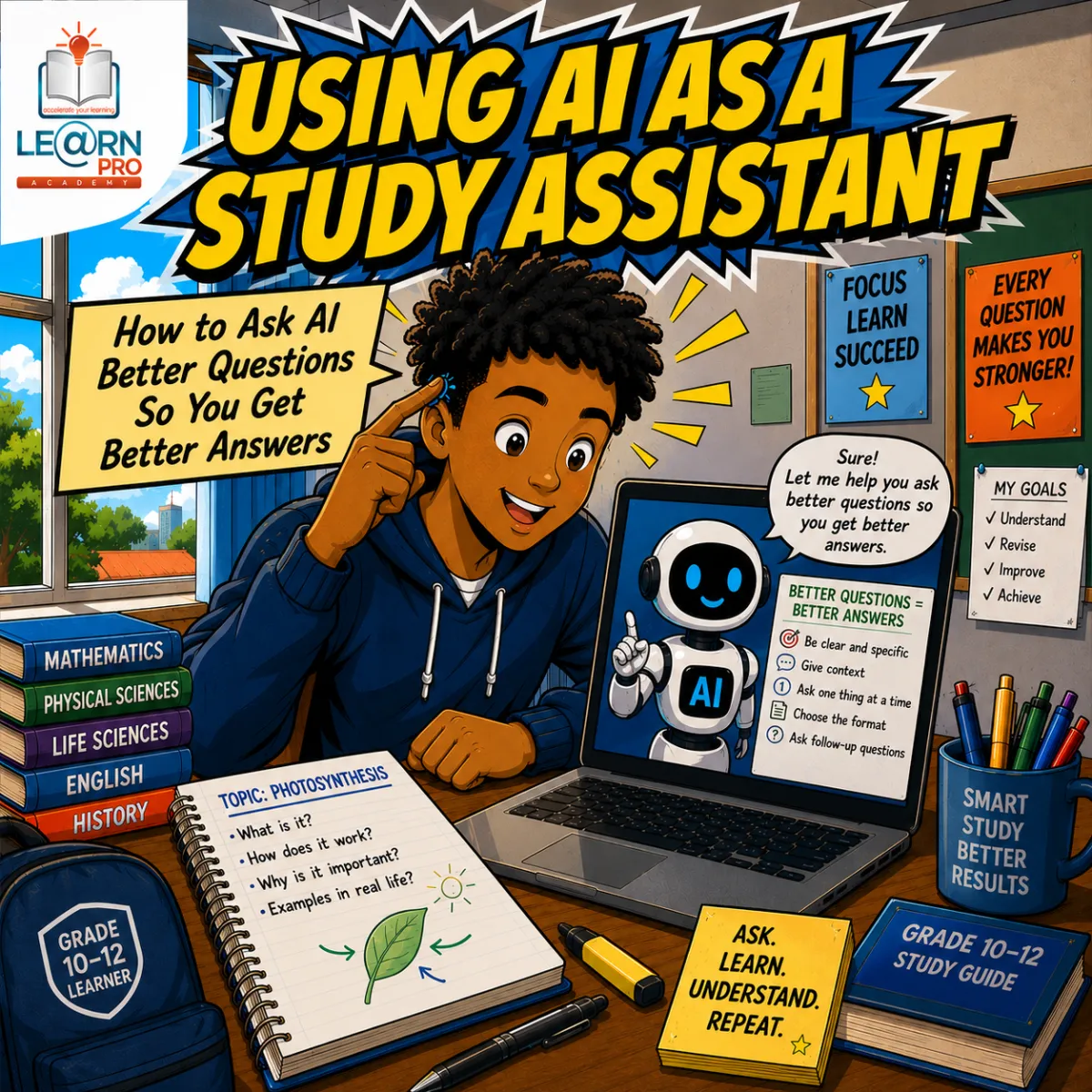
How to Ask AI Better Questions So You Get Better Answers
This is article #5 of 5 in the Using AI as a Study Assistant Series
Introduction
Artificial Intelligence (AI) has become one of the most exciting learning tools available to students today. Whether you need help understanding a difficult Mathematics problem, explaining a Life Sciences concept, summarising a History chapter, or creating revision questions, AI can provide useful support in just a few seconds.
However, many learners become disappointed when AI gives answers that are too short, too confusing, or completely different from what they expected.
Why does this happen?
In many cases, the problem is not the AI — it is the question that was asked.
Think about asking a teacher for help. If you simply say, "I don't understand," your teacher will probably ask you several follow-up questions.
Which subject?
Which chapter?
Which part is confusing?
What have you already tried?
The more information you provide, the easier it becomes for your teacher to help you.
AI works in much the same way.
The questions or instructions you give AI are called prompts. A prompt tells AI what you want it to do. The clearer and more detailed your prompt is, the more likely you are to receive a helpful answer.
Learning how to write good prompts is becoming an important skill for learners, students, and even professionals. It can save time, improve the quality of your schoolwork, and help you understand difficult topics more effectively.
In this article, you will learn how to ask AI better questions, write stronger prompts, avoid common mistakes, and use AI as a responsible learning partner throughout your school journey.
What Is A Prompt?
A prompt is simply the instruction or question you give to AI.
It tells the AI:
what you need
what topic you are studying
how much detail you want
how you would like the answer presented
Think of a prompt as giving directions.
Imagine someone asks you for directions to your school.
If they only ask: "Where is the school?"
You might not know:
where they are starting from
whether they are walking or driving
which entrance they need
whether they want the quickest or safest route
The more information they provide, the better your directions can be.
Exactly the same principle applies when using AI.
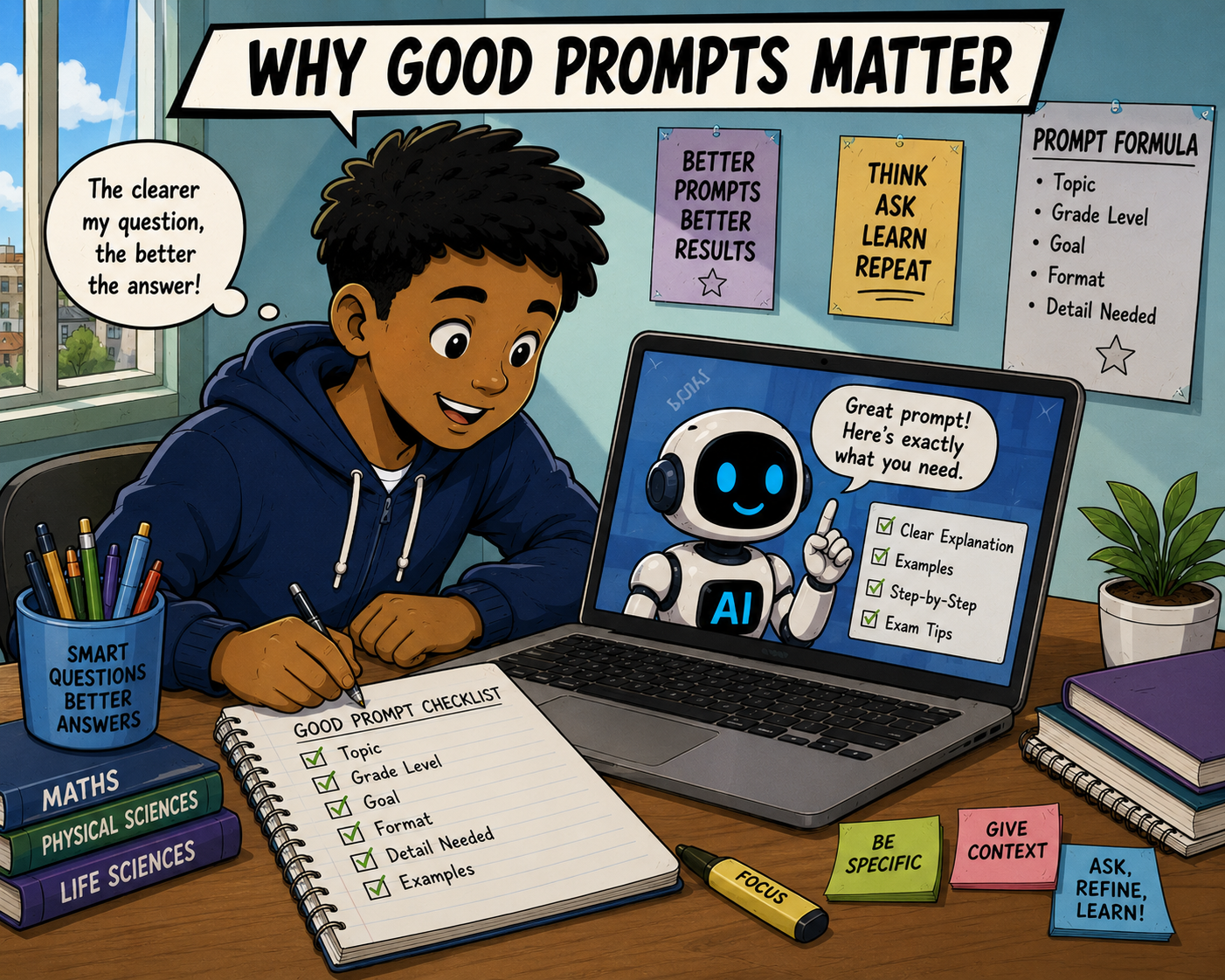
Why Good Prompts Matter
AI can only work with the information you provide. If your prompt is unclear, AI has to make assumptions. Sometimes those assumptions are correct. Sometimes they are not.
Good prompts help AI understand exactly what you need.
This usually leads to:
clearer explanations
more accurate answers
better examples
less confusion
fewer follow-up questions
faster learning
Learning to improve your prompts is one of the easiest ways to improve the quality of AI's responses.
Compare Weak Prompts With Strong Prompts
Let's look at some examples.
Weak Prompt
"Explain science."
This question is far too broad. Science includes many different subjects.
AI does not know whether you mean:
Biology
Chemistry
Physics
Earth Science
The answer will probably be very general.
Better Prompt
"Explain photosynthesis."
This is much better because it identifies the topic.
However, AI still does not know:
your grade
your level of understanding
whether you want a short or detailed explanation
Strong Prompt
"Explain photosynthesis in simple English for a Grade 10 learner. Include a real-life example and explain why it is important."
Now AI understands:
the topic
your grade level
the language level
the type of explanation you need
that you want an example
The answer is likely to be much more useful.
Always Include Your Grade Level
School subjects become more advanced every year. A Grade 10 explanation is very different from a Grade 12 explanation. If you do not mention your grade, AI may explain the topic at the wrong level.
For example:
Instead of asking: "Explain probability."
Ask: "Explain probability for a Grade 11 Mathematics learner using simple examples."
Including your grade helps AI match the explanation to your level of learning.
Mention The School Subject
Some words have different meanings in different subjects.
For example, the word "cell" could refer to:
Biology
prison
batteries
mobile phones
Instead of asking: "Explain cells."
Ask: "Explain animal cells for Grade 10 Life Sciences."
The more specific you are, the more accurate the response will be.
Explain Exactly What You Need
AI can perform many different tasks.
It can:
explain
summarise
compare
create quizzes
generate examples
write practice questions
solve problems
check grammar
create study plans
Tell AI exactly which task you want.
For example:
"Summarise this chapter."
"Create ten revision questions."
"Explain this diagram."
"Compare mitosis and meiosis."
"Rewrite this paragraph using simpler English."
Being clear saves time.
Say How You Want The Answer Presented
AI can present information in many different ways.
For example, you could ask for:
bullet points
numbered steps
tables
summaries
mind maps
question-and-answer format
flashcards
simple paragraphs
Imagine you are revising quickly before a test. Instead of receiving several long paragraphs, you might prefer bullet points.
For example: "Summarise this chapter using bullet points."
Or:
"Present the differences in a table."
Choosing the format makes studying easier.
Ask For Simple English
Many South African learners study in English even though it is not their first language. If an explanation feels too difficult, simply ask AI to simplify it.
For example: "Explain this topic using simple English suitable for a Grade 11 learner."
Or:
"Explain this as if you were teaching someone who is learning English as a second language."
This can make complex topics much easier to understand.
Tell AI What You Already Know
AI works even better when it understands your current level of knowledge.
For example: "I understand the definition of photosynthesis, but I do not understand why sunlight is necessary. Please explain only that part."
This prevents AI from repeating information you already know. It also allows the explanation to focus on your actual difficulty.
Give AI Enough Context
Context means providing background information.
For example, instead of asking: "Explain this."
You could say: "My teacher asked us to compare renewable and non-renewable energy sources. I understand renewable energy but need help understanding non-renewable energy. Please explain the differences using simple examples."
This gives AI much more information to work with.
Break Big Questions Into Smaller Ones
Sometimes learners ask extremely large questions.
For example: "Teach me all of Physical Sciences."
This is far too broad. Instead, divide the topic into smaller sections.
For example:
Explain atoms.
Explain elements.
Explain compounds.
Explain chemical reactions.
Working through one concept at a time makes learning much easier.
Ask Follow-Up Questions
One of AI's greatest strengths is that the conversation can continue. You do not need to start over every time. Suppose AI explains photosynthesis.
You can then ask: "Can you explain that using a real-life example?"
Or:
"Can you make the explanation shorter?"
Or:
"Can you explain only the part about chlorophyll?"
Each follow-up question improves your understanding. Learning becomes a conversation instead of a one-time answer.
Ask AI To Check Your Understanding
Instead of always asking AI to explain things, let AI test you.
For example: "Ask me five questions about photosynthesis without giving me the answers."
Or:
"Give me one question at a time and wait for my answer before giving the next question."
This changes you from a passive reader into an active learner. Testing yourself is one of the most effective ways to prepare for examinations.
Ask For Examples
Examples make learning much easier. Instead of asking: "Explain inflation."
Ask: "Explain inflation using a simple example that a Grade 11 learner can understand."
Examples connect new ideas to everyday experiences. This improves both understanding and memory.
Tell AI If You Are Preparing For A Test
Your goal affects the type of answer you need.
For example: "I have a Geography test next week. Please summarise this chapter and highlight the most important concepts I should revise."
Or: "I am preparing for my Grade 12 Business Studies exam. Please create exam-style practice questions."
AI can adapt its responses based on your purpose.
Use AI To Improve Your Own Work
AI is not only useful for learning new content. It can also help improve work you have already completed.
For example, ask: "Please check my paragraph for grammar mistakes."
Or: "How can I improve this essay introduction?"
Or: "Does this answer fully explain the question?"
Remember to use AI as a learning tool rather than simply copying its suggestions. Try to understand why improvements are being made.
Don't Be Afraid To Ask Again
Sometimes the first answer is not exactly what you wanted. That is perfectly normal. Instead of becoming frustrated, ask AI to improve its answer.
For example:
"Please make the explanation shorter."
"Can you explain this more simply?"
"Can you give another example?"
"Please explain this step by step."
Every new prompt helps AI understand your needs more clearly.
Build Better Prompts Step By Step
You do not need to write perfect prompts immediately. Start with a basic question. Then improve it by adding more detail.
For example:
Version 1
"Explain photosynthesis."
Version 2
"Explain photosynthesis for Grade 10."
Version 3
"Explain photosynthesis for a Grade 10 learner using simple English."
Version 4
"Explain photosynthesis for a Grade 10 learner using simple English. Include a labelled example and finish with five revision questions."
Notice how each version gives AI more useful instructions. Better prompts almost always produce better answers.
Build A Prompt Step By Step
One of the easiest ways to improve your AI results is to build your prompt one piece at a time. Think of your prompt as a set of instructions. The more useful instructions you provide, the better AI understands what you need. A good prompt usually includes several important parts.
The Topic
Tell AI exactly what you are studying.
For example:
Photosynthesis
The French Revolution
Quadratic Equations
Inflation
Supply and Demand
Avoid using words like:
"this"
"it"
"that chapter"
Be specific whenever possible.
Your Grade Level
Remember that a Grade 10 explanation is different from a Grade 12 explanation. Include your grade whenever possible.
For example: "Explain this for a Grade 11 learner."
Your Goal
Tell AI why you need the information.
Are you:
studying for an exam?
completing homework?
revising a chapter?
preparing a speech?
writing an assignment?
For example: "I am revising for my Grade 12 Life Sciences examination."
This helps AI focus its answer appropriately.
The Format
Choose how you want the information presented.
Examples include:
bullet points
numbered steps
summary
table
flashcards
practice questions
mind map
paragraph
Selecting the format can save you time because AI organises the information in a way that suits your study style.
The Level of Detail
Tell AI how detailed you want the answer to be.
For example:
one paragraph
one page
five key points
detailed explanation
short summary
This prevents answers from becoming too long or too brief.
Prompt Templates You Can Reuse
One of the best ways to learn prompt writing is to use simple templates. You can adapt these to almost any school subject.
Understanding A Topic
"Explain [topic] for a Grade [number] learner using simple English. Include one real-life example."
Example: "Explain supply and demand for a Grade 11 learner using simple English. Include one real-life example."
Summarising Notes
"Summarise these notes into one page using bullet points. Highlight the most important facts and definitions."
Preparing For A Test
"Create 15 revision questions based on this chapter. Start with easier questions and gradually make them more challenging."
Learning Vocabulary
"List the important keywords in this chapter and explain each one in simple English."
Comparing Concepts
"Compare [Topic A] and [Topic B] using a table. Highlight similarities and differences."
Checking Your Work
"Read my answer and tell me how I can improve it without rewriting everything for me."
This encourages learning rather than simply copying AI's work.
Ask AI To Teach You Step By Step
Some school topics involve several stages or calculations. Instead of asking for one large explanation, ask AI to teach you one step at a time.
For example: "Teach me how to solve quadratic equations. Explain the first step and wait until I understand before moving to the next one."
This creates an interactive learning experience. It also prevents information overload.
Ask AI To Explain Mistakes
One of the best ways to learn is by understanding your mistakes. Suppose you answer a Mathematics question incorrectly.
Instead of asking: "What's the correct answer?"
Try asking: "Please explain where I went wrong and show me how to avoid making this mistake again."
This develops problem-solving skills instead of simply providing answers.
Use AI To Create Different Levels Of Practice
As your understanding improves, your questions can become more challenging.
For example: "Give me five easy revision questions."
After completing those: "Now give me five medium-level questions."
Finally: "Now give me five examination-level questions."
This gradual progression helps build confidence while preparing you for more difficult assessments.
Ask AI To Use Real-Life Examples
Many learners remember information more easily when they can connect it to everyday life.
For example: "Explain inflation using examples from everyday shopping in South Africa."
Or: "Explain Newton's Laws using examples from sport."
Relating schoolwork to familiar experiences often makes concepts easier to understand and remember.
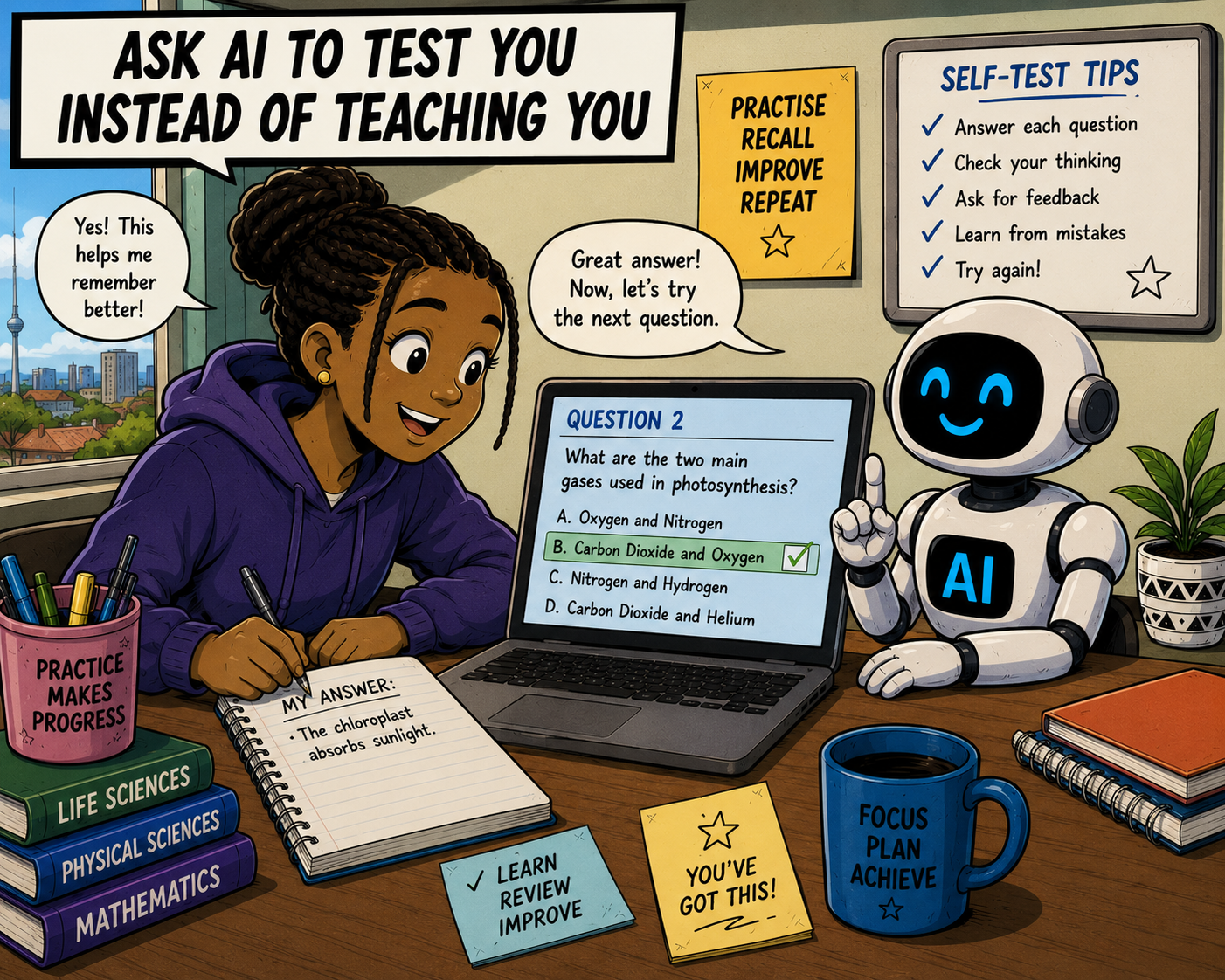
Ask AI To Test You Instead Of Teaching You
Sometimes you already understand the work but need practice recalling it. Ask AI to become your quiz partner.
For example: "Ask me ten Business Studies questions, one at a time. Wait for my answer before asking the next question."
Or: "Pretend you are my teacher and test me on this chapter."
This encourages active learning rather than passive reading.
Ask AI To Adapt To Your Learning Style
Different learners prefer different ways of learning. Some enjoy reading. Others learn better through examples, comparisons, or step-by-step explanations. Tell AI what works best for you.
For example: "I learn best through examples."
Or: "Please explain this using simple comparisons."
Or: "Teach me one small section at a time."
Personalising your prompts helps make learning more effective.
Common Prompt Mistakes To Avoid
Even experienced AI users sometimes make mistakes. Being aware of these common problems will help you get better results.
Mistake 1: Being Too Vague
Instead of asking: "Help me." Explain exactly what you need help with.
Mistake 2: Asking Several Unrelated Questions At Once
Avoid asking AI to explain five different chapters in one prompt. Work through one topic at a time.
Mistake 3: Forgetting Your Grade Level
Without your grade, AI may explain the topic at the wrong level.
Mistake 4: Expecting AI To Read Your Mind
AI only knows what you tell it. Provide enough detail for it to understand your request.
Mistake 5: Accepting Every Answer Without Checking
AI can sometimes make mistakes. Always compare important information with:
your textbook
class notes
teacher explanations
official study guides
A Practical Example
Let's see how prompt writing can improve AI responses.
First Attempt
Lebo asks: "Explain Geography."
AI gives a very broad answer covering many different topics. Lebo is still confused.
Second Attempt
Lebo asks: "Explain weather and climate."
The answer is better, but still quite general.
Third Attempt
Lebo asks: "I am a Grade 11 learner in South Africa studying Geography. Please explain the difference between weather and climate using simple English, include two real-life examples, and finish with five revision questions."
This time, AI understands exactly what Lebo needs. The answer is clear, practical, and much more useful.
The difference was not the AI. The difference was the quality of the prompt.
Build A Conversation With AI
Many learners think every prompt must start a completely new conversation. It does not. One of AI's greatest strengths is that you can continue asking questions about the same topic.
For example:
Learner: Explain ecosystems.
AI: Gives explanation.
Learner: Can you explain that more simply?
AI: Simplifies the explanation.
Learner: Can you give a South African example?
AI: Provides a local example.
Learner: Now create five revision questions.
AI: Creates questions.
Notice how each new prompt builds on the previous one. This creates a personalised learning experience.
Responsible AI Use
Learning how to write good prompts also means learning how to use AI responsibly. AI should support your education — not replace it.
Use AI to:
understand difficult concepts
organise your notes
summarise chapters
generate revision questions
improve your writing
explain mistakes
practise exam questions
Do not use AI to:
copy assignments without understanding them
cheat during tests or examinations
submit AI-generated work as your own
avoid reading your textbook
replace your teacher's guidance
The more honestly you use AI, the more valuable it becomes as a learning tool.
Becoming A Better Learner
Learning how to write effective prompts is about more than using technology. It is about learning how to think clearly.
When you create a good prompt, you are practising important skills such as:
asking thoughtful questions
identifying your learning needs
solving problems
communicating clearly
thinking critically
These skills will help you not only at school but also in university, the workplace, and everyday life.
As AI becomes more common across many careers, knowing how to communicate effectively with AI will become an increasingly valuable skill.
Final Thoughts
AI is one of the most powerful study tools available to today's learners, but its usefulness depends on how you use it. Asking vague or incomplete questions often leads to vague answers, while clear and detailed prompts help AI provide explanations that are accurate, relevant, and easy to understand.
The good news is that writing better prompts is a skill that anyone can learn. By including details such as your grade level, subject, learning goal, preferred format, and the level of detail you need, you can turn AI into a much more effective study partner. You can also build on each response by asking follow-up questions, requesting examples, generating practice questions, and asking AI to explain concepts in different ways until they make sense.
Remember that AI is there to support your learning, not replace it. Continue attending class, reading your textbooks, completing your own work, and asking your teachers for help when needed. When you combine responsible AI use with good study habits and thoughtful prompt writing, you will not only get better answers—you will become a more confident, independent, and successful learner.
Additional Articles in the AI as a Study Assistant Series
How to Use AI to Explain Difficult School Topics
Using AI to Create Practice Questions for Revision
How to Use AI to Summarise Long Notes and Textbook Chapters
Using AI to Build a Personal Study Plan for Tests and Exams
How to Ask AI Better Questions So You Get Better Answers
Disclaimer
AI Tools were used to assist with research. Remember to always cross-check everything that you read.