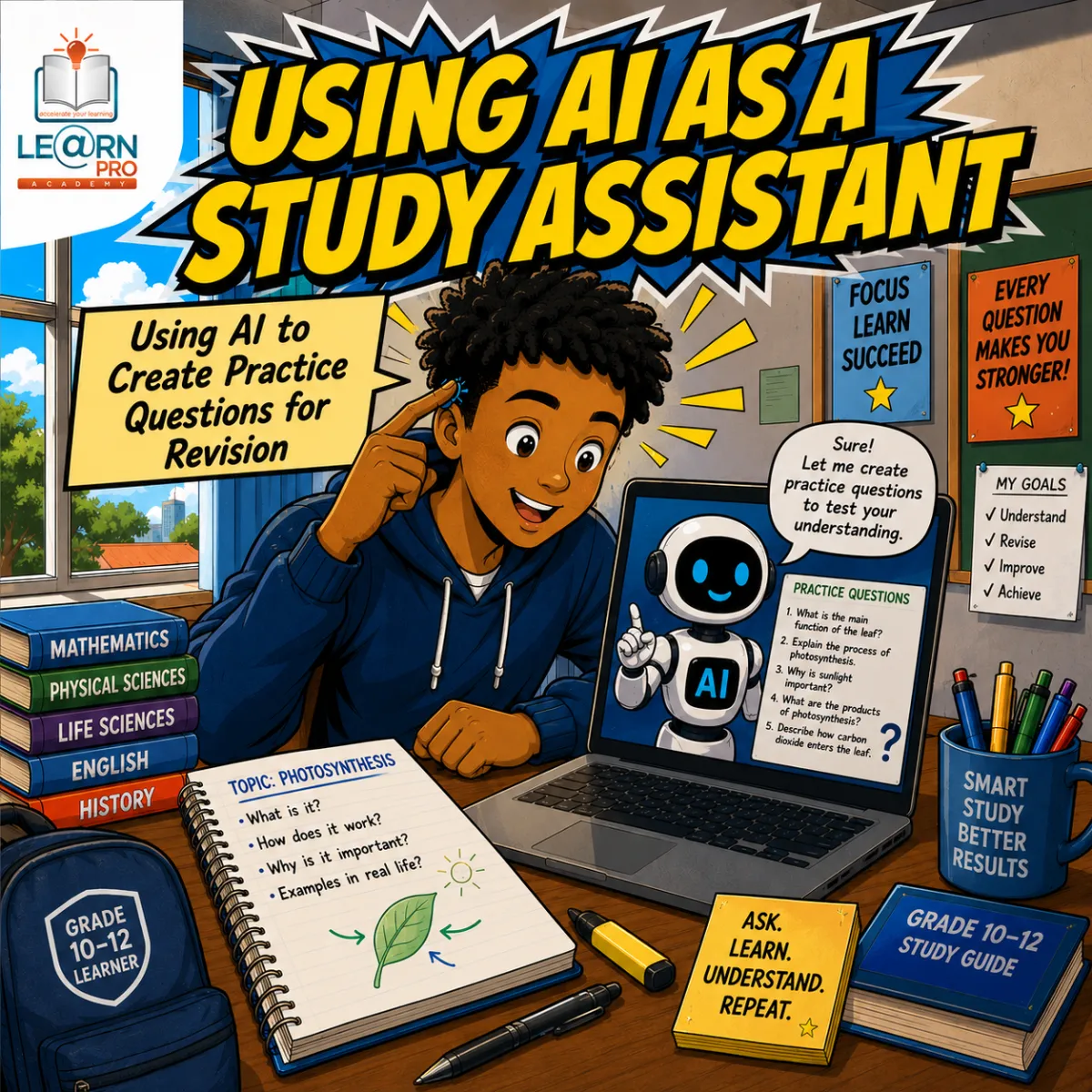
Using AI to Create Practice Questions for Revision
This is article #2 of 5 in the Using AI as a Study Assistant Series
Introduction
One of the best ways to prepare for a test or exam is to practise answering questions. Reading notes and textbooks is useful, but real learning becomes stronger when you test yourself. Practice questions help you check whether you truly understand the topic, remember important facts, and can apply what you have learned.
The problem is that many learners do not always have enough questions to practise with. A textbook may only include a few examples. A worksheet may only test one type of question. Past exam papers may not cover the exact topic you are revising. When that happens, revision can feel repetitive and limited.
This is where AI can be a very useful study assistant.
AI can help learners create extra practice questions from a topic, chapter, summary, or set of notes. It can generate multiple-choice questions, short-answer questions, definitions, calculations, essay prompts, and exam-style questions. This gives learners more chances to practise and check their understanding before a test or exam.
But there is an important difference between using AI to support revision and using AI to avoid learning. AI should not replace your own thinking. It should help you create more opportunities to practise, identify weak areas, and become more confident with school work.
This article will show learners how to use AI to create practice questions for revision in a smart, honest, and practical way. We will look at why practice questions matter, how to ask AI for useful questions, and how to use those questions effectively while studying.
Why Practice Questions Matter In Revision
Many learners spend hours reading notes, highlighting textbooks, and copying summaries. Those activities can help, but they are not always enough. A learner may feel familiar with the work and still struggle when the test question is asked in a different way.
Practice questions matter because they force you to do more than read. They make you retrieve information from memory and apply it to a question. This is a much stronger way to revise.
They Test Real Understanding
If you can answer a question without looking at your notes, it is a sign that you understand the topic. If you cannot answer it, you know where to focus your revision.
They Improve Memory
When you try to remember information, your brain strengthens the memory. This is called active recall, and it is one of the most effective study methods.
They Show You Your Weak Areas
Practice questions reveal which topics still need attention. Instead of revising everything equally, you can spend more time on the parts you find difficult.
They Prepare You For Exam Conditions
Tests and exams require you to answer questions under pressure. Practising beforehand helps you become familiar with question wording, marks, and timing.
They Build Confidence
The more questions you practise, the less nervous you may feel before an exam. Practice helps learners move from “I hope I know this” to “I have answered questions like this before.”
For these reasons, creating extra practice questions can make revision much more effective.
How AI Can Help You Create Practice Questions
AI can help learners generate additional questions quickly. Instead of waiting for a teacher or textbook to provide more examples, you can ask AI to create questions from the topic you are revising.
For example, if you are studying photosynthesis, you could ask AI to create:
multiple-choice questions
short-answer questions
diagram-labeling questions
exam-style questions
questions from easy to difficult
This gives you a larger pool of questions to practise with.
AI is especially useful when:
your textbook has too few examples
you want to revise one topic in depth
you need questions at different difficulty levels
you want to test yourself repeatedly
you want to identify which parts of the topic you still do not understand
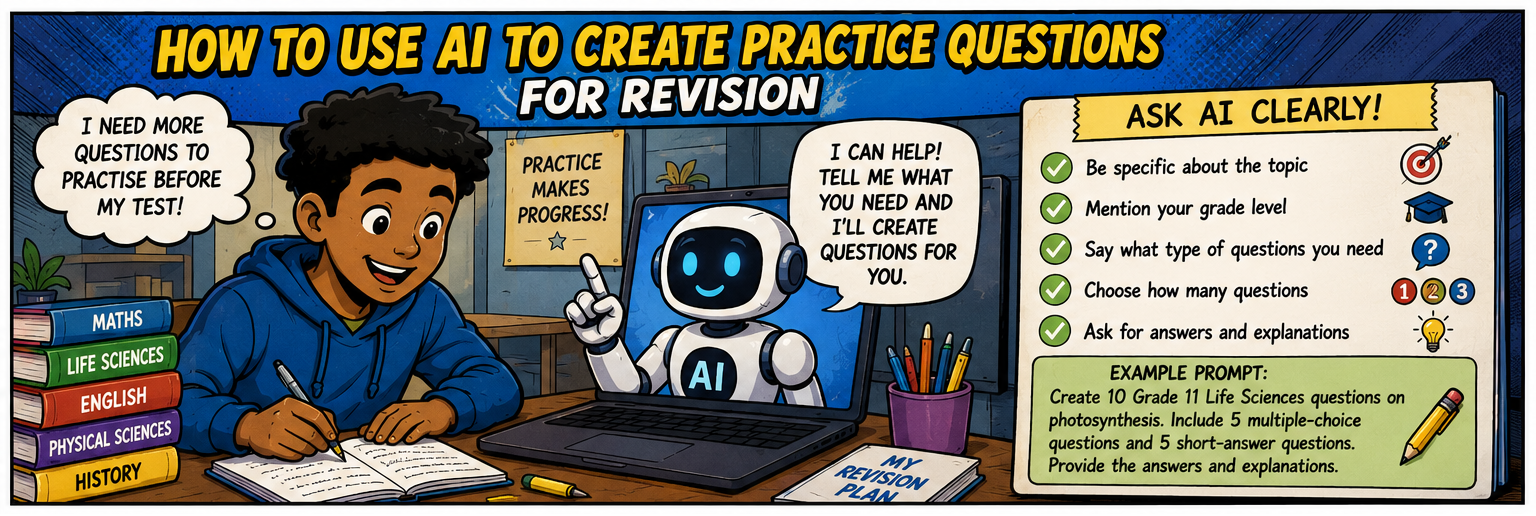
However, AI is most useful when you guide it clearly. A vague request such as “make questions” may give you weak results. A more specific request usually gives better practice questions.
Start With A Clear Topic
Before asking AI to create questions, decide exactly what topic you are revising. The more specific you are, the more useful the questions will be.
Instead of asking:
“Make revision questions for Science.”
Try asking:
“Create 10 Grade 11 Life Sciences questions on photosynthesis, including multiple-choice and short-answer questions.”
The second prompt is much better because it tells AI:
the grade level
the subject
the exact topic
the number of questions
the types of questions needed
This helps AI create questions that are more focused and suitable for your revision.
Ask For Different Types Of Questions
Good revision should not only include one kind of question. Different question types test different skills, and AI can help create a variety of them.
Multiple-Choice Questions
These are useful for checking definitions, facts, formulas, and quick understanding.
Example prompt: “Create 10 Grade 10 Geography multiple-choice questions on climate change, with four options each and the correct answer marked.”
Short-Answer Questions
These help learners explain ideas in their own words.
Example prompt: “Create 8 Grade 12 Business Studies short-answer questions on entrepreneurship, with brief model answers.”
Calculation Questions
These are useful for Maths, Accounting, Physical Sciences, and Economics.
Example prompt: “Create 5 Grade 11 Accounting calculation questions on cash flow statements, with step-by-step solutions.”
Essay Or Long-Answer Questions
These help learners practise organising ideas and writing complete answers.
Example prompt: “Create 3 Grade 12 History essay questions on the causes of World War II, with key points that should be included in the answer.”
Exam-Style Questions
These prepare learners for the wording and structure of real tests.
Example prompt: “Create 6 Grade 12 Life Sciences exam-style questions on DNA replication, with marks allocated and model answers.”
Using different question types makes revision more complete and prepares you for the variety of questions that may appear in an exam.
Use AI To Create Questions From Your Own Notes
One of the most powerful ways to use AI for revision is to turn your own notes into practice questions. This makes the questions more relevant to what you are actually studying.
You can copy a short summary, paragraph, or set of notes into AI and ask it to create questions from that content.
For example: “Using the notes below, create 10 revision questions for a Grade 11 learner. Include multiple-choice, short-answer, and exam-style questions.”
Then paste your notes below the prompt.
This method is useful because it:
focuses on the exact content you need to revise
turns passive notes into active practice
helps you see which parts of your notes are most important
creates questions that are closer to your school material
Just remember not to paste private information, full assignments, or copyrighted material that should not be shared. Use short summaries or your own notes when possible.
Ask AI To Include Answers And Explanations
Practice questions are most useful when you can check whether your answers are correct. AI can help by creating model answers, marking guides, or explanations.
For example: “Create 8 Grade 10 Maths questions on linear equations. After the questions, provide the correct answers and explain the working for each one.”
This is useful because it helps you:
check your answers immediately
understand why an answer is correct
learn from mistakes
see the method, not just the final answer
However, do not look at the answers too quickly. Try to answer the questions yourself first, then use the answers to check your work.
Make Questions Easier Or Harder
AI can also adjust the difficulty level of practice questions. This is useful because revision should build confidence gradually.
Start With Easier Questions
Easy questions help you review the basics and warm up your memory.
Prompt example: “Create 10 easy Grade 10 Physical Sciences questions on force and motion.”
Move To Medium Questions
Medium questions require more understanding and application.
Prompt example: “Create 8 medium-level Grade 11 Maths questions on quadratic equations.”
Finish With Harder Questions
Harder questions challenge you to think deeply and prepare for exam-level work.
Prompt example: “Create 5 challenging Grade 12 Economics questions on inflation and monetary policy, with model answers.”
This progression helps learners build confidence step by step instead of becoming discouraged by difficult questions too early.
Create A Mini Revision Quiz
AI can also create short quizzes that you can use for quick revision. A mini quiz is useful when you only have a short study session or want to test yourself quickly.
Prompt example: “Create a 10-question Grade 12 revision quiz on photosynthesis. Include multiple-choice and short-answer questions, then provide the answers after the quiz.”
Mini quizzes are useful because they:
save time
keep revision active
help you check understanding quickly
make studying feel less overwhelming
You can use mini quizzes before school, after class, or during exam revision to keep testing your memory.
Use AI To Find Weak Areas
Practice questions are not only for getting marks right. They are also useful for finding out what you still need to revise.
After answering AI-generated questions, ask yourself:
Which questions did I get wrong?
Which questions took me too long?
Which topics still feel confusing?
What mistakes did I repeat?
You can even ask AI for help with this: “Based on these questions, which topics should I revise more if I struggled with questions 3, 5, and 8?”
This turns practice questions into a feedback tool. Instead of revising everything equally, you can focus on the topics that need the most improvement.
Keep AI Revision Honest And Useful
AI can make revision easier, but it should still be used honestly. The goal is to create more opportunities to practise, not to avoid learning.
Good use of AI for revision includes:
creating extra practice questions
testing yourself before looking at answers
using model answers to learn from mistakes
identifying weak topics for further revision
creating quizzes for active recall
Poor use of AI includes:
copying answers without trying the questions
using AI to complete homework dishonestly
pretending AI-generated answers are your own work
relying on AI so much that you stop thinking for yourself
The best learners use AI as a tool to strengthen their own revision, not replace it.
In the next part of this article, we will look at how to use AI-generated questions effectively, how to create a full revision routine, and what mistakes to avoid when using AI for exam preparation.
Turn Practice Questions Into A Complete Study Routine
Creating practice questions is only the first step. To get the greatest benefit from them, you need to use them as part of a structured revision routine. Many learners make the mistake of generating dozens of questions but never answering them properly.
A good revision routine helps you move from simply reading information to actively using it. This strengthens your understanding and improves your ability to remember the work during a test or exam.
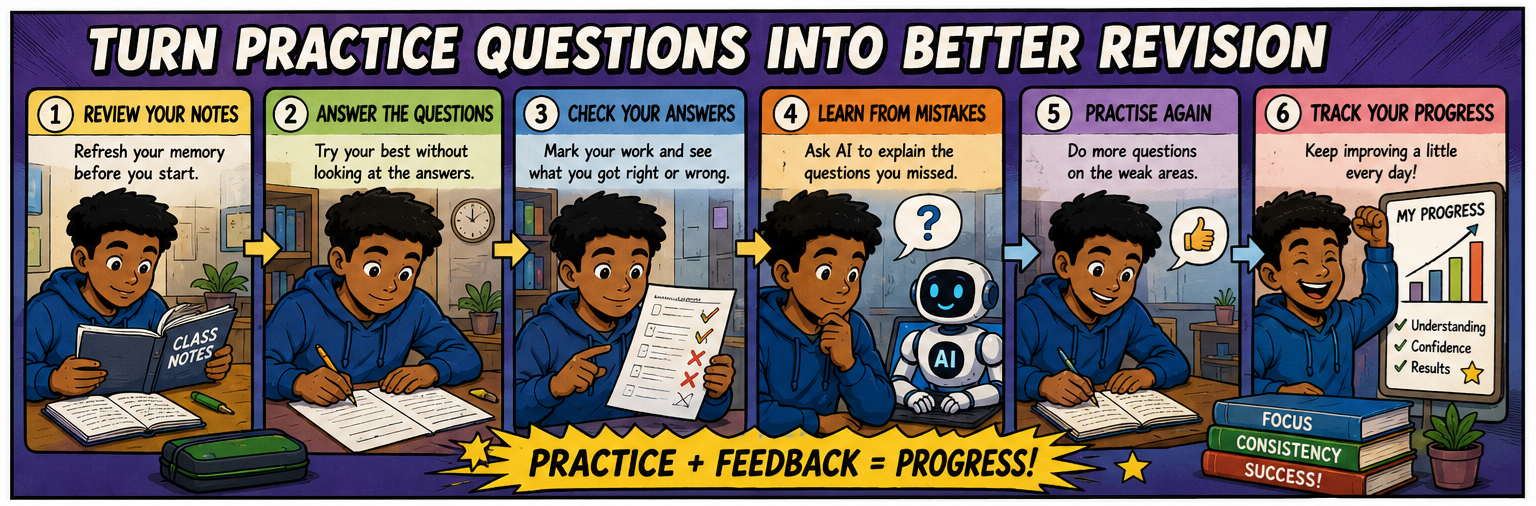
Here is an example of a practical revision routine that combines your school materials with AI.
Step 1: Review Your Class Notes
Start by reading the notes your teacher gave you. Review the important concepts, definitions, diagrams, formulas, or examples. This refreshes your memory before you begin answering questions.
Step 2: Ask AI To Create Practice Questions
Choose one topic and ask AI to generate questions that match your grade and subject.
For example:
"Create 12 Grade 11 Geography revision questions on river systems. Include multiple-choice, short-answer, and one longer exam-style question."
Limiting your revision to one topic at a time keeps your study session focused and manageable.
Step 3: Answer The Questions Without Looking At Your Notes
This is the most important step.
Resist the temptation to look up the answers immediately. Try your best to answer from memory.
Remember, revision is not about proving that you know everything already. It is about discovering what you still need to learn.
Step 4: Mark Your Work
Once you have completed the questions, compare your answers with the model answers provided by AI or with your textbook and class notes.
When you make a mistake, don't simply write down the correct answer.
Ask yourself:
Why did I get this wrong?
Which part did I misunderstand?
Was it a knowledge mistake or a careless mistake?
Learning from mistakes is one of the fastest ways to improve.
Step 5: Ask AI To Explain Incorrect Answers
If you answered a question incorrectly, AI can become your tutor.
For example:
"I answered Question 6 incorrectly. Please explain why my answer is wrong and show me how to arrive at the correct answer."
This helps you understand the thinking process instead of simply memorising the correct answer.
Step 6: Repeat The Process
After revising another topic, repeat the cycle.
Over time, this routine helps build both knowledge and confidence.
Ask AI To Mix Different Topics Together
One challenge learners face during exams is that questions often cover several topics at once.
For example, a Physical Sciences question may require knowledge from multiple chapters.
A Business Studies case study may include concepts from marketing, finance, and entrepreneurship.
Instead of always practising one chapter at a time, ask AI to mix topics together.
For example:
"Create a mixed Grade 12 Life Sciences revision test using questions from genetics, evolution, and DNA replication."
Or:
"Create a mixed Grade 11 Accounting quiz covering journals, ledgers, and trial balances."
Mixed-topic revision prepares your brain to switch between different concepts, just as you will need to do in a real examination.
Use AI To Create Timed Revision Tests
Knowing the work is one thing.
Answering questions within the available time is another.
Many learners understand the content but run out of time during exams.
AI can help you practise under realistic conditions.
For example:
"Create a 30-minute Grade 12 Economics revision test with marks allocated for each question."
Or:
"Generate a 45-minute Maths revision paper on algebra and functions."
Set a timer and complete the questions without interruptions.
When the time is finished, mark your work honestly.
Timed practice helps you:
improve your speed
manage exam pressure
become familiar with question pacing
reduce anxiety on exam day
Create Questions That Become More Difficult
Not every question should be equally challenging.
A good revision session gradually increases in difficulty.
Ask AI to organise questions into three levels.
Level 1: Easy Recall Questions
These test basic facts and definitions.
Examples include:
Define photosynthesis.
What is inflation?
What is Newton's Second Law?
These help refresh your memory.
Level 2: Application Questions
These require you to use your knowledge.
Examples include:
Explain why increasing temperature affects the rate of photosynthesis.
Calculate the missing value.
Interpret the graph.
These develop deeper understanding.
Level 3: Exam Challenge Questions
These combine several ideas.
Examples include:
Analyse the case study.
Compare two theories.
Solve a multi-step calculation.
Evaluate a business decision.
Working through questions from easy to difficult helps build confidence while preparing you for more demanding exam questions.
Let AI Create Questions In Different Formats
School assessments use many different styles of questions.
AI can help you practise them all.
Ask for:
Multiple-choice questions
True or false questions
Fill-in-the-blank questions
Matching-column questions
Diagram-label questions
Case studies
Data interpretation questions
Essay questions
Practical scenario questions
Practising different formats prevents you from becoming comfortable with only one style of questioning.
Turn Mistakes Into New Practice Questions
One of the smartest ways to revise is to learn directly from your mistakes.
Suppose you repeatedly struggle with quadratic equations.
Instead of moving on, ask AI:
"I keep making mistakes with quadratic equations. Please create another 15 practice questions that focus only on this topic."
Or:
"These are the questions I answered incorrectly. Please create similar questions so I can practise until I understand them."
This targeted practice helps strengthen weak areas much faster than revising everything equally.
Revise With Friends Using AI
Studying with classmates can make revision more enjoyable and productive.
AI can support group study sessions in several ways.
For example, ask AI to:
create a classroom quiz
generate a revision competition
prepare a rapid-fire question round
create discussion questions
prepare debate topics for subjects like History or Life Orientation
Each learner can answer different questions and explain their reasoning to the group.
Teaching someone else is one of the best ways to strengthen your own understanding.
Adapt Questions To Your Learning Style
Not every learner studies in the same way.
AI can generate questions that suit different learning preferences.
If you enjoy visual learning, ask for questions based on diagrams or flowcharts.
If you prefer reading, ask for paragraph-based questions.
If you enjoy problem solving, request calculation or scenario questions.
If you learn through discussion, ask AI to generate questions that encourage explanation rather than memorisation.
The more personalised your revision becomes, the more effective it often is.
Keep Improving Your AI Prompts
As you become more comfortable using AI, your prompts should become more detailed.
Compare these examples.
Weak Prompt
"Make revision questions."
Better Prompt
"Create 15 Grade 12 Business Studies revision questions on leadership styles. Include five multiple-choice questions, five short-answer questions, and five exam-style questions. Provide the answers separately after the questions."
Excellent Prompt
"Create a Grade 12 Business Studies revision paper on leadership styles that takes approximately 30 minutes to complete. Include a marking guideline, marks for each question, and explanations for every answer. Make the questions similar to those found in South African examinations."
Notice how each version becomes clearer.
The better your prompt, the better your revision material becomes.
Important Things To Remember When Using AI
Although AI is a powerful learning tool, it is not perfect.
Keep these points in mind.
AI Can Make Mistakes
Sometimes AI produces incorrect facts or calculations.
Always compare important information with:
your teacher's notes
your prescribed textbook
official study guides
past examination papers
Never assume AI is always correct.
AI Does Not Know Your Exact Curriculum
Different schools and examination boards may teach topics differently.
Some AI-generated questions may include material that is outside your syllabus.
If a question looks unfamiliar, check whether it belongs to your curriculum before spending time studying it.
Quality Is Better Than Quantity
Generating 200 questions does not guarantee better learning.
Answering 20 carefully chosen questions properly is often more valuable than rushing through hundreds without thinking.
Focus on understanding rather than simply completing as many questions as possible.
Common Mistakes Learners Should Avoid
There are several mistakes that reduce the value of AI-assisted revision.
Looking At The Answers Too Soon
Give yourself enough time to think before checking the solution.
Your brain learns much more when it has to retrieve information.
Copying Model Answers
The goal is to understand the answer, not memorise someone else's wording.
Try writing your own answer first.
Ignoring Incorrect Answers
Wrong answers are valuable because they show you exactly where to improve.
Don't feel discouraged by mistakes.
Use them as learning opportunities.
Using Only AI Questions
AI should complement your school resources.
Continue using:
class notes
homework
textbooks
previous tests
past examination papers
These remain essential parts of successful revision.
Revising Only Your Favourite Subjects
It is easy to spend more time on subjects you enjoy.
Use AI to give extra attention to the subjects you find most difficult.
That is where the greatest improvement usually happens.
A Practical Example Of AI Revision
Imagine Sipho is preparing for a Grade 11 Life Sciences test on photosynthesis.
Instead of reading the chapter repeatedly, he follows this routine:
Reviews his class notes for 20 minutes.
Asks AI to create 15 mixed revision questions.
Answers every question without using his notes.
Marks his work using the model answers.
Identifies that he struggles with limiting factors.
Asks AI to explain limiting factors in simpler language.
Requests another 10 questions focusing only on limiting factors.
Answers the new questions.
Finishes by asking AI to create a short timed quiz.
By the end of the session, Sipho has not only read the work—he has actively practised it, identified his weaknesses, corrected his mistakes, and strengthened his understanding.
This is a much more effective use of study time than simply reading the chapter repeatedly.
Final Thoughts
Revision is not about reading the same notes over and over again. It is about challenging your brain to remember, apply, and explain what you have learned. Practice questions are one of the most effective ways to do this because they transform passive studying into active learning.
AI makes this process easier by helping learners create an almost unlimited supply of revision questions. Whether you need multiple-choice questions, short-answer questions, calculations, essay topics, or full exam-style papers, AI can generate additional opportunities to practise and improve.
However, remember that AI is only a tool. It cannot replace your effort, your teacher, or your own thinking. The greatest benefit comes when you answer the questions honestly, learn from your mistakes, ask AI to explain difficult concepts, and continue practising until you feel confident.
Used responsibly, AI becomes more than a question generator. It becomes a personal revision assistant that helps you study smarter, identify weak areas, and prepare more effectively for tests and exams.
The next time you begin revising, don't just read your notes. Challenge yourself with new questions, test your understanding, and use AI to help you become a more confident and independent learner.
Additional Articles in the AI as a Study Assistant Series
How to Use AI to Explain Difficult School Topics
Using AI to Create Practice Questions for Revision
How to Use AI to Summarise Long Notes and Textbook Chapters
Using AI to Build a Personal Study Plan for Tests and Exams
How to Ask AI Better Questions So You Get Better Answers
Disclaimer
AI Tools were used to assist with research. Remember to always cross-check everything that you read.