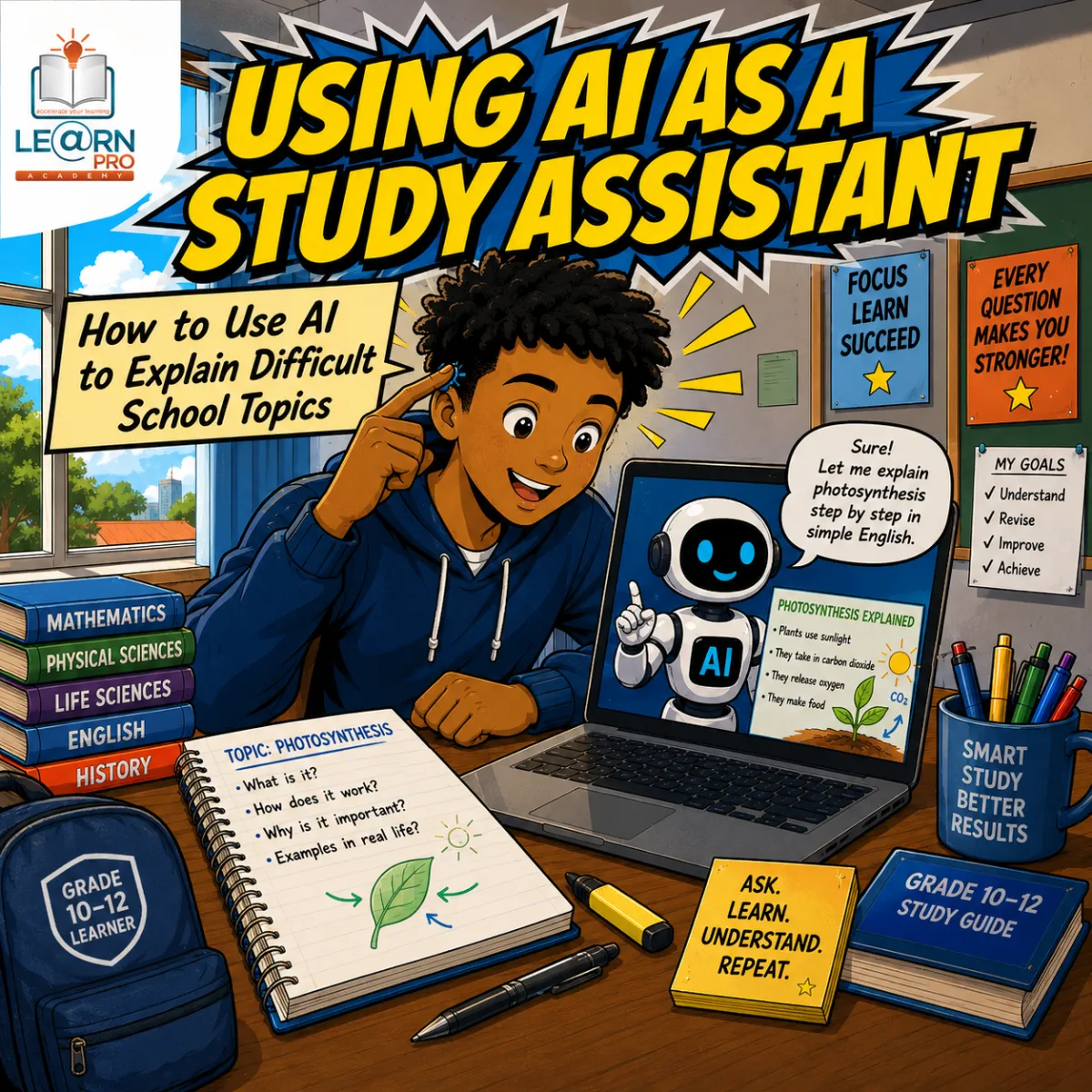
How to Use AI to Explain Difficult School Topics
This is article #1 of 5 in the Using AI as a Study Assistant Series
Introduction
Sometimes school work feels difficult not because you are lazy or “bad at the subject,” but because the explanation you got did not connect with the way you learn. A teacher may explain a concept quickly in class. A textbook may use formal language that feels heavy and confusing. A worksheet may jump straight into questions before you really understand the idea behind them. When that happens, many learners get stuck, frustrated, or tempted to memorise work without actually understanding it.
This is one of the areas where AI can be genuinely helpful.
Used properly, AI can act like a study assistant that explains difficult school topics in a different way. It can simplify a paragraph, break a process into steps, give an example, compare one idea to another, or explain a concept in language that feels easier to follow. It can also keep helping when you need the explanation repeated in a new way. That matters because learning often takes more than one explanation.
But there is an important warning here: AI should help you understand the work, not help you avoid the work.
If you use AI to do your thinking for you, copy answers, or complete homework without learning anything, it may save time today but it will hurt you later in tests, exams, assignments, and real life. The real value of AI is not that it gives you an answer. The real value is that it can help you move from “I don’t get it” to “Now I understand how this works.”
This article will show you how to use AI to explain difficult school topics in a smart, practical, and honest way. We will look at when AI can help, how to ask better questions, what to do when the first answer still doesn’t make sense, and how to make sure you are learning instead of becoming dependent on technology.
Why Difficult Topics Feel So Hard In The First Place
Before looking at AI, it helps to understand why some topics feel so confusing.
Many learners assume that if they do not understand something immediately, it means they are not clever enough. That is usually not true. In many cases, the real problem is one of the following:
The Explanation Uses Language That Is Too Complicated
School subjects often use formal words, technical terms, and long textbook-style sentences. If English is not your first language, the problem becomes even bigger. Sometimes you are trying to learn the subject and decode the language at the same time.
The Topic Builds On Earlier Knowledge
A lot of school work is connected. If you missed an earlier concept, the new topic may feel impossible. For example, if you struggle with fractions, algebra may become difficult. If you do not understand cell structure, genetics may feel confusing later.
The Teacher’s Explanation Style Does Not Match The Way You Learn
Some learners understand best when they see a diagram. Others need a real-life example. Others need a slow, step-by-step explanation. A teacher may be good, but their explanation may still not click for you personally.
The Work Moves Too Fast
In class, teachers often have to keep moving because they must finish the syllabus. That means there is not always time to stop and explain one idea five different ways. If you fall behind, the gap grows quickly.
You Panic As Soon As The Work Looks Hard
Sometimes the problem is not only the content. It is also the emotional reaction. You see a difficult Maths problem or a long Physical Sciences paragraph and immediately think, “I’ll never understand this.” That stress makes it even harder to focus.
This is where AI can help. It does not replace your teacher, your notes, or your effort. But it can give you another explanation, another example, and another way into the topic.
What AI Can Actually Help You Do
When people hear “use AI for school,” they sometimes imagine cheating, copying, or getting a machine to do homework. That is not the goal here. A good use of AI is much more practical than that.
AI can help you with difficult school topics by doing things like these:
It Can Explain A Topic In Simpler Language
If your textbook explanation feels too formal or complicated, you can ask AI to explain it in plain English, in simpler words, or at a Grade 10, 11, or 12 level.
It Can Break A Big Idea Into Smaller Steps
Many topics are confusing because they arrive all at once. AI can split a concept into parts and walk through it one step at a time.
It Can Give Examples
Sometimes a definition makes no sense until you see an example. AI can create examples, sample questions, mini scenarios, or simple practice situations to make the concept more concrete.
It Can Compare Similar Ideas
A lot of confusion comes from mixing up related concepts. For example:
mitosis vs meiosis
metaphor vs simile
speed vs velocity
current vs voltage
democracy vs dictatorship
AI can explain the difference between these ideas side by side.
It Can Re-Explain The Same Topic In A Different Way
If the first explanation still does not make sense, you can ask AI to explain it again more simply, more visually, more slowly, or with a different example.
It Can Help You Identify What You Don’t Understand
Sometimes learners say, “I don’t understand this whole chapter,” when the real problem is only one small part. AI can help you narrow the problem down.
These are all useful study tasks because they support understanding. They do not replace learning. They support it.
Start With The Right Mindset: AI Is A Tutor, Not A Shortcut
If you remember only one thing from this article, let it be this:
Use AI to help you think, not to help you avoid thinking.
That mindset changes everything.
If you open an AI tool and type:
“Give me the answer”
“Do this homework for me”
“Write my assignment”
“Solve this without explaining”
you are using AI like a shortcut. That may feel helpful in the moment, but it weakens your learning.
A better approach is to ask:
“Please explain this topic in simpler language.”
“Break this question into steps and show me how to start.”
“I don’t understand why this answer works. Can you explain it?”
“Give me a similar example so I can practise.”
That approach keeps you in the learning process.
Think of AI as a study partner that is available when you need support. It can explain, guide, simplify, and question. But it cannot replace your own reading, thinking, practising, and checking.
If you use it well, AI becomes like a tutor who sits next to you and says, “Let’s work through this together.”
If you use it badly, it becomes a crutch that stops you from developing your own ability.
When AI Is Most Useful For Difficult School Topics
AI is not equally useful for every study task. It works best in certain situations.
When You Understand The Topic Name But Not The Meaning
For example, maybe you know that you are studying “photosynthesis” or “trigonometric ratios,” but the explanation still feels unclear. AI can help unpack the meaning.
When The Textbook Explanation Feels Too Heavy
Textbooks often contain good information, but they are not always learner-friendly. AI can translate a difficult paragraph into simpler language.
When You Need A Topic Broken Into Steps
This is especially useful in subjects like Maths, Physical Sciences, Accounting, and Life Sciences, where one process leads to another.
When You Need More Than One Example
If your notes only contain one example and it still does not make sense, AI can create extra examples to help you practise the same idea.
When You Need To Prepare Before Asking A Teacher
Sometimes learners are embarrassed to ask for help because they feel they do not even know what to ask. AI can help you clarify your confusion first, so that when you speak to your teacher, your question is more focused.
When You Are Revising And Need A Quick Refresher
If you learned a topic weeks ago and now need a quick explanation before revision, AI can help you review the basics.
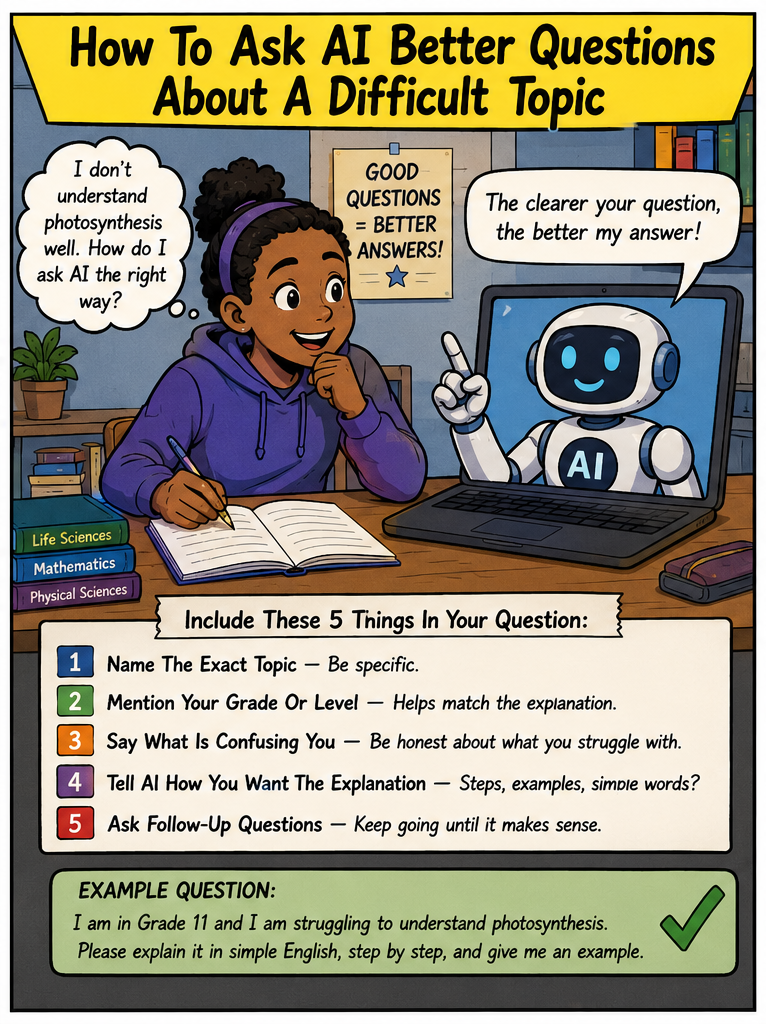
How To Ask AI Better Questions About A Difficult Topic
The quality of the answer you get often depends on the quality of the question you ask. If your prompt is vague, the answer may also be vague. If your prompt is specific, the answer is usually more useful.
Compare these two prompts:
Weak prompt:
“Explain Maths.”
That is too broad. AI does not know what part of Maths you mean.
Better prompt:
“I am in Grade 11 and I am struggling to understand simultaneous equations. Please explain what simultaneous equations are in simple English, step by step, and give one worked example.”
The second prompt is better because it tells the AI:
your level
the exact topic
what kind of explanation you want
the level of detail you need
A good prompt usually includes some of the following:
1. Name The Exact Topic
Do not say “I don’t understand Science.” Say exactly what part you are struggling with.
For example:
“I don’t understand balancing chemical equations.”
“I’m struggling with the theme of conflict in this poem.”
“I don’t understand how to calculate gross profit.”
“I’m confused about the difference between weather and climate.”
2. Mention Your Grade Or Level
This helps AI pitch the explanation at the right difficulty level.
For example:
“Explain this for a Grade 10 learner.”
“I’m in Grade 12. Keep the explanation at Grade 12 level but use simple language.”
3. Say What Is Confusing You
Try to name the part that feels difficult.
For example:
“I understand the definition, but I don’t understand how to use it in a question.”
“I can see the formula, but I don’t know when to use it.”
“I understand the process up to step 2, but after that I get lost.”
4. Tell AI How You Want The Explanation
This is one of the most powerful things you can do.
You can ask for:
a simple explanation
a step-by-step explanation
a real-life example
a comparison between two ideas
a worked example
a summary first and then more detail
an explanation in bullet points
an explanation using an analogy
5. Ask Follow-Up Questions
You do not have to stop after one answer. If the first answer is still confusing, keep going.
For example:
“Explain that more simply.”
“Give me a real-life example.”
“Show me what step 3 means.”
“Can you compare this with another topic I already know?”
“Pretend you are teaching a learner who is seeing this for the first time.”
A Simple Prompt Formula Learners Can Use
If you are not sure how to ask for help, use this formula:
“I am in Grade __ and I am struggling with __. Please explain it in simple language. Break it into steps, give me an example, and then ask me 3 short questions to check if I understand.”
Here are some examples.
Example 1: Maths
“I am in Grade 10 and I am struggling with factorising quadratic expressions. Please explain what factorising means in simple language, show me the steps, and give me two examples.”
Example 2: Life Sciences
“I am in Grade 11 and I don’t understand photosynthesis. Please explain it in simple English, show the process step by step, and use a plant example.”
Example 3: Accounting
“I am in Grade 12 and I’m confused about cash flow statements. Please explain what they show, why they matter, and give me a simple example using a small business.”
Example 4: English
“I am in Grade 11 and I don’t understand personification in poetry. Please explain what it is, give me three simple examples, and show me how to identify it in a poem.”
This kind of prompt is much stronger than “Explain this” because it gives direction.
Ask AI To Explain The Topic In More Than One Way
One of the best things about AI is that it can explain the same concept from different angles. That matters because learning is not one-size-fits-all.
If the first explanation does not help, try one of these follow-up requests:
“Explain It Like I’m New To The Topic”
This is useful when you feel completely lost and need the basics.
“Use Simpler English”
Very helpful if the explanation contains too many formal words.
“Give Me A Real-Life Example”
This helps when the concept feels too abstract.
“Show Me A Worked Example”
Perfect for subjects like Maths, Accounting, Physical Sciences, and Economics.
“Compare It To Something Similar”
Useful when you keep mixing two concepts up.
“Explain It In Bullet Points”
Helpful when a long paragraph feels overwhelming.
“Teach It Step By Step”
This is often the best option for processes, calculations, and cause-and-effect topics.
For example, imagine you are struggling with photosynthesis. You could ask AI to:
explain the definition in simple English
explain the process step by step
compare photosynthesis and respiration
give a labelled summary of the inputs and outputs
create 5 practice questions to test your understanding
That is a much richer learning process than simply asking for a short definition and moving on.
Use AI To Translate “School Language” Into Everyday Language
One of the biggest reasons learners struggle is that school content often sounds formal, academic, and distant from everyday life. AI can be useful because it can translate that language into something more understandable.
For example, a textbook might say:
“Photosynthesis is the process by which green plants synthesise glucose from carbon dioxide and water in the presence of sunlight and chlorophyll.”
That sentence is accurate, but it may feel heavy if you are already struggling.
You could ask AI:
“Rewrite this definition in simple English.”
“Explain this definition like I’m 16 years old.”
“Which words in this definition are the most important?”
“Explain each keyword in this definition.”
AI might then help you understand that photosynthesis is basically the way plants use sunlight to make their own food. That simpler explanation does not replace the official definition, but it helps you understand what the definition means.
This is especially helpful in subjects like:
Life Sciences
Geography
History
Economics
Business Studies
Physical Sciences
These subjects often use academic language, and AI can help bridge the gap between textbook wording and learner understanding.
Use AI To Break Big Topics Into Smaller Parts
Large topics often feel difficult because they are too big to hold in your head all at once. AI can help by breaking them into manageable parts.
Let’s say you are studying DNA replication. Instead of trying to understand the whole chapter at once, you can ask AI to split it up like this:
What is DNA?
Why does DNA need to replicate?
When does replication happen?
What are the steps of replication?
Which enzymes are involved?
What mistakes do learners usually make in questions about DNA replication?
That turns one scary topic into a set of smaller questions.
The same method works in many subjects:
Maths
Instead of “Teach me algebra,” break it down:
What is a variable?
What is an equation?
What does it mean to solve for x?
How do I move terms across the equals sign?
Can you give me one-step, two-step, and harder examples?
History
Instead of “Explain apartheid,” break it down:
What was apartheid?
When did it start?
What laws supported it?
How did it affect education, movement, and work?
What resistance movements opposed it?
Accounting
Instead of “Explain financial statements,” break it down:
What is an income statement?
What is a balance sheet?
What is a cash flow statement?
Why are they different?
What questions do exams ask about them?
Breaking topics down makes learning feel possible.
Use AI To Build From What You Already Know
Good learning does not always start from zero. Often, the best explanation is one that connects a new topic to something you already understand.
You can ask AI to do that directly.
Try prompts like:
“Explain momentum using a soccer example.”
“Compare electrical circuits to water flowing through pipes.”
“Explain inflation using the price of groceries.”
“Teach me probability using cards or dice.”
“Explain the digestive system like a food journey through the body.”
When a topic connects to something familiar, it becomes less abstract and easier to remember.
This strategy is especially useful if you learn well through:
stories
comparisons
visuals
real-world examples
practical situations
It can also help you study in a way that feels less intimidating.
Let AI Check Your Understanding, Not Just Give Explanations
One mistake learners make is using AI only as a one-way information machine. They read the explanation and move on without checking whether they actually understood it.
A smarter approach is to ask AI to test you after the explanation.
For example, after learning a topic, ask:
“Ask me 5 short questions about this topic.”
“Give me a mini quiz on what you just explained.”
“Ask me one question at a time and tell me if my answer is correct.”
“Give me 3 exam-style questions from easiest to hardest.”
This matters because understanding often feels stronger than it really is. You may read an explanation and think, “Yes, I get it,” but when you try to answer a question on your own, you realise there are still gaps.
Testing yourself helps expose those gaps early.
A good learning cycle looks like this:
Read the topic or look at the class notes
Ask AI to explain the confusing part
Ask AI for a worked example
Try a question on your own
Ask AI to check your answer or explain your mistake
Do another question without help
That process is much stronger than just reading one explanation and hoping for the best.
Subjects Where This Works Especially Well
AI can support most school subjects, but the way you use it may differ depending on the subject.
Maths
AI can:
explain formulas in simple language
break methods into steps
show worked examples
explain where learners usually make mistakes
create similar practice questions
Important: do not just copy the solution. Try the problem yourself after the explanation.
Physical Sciences
AI can:
explain concepts like force, energy, acids and bases, or circuits
simplify definitions
explain formulas and variables
connect theory to real-life examples
walk through calculations step by step
Important: always check calculations and terminology against your textbook or teacher’s method if possible.
Life Sciences
AI can:
explain processes like respiration, photosynthesis, meiosis, and DNA replication
summarise large chunks of theory
compare concepts side by side
explain diagrams and biological terms more simply
Important: use AI to understand the process, not just memorise definitions.
English And Other Languages
AI can:
explain figurative language, themes, tone, character development, and essay structure
simplify difficult passages
help you understand poems and stories
give examples of language devices
Important: do not let AI do all your interpretation for you. Your own reading and evidence from the text still matter.
Accounting, Economics, And Business Studies
AI can:
explain terms in plain language
show how concepts work in real business situations
compare related ideas
create short examples and case studies
help you understand the “why” behind the topic
Important: always make sure your examples and explanations fit the syllabus you are actually studying.
How To Tell If AI’s Explanation Is Actually Good
Not every AI answer is useful. Sometimes the answer is too vague, too advanced, too wordy, or even inaccurate. That means you need to read with your brain switched on.
A good AI explanation usually does these things:
answers the exact question you asked
uses clear language
stays focused on the topic
gives examples when needed
explains the process logically
does not jump over important steps
makes you feel more clear, not more confused
A weak explanation often:
sounds clever but says very little
uses too many difficult words
skips from the problem to the answer too quickly
gives facts without helping you understand them
includes examples that do not match your grade level
If the explanation is not good enough, do not just accept it. Ask for a better version.
You can say:
“This is still too difficult. Please simplify it.”
“You skipped a step. Explain the middle part.”
“Use a Grade 11 example.”
“Make it shorter and clearer.”
“Turn this into bullet points.”
“Give me one worked example and then one question to try myself.”
Important Warning: AI Can Be Wrong
This is one of the biggest reasons you should never trust AI blindly.
AI tools can make mistakes. They can:
give wrong facts
use the wrong formula
misread your question
sound confident even when the answer is incorrect
explain something in a way that does not match your school curriculum
So how do you protect yourself?
Compare The Answer With Your Notes
If your teacher gave notes, a memo, or a worksheet, use them to check whether the AI explanation fits.
Use Your Textbook As A Second Check
Especially for definitions, processes, and key terms.
Ask AI To Show Its Reasoning
You can say:
“Explain why this answer is correct.”
“Show the steps.”
“Which rule or concept are you using here?”
Be Extra Careful With Memorisation Subjects
In subjects like History, Life Sciences, and Geography, details matter. Dates, definitions, and processes must be accurate.
Ask A Teacher When Something Still Feels Off
AI is a support tool, not the final authority.
A smart learner does not use AI blindly. A smart learner uses it critically.
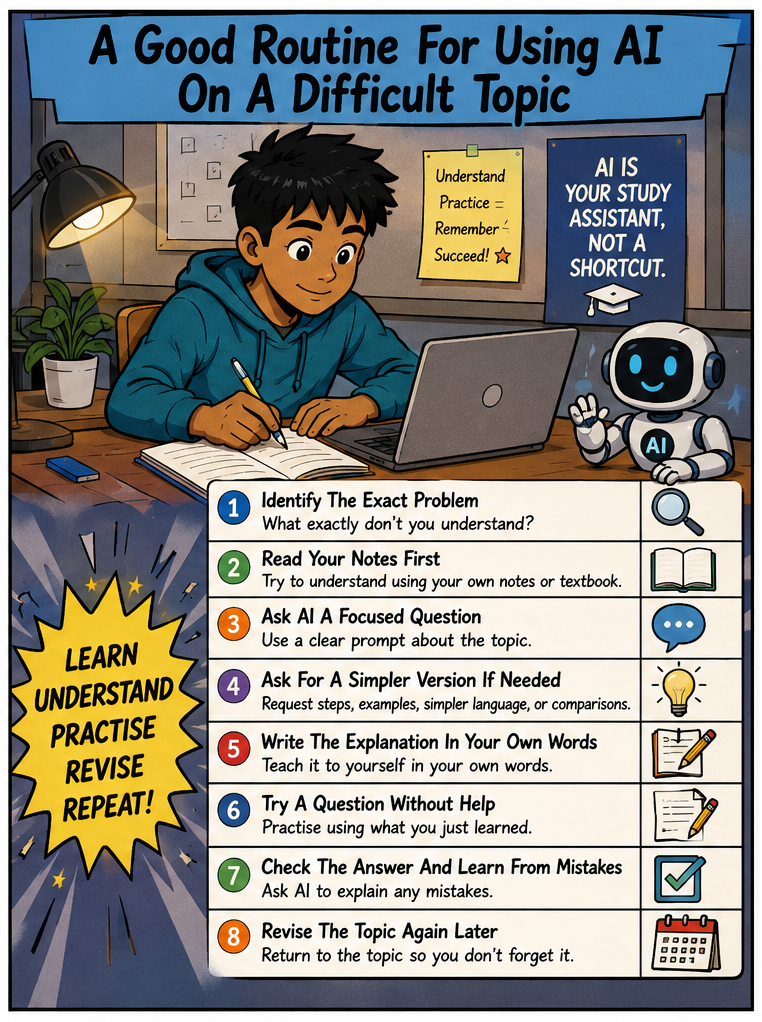
A Good Routine For Using AI On A Difficult Topic
Here is a practical study routine you can follow.
Step 1: Identify The Exact Problem
Do not say, “I hate this chapter.” Ask yourself:
What exactly do I not understand?
Is it a word, a process, a formula, or a question type?
Step 2: Read Your Notes First
Spend a few minutes with your notes, worksheet, or textbook. Try to spot the part that confuses you.
Step 3: Ask AI A Focused Question
Use a clear prompt with the topic, your grade, and what you want explained.
Step 4: Ask For A Simpler Version If Needed
If the first answer still feels hard, ask for:
simpler language
step-by-step teaching
a real-life example
a worked example
Step 5: Write The Explanation In Your Own Words
This step matters a lot. After AI explains the topic, close the chat and write what you understood in your own words. If you cannot do that, you probably do not understand it yet.
Step 6: Try A Question Without Help
Use your textbook, worksheet, or ask AI to generate a similar question.
Step 7: Check The Answer And Learn From Mistakes
If you get it wrong, ask AI to explain the mistake instead of just giving the correct answer.
Step 8: Revise The Topic Again Later
Understanding today does not guarantee memory next week. Come back to the topic during revision.
This routine turns AI into a proper study tool instead of a shortcut machine.
Mistakes To Avoid When Using AI For School Topics
There are a few common mistakes that can make AI less helpful.
Mistake 1: Asking Questions That Are Too Vague
If you ask vague questions, you get weak answers.
Mistake 2: Copying Without Understanding
If AI explains a concept and you simply paste the answer into homework, you lose the chance to learn.
Mistake 3: Never Checking If The Answer Is Correct
AI can sound confident and still be wrong.
Mistake 4: Skipping Your Own Notes Completely
AI should support your school material, not replace it.
Mistake 5: Giving Up After One Explanation
Sometimes you need a second or third explanation before the topic clicks.
Mistake 6: Letting AI Do All The Thinking
The goal is not to become dependent. The goal is to become more capable.
What Responsible AI Use Looks Like For A Learner
Responsible AI use is not about avoiding technology. It is about using technology in a way that strengthens your learning and protects your honesty.
Responsible use looks like this:
using AI to understand difficult topics
asking for explanations, examples, and quizzes
checking important facts against school material
writing your own answers after learning
using AI to improve your understanding, not hide your lack of understanding
being honest in tests, assignments, and schoolwork
In other words, responsible AI use means staying the learner. AI is the helper, not the replacement.
Final Thoughts
Difficult school topics can make you feel stuck, discouraged, or behind. But confusion does not mean you are incapable. Very often, it simply means you need a different explanation, a slower explanation, or an explanation that connects better with the way you learn.
That is where AI can be useful.
Used properly, AI can simplify hard concepts, break topics into steps, give examples, test your understanding, and help you approach school work with more confidence. It can be especially helpful when you feel embarrassed to ask a basic question, when your textbook explanation feels too heavy, or when you need extra practice outside the classroom.
But the key is how you use it.
If you use AI to avoid thinking, it becomes a problem. If you use AI to strengthen your thinking, it becomes a powerful study assistant.
So the next time you feel stuck on a difficult school topic, do not just stare at the page and hope it will magically make sense. Ask better questions. Ask for a simpler explanation. Ask for examples. Ask for steps. Then test yourself and make sure the learning is really happening.
That is how AI becomes more than a shortcut. That is how it becomes a tool that helps you learn smarter.
Additional Articles in the AI as a Study Assistant Series
How to Use AI to Explain Difficult School Topics
Using AI to Create Practice Questions for Revision
How to Use AI to Summarise Long Notes and Textbook Chapters
Using AI to Build a Personal Study Plan for Tests and Exams
How to Ask AI Better Questions So You Get Better Answers
Disclaimer
AI Tools were used to assist with research. Remember to always cross-check everything that you read.