
Using AI to Build a Personal Study Plan for Tests and Exams
This is article #4 of 5 in the Using AI as a Study Assistant Series
Introduction
Every learner knows that studying is important, especially when tests and exams are approaching. However, knowing that you need to study and knowing how to study are two very different things. Many learners sit down with good intentions but quickly become overwhelmed by the amount of work they need to cover. They may have several subjects, multiple chapters to revise, assignments to complete, and only a limited number of hours available each day.
Without a clear plan, it is easy to spend too much time on one subject while neglecting another. Some learners avoid difficult subjects because they feel discouraged, while others spend so much time creating colourful timetables that they never actually begin studying. As deadlines get closer, stress increases, confidence decreases, and revision becomes rushed instead of organised.
This is where Artificial Intelligence (AI) can become a valuable study partner.
AI can help learners create realistic and personalised study plans based on their subjects, available study time, upcoming tests, strengths, and areas that need improvement. Instead of trying to manage everything in your head, AI can help organise your workload into smaller, achievable tasks that are easier to complete.
However, AI cannot study for you.
A study plan is only effective if you follow it consistently. AI can suggest a timetable, recommend priorities, and help you organise your revision, but your success still depends on your commitment, effort, and willingness to learn.
In this article, you will discover how to use AI to create a practical study plan that reduces stress, improves time management, and helps you prepare confidently for tests and exams.
Why Every Learner Needs A Study Plan
Imagine you are asked to build a house without a blueprint. You might have the right materials, but without a plan, you would not know where to begin or what to do next.
Studying works in much the same way.
Your textbooks, notes, worksheets, and online resources are the building materials. Your study plan is the blueprint that shows you how to use them effectively.
Without a study plan, learners often experience several common problems.
They Waste Valuable Time
Many students spend the first twenty or thirty minutes of a study session deciding what to study. By the time they finally start, they have already lost valuable learning time. A study plan removes this uncertainty because you already know what needs to be done.
They Forget Important Topics
Without a written plan, it is easy to overlook certain chapters or subjects. You may revise the topics you enjoy while accidentally ignoring those you find difficult. A study plan helps ensure that every important topic receives attention.
They Feel Overwhelmed
Looking at an entire textbook can make revision feel impossible. Breaking large tasks into smaller daily goals makes studying feel much more manageable. Instead of thinking, "I have to study the whole chapter," you can focus on one section at a time.
They Leave Everything Until The Last Minute
Procrastination is one of the biggest challenges learners face. When you do not have a clear plan, it becomes easy to delay studying because you are unsure where to begin. A study timetable encourages you to make steady progress every day instead of cramming the night before a test.
They Experience More Stress
Uncertainty creates anxiety. Knowing exactly what you need to study each day helps you feel more in control and more confident about your preparation.
What Makes A Good Study Plan?
Not every timetable is effective. Some learners create beautiful colour-coded schedules that are impossible to follow. Others try to study every subject for several hours every day, leaving no time for rest, family responsibilities, hobbies, or sleep.
A good study plan should be realistic. It should match your daily life rather than an ideal version of it.
A practical study plan should answer questions such as:
What subjects do I need to study?
Which topics are the most important?
Which subjects do I find difficult?
When are my tests and exams?
How much study time do I have each day?
What other responsibilities do I have?
When will I take breaks?
When will I review what I have already learned?
The more accurately you answer these questions, the better AI can help you create a useful study plan.
How AI Can Help You Organise Your Revision
Creating a study timetable can take time. You need to think about deadlines, priorities, available hours, and the amount of work in each subject. AI can speed up this process considerably.
It can help you:
organise your subjects
prioritise important topics
divide large chapters into smaller tasks
create daily study schedules
adjust your timetable when plans change
include revision sessions
remind you to take breaks
Instead of staring at a blank page wondering where to begin, AI can provide a structured starting point. Remember, though, that AI suggestions are only as good as the information you provide.
The more details you give, the better your timetable will be.
Start By Gathering The Right Information
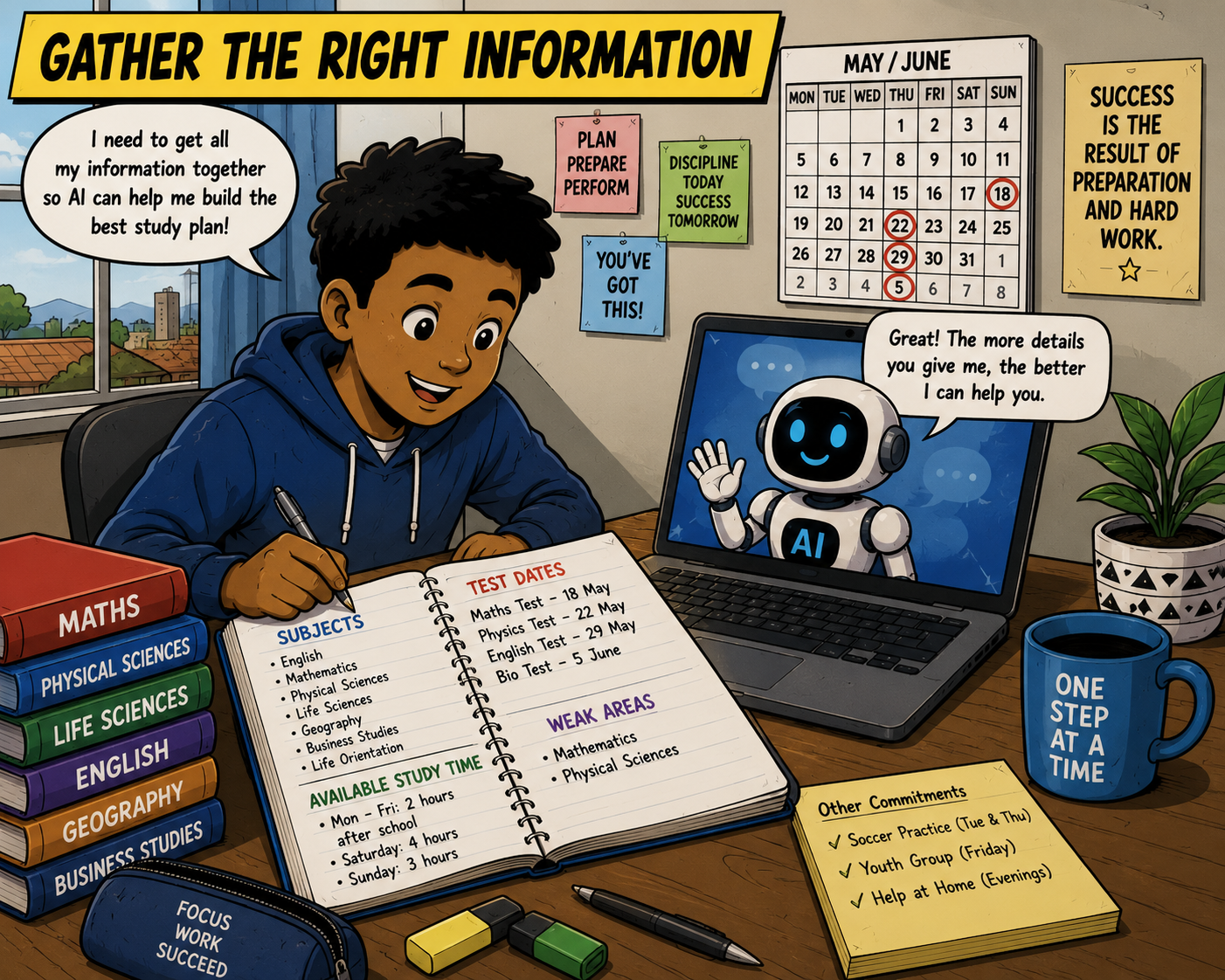
Before asking AI to build a study plan, collect the information it needs. Think of AI as a personal assistant. Your assistant cannot organise your schedule if you do not explain what your schedule looks like.
Useful information includes:
Your Subjects
List every subject you are currently studying.
For example:
English
Mathematics
Physical Sciences
Life Sciences
Geography
Business Studies
History
Accounting
Upcoming Tests And Exams
Write down:
test dates
assignment deadlines
examination dates
project due dates
This helps AI prioritise urgent work.
Your Available Study Time
Be realistic.
Perhaps you can study:
one hour after school
two hours on Saturdays
three hours on Sundays
Avoid exaggerating how much free time you have. A timetable that fits your real life is much easier to follow.
Your Strongest And Weakest Subjects
AI can allocate more study time to subjects you find difficult while reducing unnecessary revision for topics you already understand well.
For example:
Strong subjects:
English
Geography
Subjects needing more attention:
Mathematics
Physical Sciences
This creates a more balanced revision plan.
Give AI Clear Instructions
Many learners ask AI something like: "Make me a study plan." While AI will try to help, the timetable may be too general.
Instead, include useful details.
For example: "I am a Grade 11 learner in South Africa. I study English, Mathematics, Geography, Business Studies, and Life Sciences. I have two hours available each weekday and four hours on Saturday. My Mathematics test is in two weeks, and my Business Studies assignment is due next Friday. Please create a study timetable that includes revision, homework, and short breaks."
Notice how much more information this prompt provides.
It explains:
grade level
subjects
available time
upcoming deadlines
priorities
The clearer your instructions, the more personalised your timetable becomes.
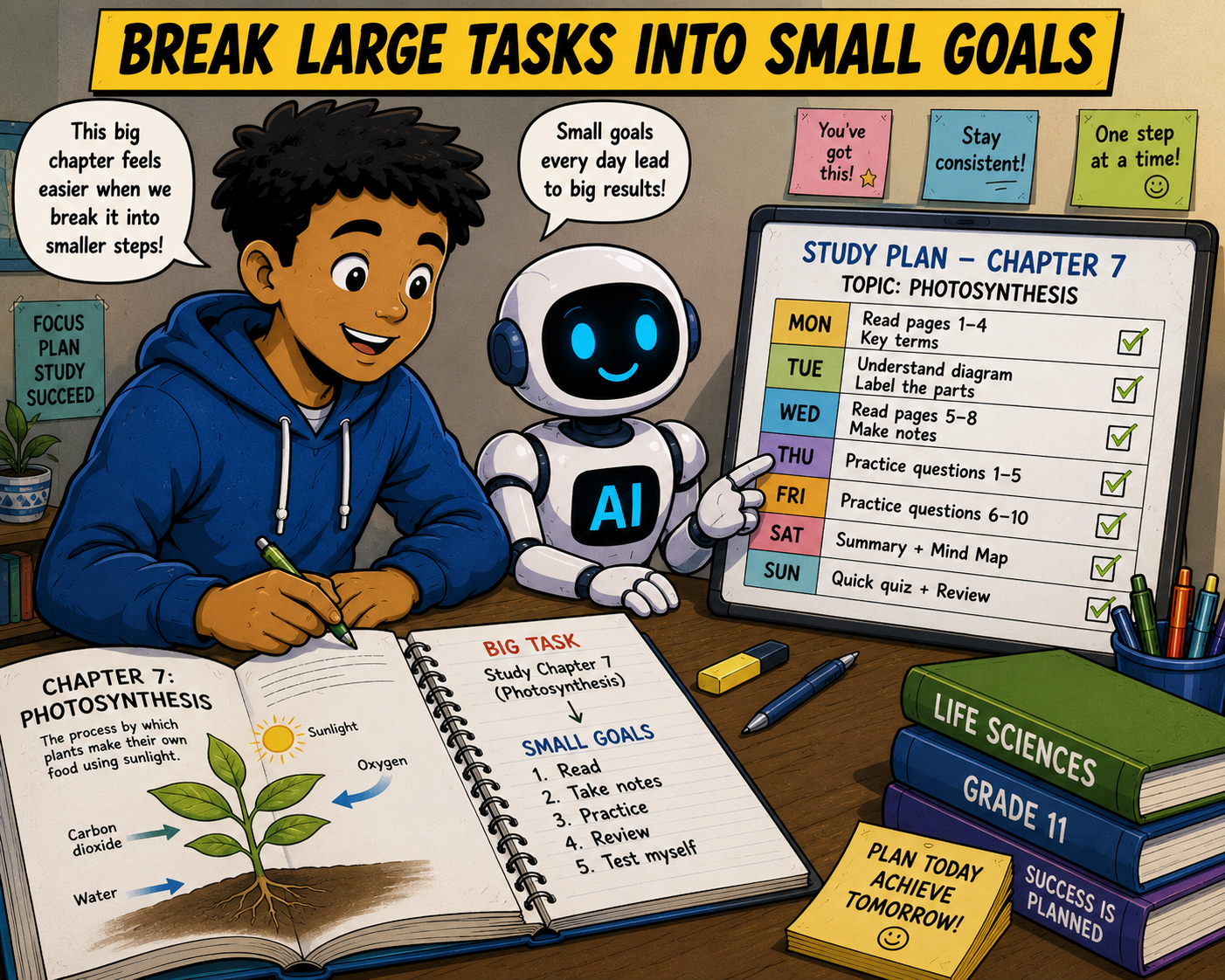
Break Large Tasks Into Smaller Goals
One reason learners become overwhelmed is because they focus on large goals.
For example: "Study Geography."
This sounds simple, but what does it actually mean? Instead, divide the task into smaller pieces.
For example:
Monday:
Read pages 25–30.
Review climate definitions.
Complete five practice questions.
Tuesday:
Revise weather systems.
Label diagrams.
Complete worksheet questions.
Small goals are easier to complete. Completing them also gives you a sense of progress, which keeps you motivated. AI is excellent at dividing large chapters into smaller daily tasks.
Prioritise Your Most Difficult Subjects
Most learners enjoy studying subjects they already understand. Unfortunately, this often means avoiding the subjects they find challenging. AI can help create a more balanced timetable.
For example, instead of studying English every evening because it feels easy, AI may recommend spending additional time on Mathematics before an upcoming test.
This ensures that difficult subjects receive the attention they deserve. That does not mean studying only difficult subjects.
Balance is important. A good timetable includes both strengths and weaknesses.
Build Regular Revision Into Your Schedule
Many learners make another common mistake. They study a topic once and never look at it again until the exam. Unfortunately, our brains naturally forget information over time.
That is why revision is so important. When asking AI to create your timetable, include regular review sessions.
For example:
Monday:
Learn new Geography chapter.
Wednesday:
Review Monday's Geography notes.
Saturday:
Complete Geography revision quiz.
This repeated exposure helps move information into your long-term memory.
Remember To Include Breaks
Some learners believe studying for five hours without stopping shows dedication. In reality, long periods of uninterrupted studying often reduce concentration and memory. Your brain needs regular breaks.
A practical study plan includes short rest periods.
For example:
Study for 45–50 minutes.
Take a 10-minute break.
Return refreshed for the next session.
During your break:
stretch
drink water
walk around
rest your eyes
Avoid spending the entire break scrolling through social media, as this can make it difficult to return to studying. AI can include healthy break times when creating your timetable.
Balance School With The Rest Of Your Life
Every learner has responsibilities outside the classroom.
You may have:
sports practice
music lessons
household chores
religious activities
family commitments
part-time work
transport time
A study plan that ignores these responsibilities is unlikely to succeed. When asking AI to create your timetable, include these commitments.
For example: "I have soccer practice every Tuesday and Thursday from 4:00 pm to 6:00 pm."
or
"I help my family every evening between 6:00 pm and 7:00 pm."
AI can then build a timetable around your existing commitments instead of creating unrealistic expectations.
Make Your Study Plan Flexible
Life does not always go according to plan.
Sometimes:
a teacher gives unexpected homework
a family event changes your schedule
you become ill
a test date changes
you need extra time on one subject
Your timetable should be flexible enough to adapt. One of AI's biggest advantages is that it can quickly update your study plan. Instead of rewriting your entire timetable, simply tell AI what has changed.
For example: "My Mathematics test has been moved to next Friday. Please adjust my study timetable."
Or:
"I missed yesterday's study session because I was sick. Please help me rearrange this week's revision schedule."
This allows your timetable to stay useful even when unexpected events occur.
Use AI To Set Weekly Goals
A timetable tells you when to study. Goals tell you what you want to achieve.
Instead of writing: "Study History." Set a clearer goal.
For example:
Complete Chapter 4.
Memorise important dates.
Finish two essay questions.
Review teacher feedback.
Complete one past exam paper.
AI can help you create realistic weekly goals based on your available time and upcoming assessments.
These goals make it much easier to measure your progress and stay motivated.
Track Your Progress As You Study
Creating a study plan is an excellent first step, but it is only the beginning. To make your timetable effective, you need to monitor your progress regularly.
Many learners make a detailed timetable at the beginning of the week but never look at it again. By Friday, they are unsure which tasks they completed and which ones they skipped.
AI can help you keep track of your progress.
For example, after each study session, you can tell AI: "Today I completed my English essay revision and half of my Mathematics exercises. I did not have time to study Geography. Please update my study plan for the rest of the week."
AI can then suggest a revised timetable that keeps you on track without making your workload unrealistic.
Tracking your progress also helps you celebrate small successes. Every completed task is one step closer to your goal.
Adjust Your Plan When Circumstances Change
No study plan stays perfect forever. Unexpected events are part of life.
Perhaps:
your teacher moves a test to an earlier date
you receive a new assignment
you become sick
your family has an emergency
school activities take longer than expected
Instead of giving up on your timetable, adjust it. One advantage of AI is that it can quickly reorganise your schedule. For example:
"My Geography test has been moved from next Friday to this Monday. Please adjust my study timetable so I can prepare properly."
Or:
"I missed two study sessions this week. Please help me catch up without making my timetable too stressful."
Being flexible helps you stay organised even when your plans change.
Use AI To Prepare For Exam Week
Studying during the school term is different from preparing for final examinations. During exam season, your timetable needs to focus more on revision than on learning new work.
AI can help create a dedicated exam revision timetable.
For example: "Create a two-week Grade 12 exam study plan. I have exams in English, Mathematics, Life Sciences, Geography, and Business Studies. Prioritise my weakest subjects while allowing time to revise everything."
A good exam timetable should include:
subject revision
practice questions
past exam papers
review sessions
regular breaks
enough sleep
Exam preparation should be balanced rather than rushed.
Include Practice Questions In Your Study Plan
Reading notes is important, but answering questions helps you apply what you have learned. When building your timetable, ask AI to include practice sessions.
For example:
Monday
Read Chapter 6.
Summarise key ideas.
Complete ten revision questions.
Wednesday
Complete a short quiz.
Review incorrect answers.
Saturday
Write one past exam paper under timed conditions.
This combination of reading and practising strengthens your understanding and prepares you for real assessments.
Schedule Time To Review Mistakes
One of the most valuable parts of studying is reviewing your mistakes. Many learners mark a test, see their score, and immediately move on to the next topic. Instead, use your mistakes as learning opportunities.
Ask AI: "I struggled with algebra and graphs in today's Maths test. Please add extra revision sessions for these topics to next week's timetable."
This helps you focus your effort where it is needed most.
Over time, your timetable becomes more personalised because it is based on your own learning needs.
Don't Forget Time For Rest
Many learners believe that studying for as many hours as possible will produce the best results. In reality, your brain needs time to recover. Without enough rest, concentration decreases, memory becomes weaker, and motivation often disappears.
A healthy study plan should include:
regular breaks
enough sleep each night
healthy meals
physical activity
time with family and friends
Rest is not wasted time. It is an important part of learning. When your mind is refreshed, you are able to study more effectively.
Stay Motivated Throughout The Term
Motivation often changes from week to week. Some days you feel eager to study. Other days you may feel tired or discouraged. Instead of relying only on motivation, build consistent habits.
AI can help by creating achievable daily goals. Rather than writing: "Study for four hours." Break the task into smaller objectives.
For example:
Read one chapter.
Learn five definitions.
Complete one worksheet.
Answer ten revision questions.
Small achievements create momentum and help you stay motivated over time.
Use AI To Build Healthy Study Habits
A good timetable is about more than subjects and deadlines. It can also help you develop habits that support long-term success.
For example, ask AI to remind you to:
prepare your books before bed
pack your school bag
review yesterday's lesson
drink enough water
take regular breaks
avoid distractions while studying
These habits may seem small, but they can make a significant difference over the course of a school year.
Reduce Distractions During Study Time
Even the best timetable cannot help if you are constantly distracted.
Common distractions include:
social media
mobile phones
television
gaming
noisy environments
When planning your study sessions, identify where you work best. Some learners prefer complete silence. Others concentrate better with soft background music. AI can even suggest strategies to reduce distractions.
For example: "Give me five practical ways to stay focused during a one-hour study session."
Remember, studying for one focused hour is often more productive than spending three distracted hours at your desk.
Study According To Your Energy Levels
Not everyone learns best at the same time of day. Some learners concentrate better early in the morning. Others work more effectively after school. Think about when you feel most alert.
If Mathematics requires your greatest concentration, schedule it when your mind is fresh. Less demanding tasks, such as organising notes or reviewing vocabulary, can be completed when your energy is lower.
AI can help you organise subjects according to your natural study patterns.
Balance Strong And Weak Subjects
It is tempting to spend all your time on subjects you enjoy. However, improving your weaker subjects often has the greatest impact on your overall results.
A balanced timetable should include:
enough time to maintain your strongest subjects
additional time for subjects that need improvement
regular revision for all subjects
Avoid ignoring difficult subjects simply because they feel challenging. Small, consistent study sessions usually produce better results than trying to master everything in one evening.
Common Mistakes Learners Should Avoid
Even with AI, some study plans fail because of common mistakes.
Trying To Study Too Much In One Day
A timetable packed with unrealistic goals quickly becomes discouraging. Be realistic about what you can achieve.
Ignoring Breaks
Continuous studying without rest reduces concentration and makes learning less effective.
Forgetting To Revise
Learning new material is important, but regular revision helps move information into long-term memory.
Making A Timetable But Never Following It
A perfect timetable is useless if it stays in a notebook. Your actions matter more than your planning.
Comparing Yourself To Others
Every learner is different. Your timetable should reflect your own subjects, strengths, weaknesses, and available time — not someone else's.
A Practical Example
Let's look at how AI can help a learner create a realistic study plan. Sipho is a Grade 12 learner.
He studies:
English
Mathematics
Physical Sciences
Life Sciences
Geography
Life Orientation
He has:
two hours available after school
four hours available on Saturdays
three tests in the next two weeks
He tells AI: "Create a study timetable that gives extra time to Mathematics and Physical Sciences because these are my weakest subjects. Include revision sessions, practice questions, and 10-minute breaks after every 50 minutes of studying."
AI creates a weekly timetable that:
prioritises urgent tests
spreads study sessions across the week
includes revision days
schedules practice papers
allows time for rest
Sipho follows the timetable for two weeks. After completing several quizzes, he realises he has improved in Mathematics but still struggles with Physics calculations. He asks AI to adjust the timetable by adding extra Physics practice sessions.
Instead of starting from scratch, AI updates his existing plan. This allows Sipho to continue improving without becoming overwhelmed.
Build A Long-Term Study Routine
The best study plans are not only useful during exam time. They help learners build habits that last throughout the school year.
A simple weekly routine might look like this:
Monday
Review today's lessons.
Complete homework.
Tuesday
Revise previous topics.
Complete practice questions.
Wednesday
Work on assignments.
Review difficult concepts.
Thursday
Revise Mathematics.
Test yourself.
Friday
Review the week's work.
Saturday
Complete a past paper.
Mark your answers.
Identify weak areas.
Sunday
Prepare for the coming week.
Organise books and notes.
Rest before school begins again.
Following a routine like this helps prevent last-minute cramming before tests and examinations.
Responsible AI Use When Planning Your Studies
AI is an excellent planning tool, but it should never become something you depend on completely.
Responsible learners use AI to:
organise their time
prioritise subjects
create realistic timetables
adjust study plans
track progress
identify weak areas
Responsible learners still:
attend class
complete homework
ask teachers for help
revise regularly
take responsibility for their own learning
Remember, AI provides guidance. You provide the effort.
Final Thoughts
A good study plan does more than organise your time—it helps you study with purpose. Instead of wondering what to revise each day, you have a clear roadmap that breaks large tasks into manageable steps and keeps you focused on your goals. This reduces stress, improves confidence, and makes it easier to stay consistent throughout the school term.
AI can make creating a study plan much quicker and easier. It can organise your subjects, prioritise important topics, adjust your timetable when circumstances change, and help you balance school with your other responsibilities. It can even suggest when to revise, when to practise exam questions, and when to take breaks so that your study sessions remain productive.
However, no timetable can guarantee success on its own. The most effective study plan is one that you follow consistently. Small, regular study sessions are usually far more successful than long periods of last-minute cramming. By combining a realistic timetable with good study habits, active revision, and responsible use of AI, you can take greater control of your learning and prepare more confidently for every test and examination.
Remember, your study plan is not meant to make life more complicated. It is there to help you use your time wisely, reduce unnecessary stress, and move steadily towards your academic goals — one study session at a time.
Additional Articles in the AI as a Study Assistant Series
How to Use AI to Explain Difficult School Topics
Using AI to Create Practice Questions for Revision
How to Use AI to Summarise Long Notes and Textbook Chapters
Using AI to Build a Personal Study Plan for Tests and Exams
How to Ask AI Better Questions So You Get Better Answers
Disclaimer
AI Tools were used to assist with research. Remember to always cross-check everything that you read.