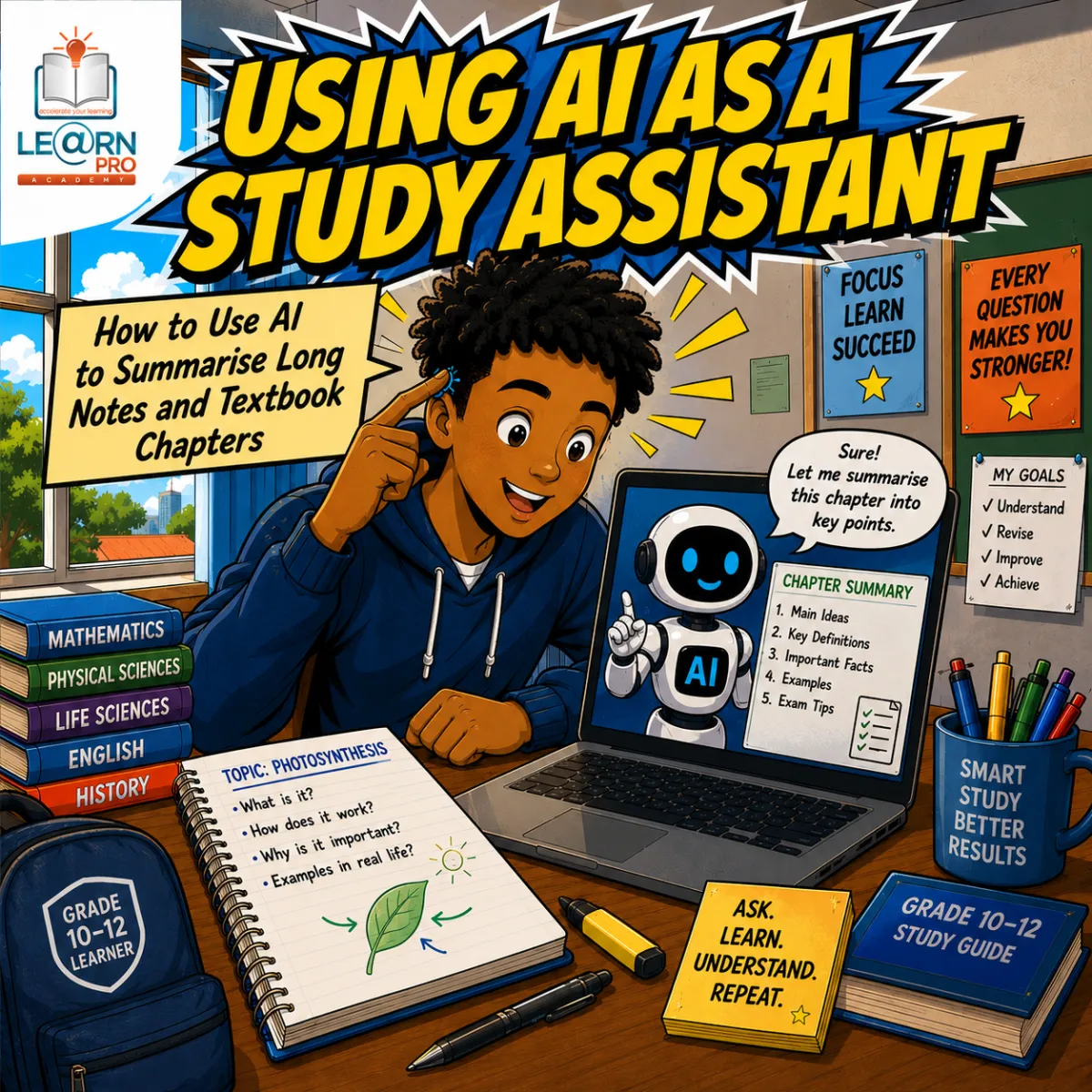
How to Use AI to Summarise Long Notes and Textbook Chapters
This is article #3 of 5 in the Using AI as a Study Assistant Series
Introduction
School life can become very busy, especially as tests and exams get closer. Learners often have several subjects to study, homework to complete, assignments to finish, and extracurricular activities to attend. When revision time finally arrives, many students open their textbooks or files only to discover pages and pages of notes waiting for them. It can feel overwhelming.
Perhaps you have experienced this yourself. You open a chapter in your textbook, expecting to revise quickly, but instead you find ten pages of information, long paragraphs, unfamiliar words, and dozens of important facts. After reading for a while, you realise that you are not sure which information is most important. You may even forget what you read at the beginning of the chapter before you reach the end.
This is where Artificial Intelligence (AI) can become a valuable study assistant.
AI can help learners turn long notes and textbook chapters into shorter, easier-to-read summaries. It can identify the main ideas, explain difficult concepts in simpler language, highlight important keywords, and organise information into bullet points or study notes. Instead of feeling lost in a large amount of information, learners can focus on the concepts that matter most.
However, there is one very important point to remember:
A summary is meant to help you learn — not replace your learning.
If you only read AI-generated summaries without understanding the original material, you may struggle when you need to answer detailed questions in a test or exam. A good summary should make revision easier, but it should never replace careful reading, class notes, or your own thinking.
In this article, you will learn how to use AI responsibly to summarise long notes and textbook chapters. You will also discover how to avoid common mistakes, how to create better summaries, and how to use those summaries as part of an effective revision strategy.
Why Long Notes Can Feel Overwhelming
Many learners think they struggle because they are not clever enough. In reality, the problem is often the amount of information they need to process.
Think about a typical Grade 11 or Grade 12 textbook chapter. It may include:
several pages of explanations
new vocabulary
diagrams and illustrations
definitions
examples
case studies
tables
formulas
review questions
That is a lot of information for your brain to organise.
When learners see a large amount of work, they often experience one of these reactions:
They Don't Know Where To Start
Looking at twenty pages of notes can feel intimidating. Instead of beginning, some learners delay studying because they do not know which section to tackle first.
Everything Looks Important
When every paragraph seems important, it becomes difficult to identify the key ideas.
Some learners respond by highlighting almost every sentence in the textbook. Unfortunately, that defeats the purpose of highlighting.
They Spend Too Much Time Reading
Reading the same chapter several times may feel productive, but it is not always the most effective way to learn.
Without organising the information, it is easy to forget what you have already read.
They Become Mentally Tired
Long periods of reading require concentration.
As your attention decreases, your brain remembers less of what you are reading.
This is why summarising information can make revision much easier.
What Is A Summary?
Before using AI, it helps to understand what a good summary actually is.
A summary is a shorter version of the original material that includes only the most important ideas.
A good summary should:
explain the main concepts
include important facts
keep key definitions
remove unnecessary detail
make revision quicker
remain accurate
A summary is not simply a list of random sentences copied from the textbook.
Instead, it should help you understand the "big picture" while reminding you of the important details.
For example, imagine your textbook contains six pages explaining photosynthesis.
A summary might reduce those six pages to:
the purpose of photosynthesis
where it happens
the materials needed
the products produced
the importance of the process
key scientific terms learners need to know
Instead of reading six pages every time you revise, you can first review the summary and then return to the textbook if you need more detail.
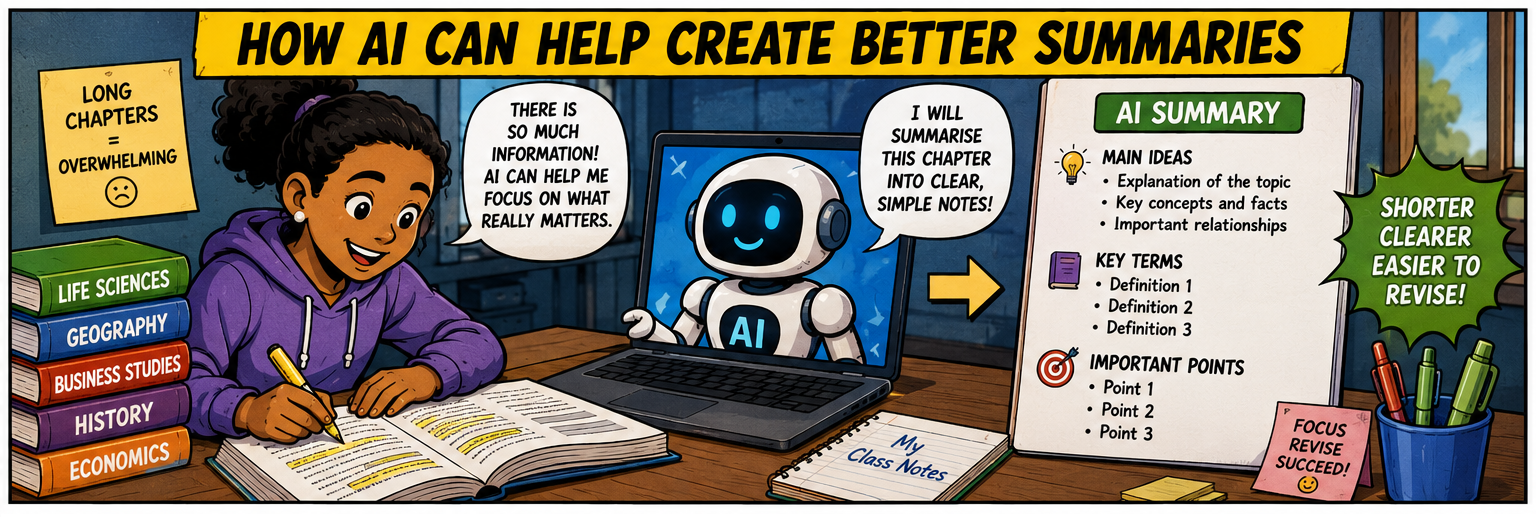
How AI Can Help Create Better Summaries
AI is very good at identifying patterns and extracting important information from text.
When given a chapter, set of notes, or article, AI can often:
identify the main ideas
remove repeated information
simplify difficult language
organise ideas logically
create bullet-point summaries
explain technical terms
produce revision notes
This saves learners valuable time during revision.
Imagine you have ten pages of Geography notes.
Instead of reading every page repeatedly, you can ask AI to create:
a one-page summary
key definitions
important facts
revision bullet points
exam reminders
This gives you a shorter version that is easier to revise.
However, remember that AI should support your understanding — not replace it.
Read The Original Material First
One of the biggest mistakes learners make is asking AI to summarise a chapter before they have even looked at it themselves.
This is not the best approach.
Before asking AI for help, spend a few minutes reading:
your class notes
the textbook chapter
your worksheet
teacher handouts
You do not need to understand everything perfectly. Your goal is simply to become familiar with the topic. Once you have done that, AI can help organise the information into a more manageable format.
Think of AI as someone helping you organise your school bag. You still need to own the books and know what they are for.
Ask AI For The Right Type Of Summary
Not every summary is the same. Different situations require different types of summaries. The better your instructions, the more useful your summary will be.
Here are some examples.
Simple Revision Summary
Prompt example: "Summarise these Grade 11 Business Studies notes into one page using simple English."
This is useful when you need a quick overview before revision.
Bullet-Point Summary
Prompt example: "Turn this chapter into clear bullet-point revision notes."
Bullet points are easy to read and ideal for quick review sessions.
Key Concepts Summary
Prompt example: "Identify the ten most important concepts in this chapter and explain each one briefly."
This helps learners focus on the information most likely to appear in assessments.
Keyword Summary
Prompt example: "Extract all the important keywords from this chapter and explain each one in simple language."
Many examination questions are based on key terms.
Learning these keywords helps improve both understanding and exam performance.
Definition Summary
Prompt example: "Create a list of every important definition in this chapter with short explanations."
This is particularly useful for subjects such as:
Life Sciences
Business Studies
Economics
Geography
History
Study Sheet Summary
Prompt example: "Turn this chapter into a one-page study sheet that I can revise before my test."
Study sheets are useful for quick revision during exam week.
Use AI To Simplify Difficult Language
Many South African learners study in English even though it is not their home language. Sometimes the biggest challenge is not the subject itself. It is the language used in textbooks.
Academic writing often contains:
long sentences
unfamiliar words
technical vocabulary
formal writing styles
AI can help translate these into simpler English.
For example, instead of asking: "Summarise this chapter."
You could ask: "Summarise this Grade 12 Life Sciences chapter using simple English suitable for a learner whose first language is not English."
This small change can make a big difference. The information stays accurate while becoming easier to understand.
Ask AI To Explain Difficult Words
Sometimes one unfamiliar word can make an entire paragraph confusing. Instead of ignoring difficult vocabulary, ask AI to explain it.
For example: "Explain the following terms in simple English..."
or
"Which words in this chapter are the most important for the exam?"
AI can provide:
simple definitions
pronunciation help
examples
real-life comparisons
Building your vocabulary also improves your understanding of future chapters.
Use AI To Organise Information Better
Sometimes the information itself is not difficult.
It is simply poorly organised.
AI can reorganise information into formats that are easier to revise.
For example, ask AI to organise a chapter into:
Headings And Subheadings
This helps you understand the structure of the topic.
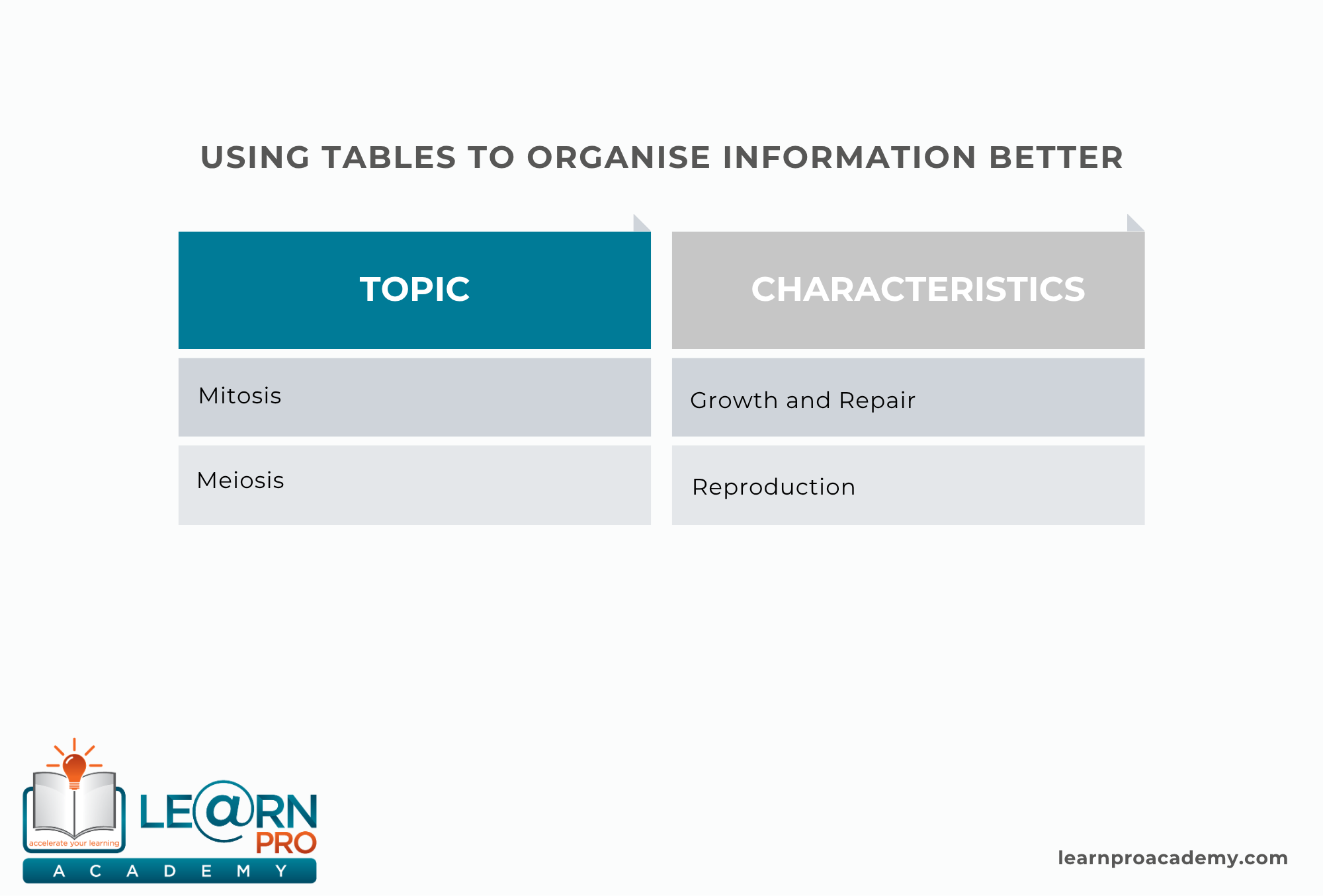
Tables
Tables are useful when comparing concepts.
For example:
Timelines
Perfect for History and Life Sciences.
Numbered Steps
Useful for:
scientific processes
mathematical methods
Accounting procedures
Geography processes
Cause And Effect Lists
Excellent for:
History
Economics
Geography
Business Studies
Seeing information organised clearly often makes it much easier to remember.
Don't Make Your Summaries Too Short
This is another common mistake. Some learners ask AI: "Summarise this entire chapter in five sentences."
While this sounds convenient, the summary may become too short. Important information may disappear. Instead, choose a summary length that still keeps the key ideas.
For example:
one-page summary
two-page revision notes
bullet-point overview
key concepts list
A good summary removes unnecessary detail without removing important learning.
Remember:
The goal is to reduce information — not remove understanding.
Check The Summary Against Your School Notes
AI is a powerful tool, but it is not perfect.
Sometimes it may:
leave out important information
misunderstand a paragraph
simplify too much
include incorrect details
For this reason, always compare your AI summary with:
your class notes
your teacher's explanations
your textbook
official study guides
If something looks different, investigate it. Never assume AI is automatically correct simply because it sounds confident. Using AI responsibly means checking its work just as you would check your own work.
Use AI Summaries As A Starting Point
One of the smartest ways to revise is to combine AI summaries with your own learning. Instead of treating the summary as the final product, use it as a starting point.
For example:
Read the original chapter.
Ask AI to summarise it.
Compare the summary with your own notes.
Add any missing points.
Highlight the most important facts.
Write one or two ideas in your own words.
By adding your own thinking, you make the summary much more valuable. More importantly, you help your brain process and remember the information.
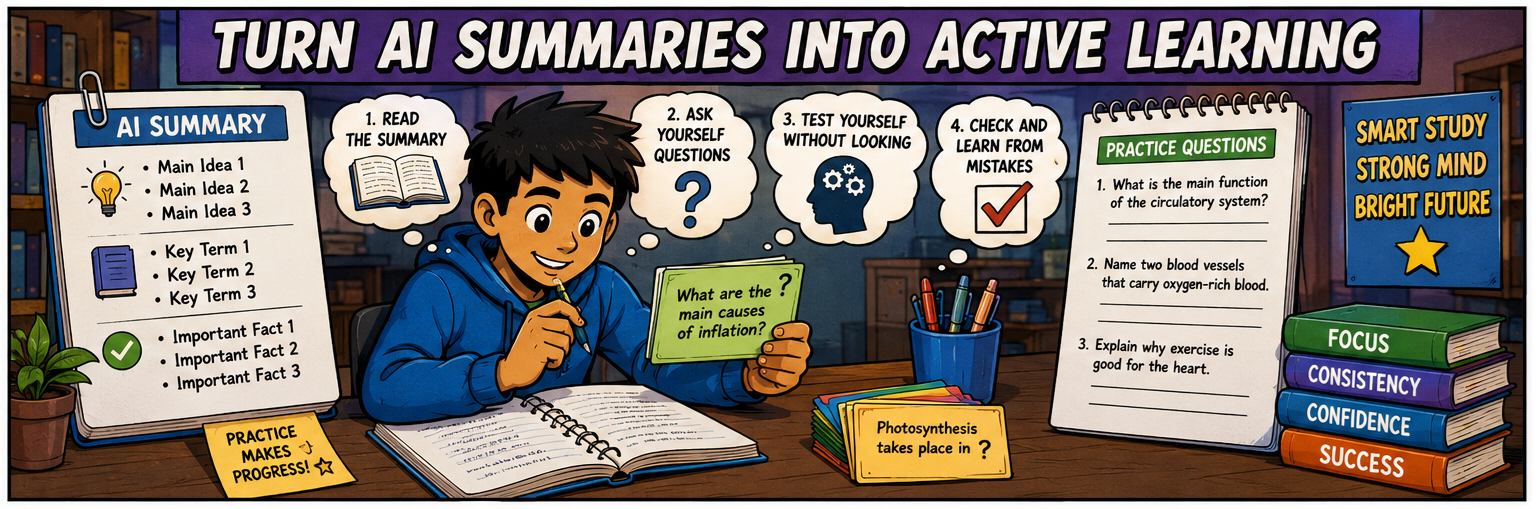
Turn AI Summaries Into Active Learning
Reading a summary is helpful, but reading alone is not enough to prepare for tests and exams. The learners who achieve the best results do more than simply read — they actively work with the information.
Once AI has created a summary, look for ways to interact with it.
For example, after reading your summary, close your notes and ask yourself:
What are the three most important ideas?
Can I explain this topic without looking?
Which parts am I still unsure about?
What would I tell a friend if they asked me to explain this topic?
This forces your brain to retrieve information from memory instead of simply recognising it on the page. Educational research shows that actively recalling information is one of the most effective ways to strengthen long-term memory.
Remember, your goal is not to recognise the information. Your goal is to be able to explain it yourself.
Ask AI To Create Different Types Of Summaries
One of AI's biggest strengths is that it can present the same information in different ways. If one style of summary does not suit you, ask AI to create another version.
Mind Map Summary
Mind maps help learners see how ideas connect to one another.
Prompt example: "Turn this chapter into a text-based mind map showing the main topic, subtopics, and key concepts."
This works particularly well for subjects like Geography, Business Studies, Life Sciences, and History.
Question-And-Answer Summary
Instead of listing facts, ask AI to organise the information as questions and answers.
For example:
Question: What is photosynthesis?
Answer: Photosynthesis is the process plants use to make food using sunlight, water, and carbon dioxide.
This format prepares you for exam-style thinking.
Step-By-Step Summary
Some topics involve processes rather than facts.
Ask AI: "Summarise this chapter as a step-by-step process."
This works well for:
scientific experiments
Accounting procedures
mathematical methods
biological processes
geographical cycles
Comparison Summary
Many learners confuse similar concepts. AI can organise information into comparison tables.
For example:
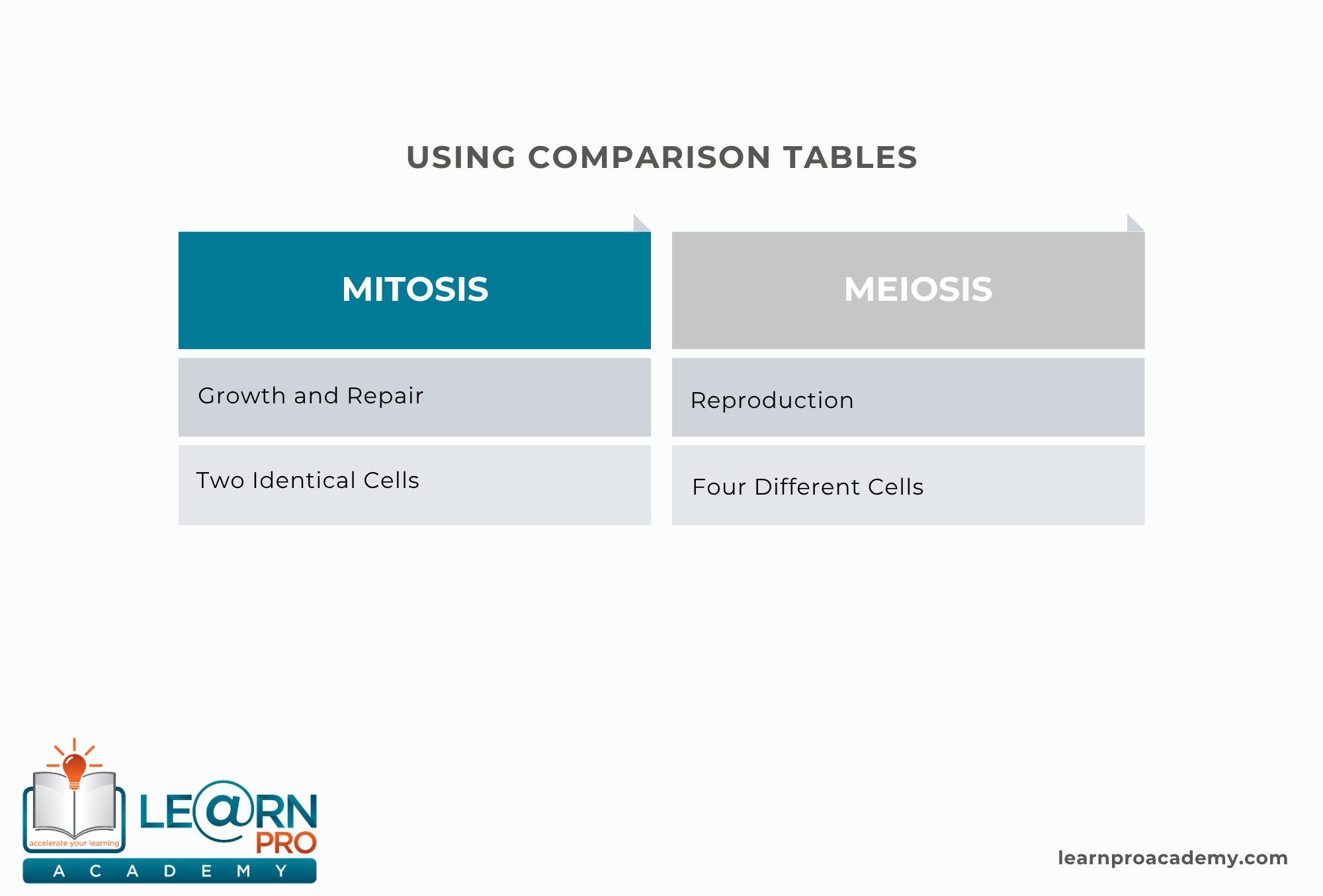
This makes revision much easier.
Build Your Own Revision Notes
AI should never replace your own notes.
Instead, combine AI's summary with what you already have.
A useful approach is called the 80/20 Revision Method.
Step 1
Read your teacher's notes.
Step 2
Read your textbook.
Step 3
Ask AI to create a summary.
Step 4
Compare all three sources.
Step 5
Create your own final revision page.
Your final notes should include:
important definitions
key facts
formulas
diagrams
examples
reminders from your teacher
information you personally find difficult
These become your personalised revision notes. Because you created them yourself, they are often much easier to remember.
Use AI Summaries Before And After Class
AI summaries are not only useful during exam time. They can also help throughout the school term.
Before A Lesson
If you know which topic your teacher will cover tomorrow, ask AI for a short overview first. This helps you become familiar with:
important vocabulary
key ideas
difficult concepts
When your teacher explains the topic, it will already feel more familiar.
After A Lesson
After class, ask AI to summarise what you learned. Then compare the summary with your class notes. This helps reinforce your learning while the lesson is still fresh in your mind.
Combine AI Summaries With Practice Questions
One of the most powerful study methods is combining summaries with practice questions.
Here is an example.
Step 1: Read the chapter.
Step 2: Ask AI to create a summary.
Step 3: Study the summary.
Step 4: Ask AI to generate ten revision questions based on the summary.
Step 5: Answer the questions without looking at your notes.
Step 6: Check your answers.
This combines two excellent learning techniques:
summarising
active recall
Together they help learners remember much more than reading alone.
Create Flashcards From AI Summaries
Flashcards are another excellent revision tool. Instead of creating every flashcard manually, ask AI to help.
Prompt example: "Turn this summary into 20 flashcards. Put the question on one side and the answer on the other."
Flashcards work well because they encourage quick recall.
You can revise:
while travelling
during study breaks
before class
before a test
Small revision sessions throughout the week often work better than one long study session.
Ask AI To Highlight Common Exam Topics
Some chapters contain information that is interesting but rarely tested. Other concepts appear regularly in examinations. AI can help identify these areas.
Prompt example: "Based on this Grade 12 topic, which concepts are most likely to appear in tests and examinations?"
This does not guarantee what will appear in your exam. However, it can help you identify concepts that are generally considered important.
Always compare this with your teacher's guidance and your examination guidelines.
Use AI To Explain Your Summary
Sometimes even the summary still feels confusing. That is perfectly normal.
Instead of giving up, ask AI to explain the summary itself.
For example: "Please explain point number four in simpler English."
Or
"Give me a real-life example of this concept."
Or
"Explain this as if you were teaching a Grade 10 learner."
This allows you to deepen your understanding one section at a time.
Avoid Copying AI Summaries Without Thinking
This is probably the biggest mistake learners make. Some students ask AI to summarise an entire chapter. Then they print the summary. Then they never read it again until the night before the exam. Unfortunately, this does very little to improve learning.
Remember:
A summary is only useful if you actually work with it.
Ask yourself questions.
Highlight key ideas.
Rewrite difficult sections.
Add your own examples.
Explain the topic to someone else.
Learning happens through thinking — not simply through owning good notes.
Common Mistakes Learners Should Avoid
AI can be extremely helpful, but only when it is used correctly.
Here are some common mistakes to avoid.
Mistake 1: Summarising Everything
Not every page needs summarising. Some sections are already short and clear. Use AI where it adds value.
Mistake 2: Making Summaries Too Short
If important ideas disappear, the summary becomes less useful. A good summary is shorter — but still complete.
Mistake 3: Never Reading The Original Chapter
The textbook provides context that summaries sometimes remove. Always read the original material first.
Mistake 4: Trusting Every AI Answer
AI sometimes makes mistakes.
Always compare important information with:
class notes
textbooks
teacher explanations
official study guides
Mistake 5: Studying Only The Summary
The summary should support your revision. It should never become your only study material.
Subjects Where AI Summaries Work Particularly Well
AI summaries can be useful in almost every school subject. Here are a few examples.
Life Sciences
Summarise:
biological processes
definitions
diagrams
scientific terminology
Geography
Summarise:
climate systems
landforms
case studies
environmental issues
History
Summarise:
timelines
important events
causes and consequences
historical figures
Business Studies
Summarise:
business concepts
leadership theories
marketing strategies
legislation
Economics
Summarise:
economic systems
graphs
definitions
government policies
English
Summarise:
novels
poems
characters
themes
language techniques
Even subjects like Mathematics and Physical Sciences can benefit.
Instead of summarising calculations, ask AI to summarise:
formulas
methods
problem-solving steps
common mistakes
examination tips
A Practical Example
Imagine that Thandi is preparing for her Grade 11 Geography test. She has an eighteen-page chapter on climate and weather.
Instead of reading all eighteen pages repeatedly, she follows this routine.
Reads the chapter once.
Highlights the important sections.
Asks AI to create a two-page summary.
Compares the summary with her teacher's notes.
Adds information her teacher emphasised in class.
Asks AI to explain two concepts she still finds confusing.
Creates flashcards from the final summary.
Asks AI to generate ten revision questions.
Answers the questions without looking at her notes.
Revises the summary again two days later.
By the time her test arrives, Thandi has not simply read the chapter. She has organised it, understood it, revised it, practised it, and tested herself. That is far more effective than reading the same chapter five times.
Build A Smart AI Revision Workflow
As you become more confident using AI, you can combine several techniques into one powerful study routine.
A practical workflow looks like this:
Step 1: Read the original chapter.
Step 2: Highlight important information.
Step 3: Ask AI to create a summary.
Step 4: Compare the summary with your school notes.
Step 5: Add your own notes and examples.
Step 6: Ask AI to explain confusing sections.
Step 7: Create flashcards.
Step 8: Ask AI to generate practice questions.
Step 9: Complete the questions without help.
Step 10: Review your mistakes and revise again.
This workflow combines several powerful study techniques into one organised revision system.
Responsible AI Use During Revision
As AI becomes more common in education, it is important to remember that technology should strengthen your learning — not replace it.
Responsible learners use AI to:
simplify difficult material
organise information
create summaries
generate revision questions
explain confusing concepts
identify weak areas
Responsible learners do not use AI to:
avoid reading the textbook
copy assignments
complete homework dishonestly
memorise summaries without understanding them
replace their own thinking
The goal is not to become dependent on AI. The goal is to become a more independent learner.
Final Thoughts
Long notes and textbook chapters can feel intimidating, especially when you have several subjects to revise. AI offers learners a practical way to organise information, identify the most important ideas, and turn large amounts of content into manageable study summaries.
However, the real value of AI is not that it shortens your notes — it is that it helps you understand them more clearly. A good summary should guide your learning, highlight the key concepts, and make revision more focused. It should never replace careful reading, classroom learning, or your own effort.
The most successful learners use AI as one part of a complete revision strategy. They read the original material, compare AI summaries with their class notes, create personalised study sheets, build flashcards, answer practice questions, and regularly test their understanding. This active approach develops stronger knowledge, better memory, and greater confidence before tests and exams.
As you continue your studies, remember that learning is not about finding the quickest shortcut. It is about building understanding step by step. Used responsibly, AI can become a valuable study partner that saves time, reduces stress, and helps you focus on what matters most—developing the knowledge and skills you need to succeed.
Additional Articles in the AI as a Study Assistant Series
How to Use AI to Explain Difficult School Topics
Using AI to Create Practice Questions for Revision
How to Use AI to Summarise Long Notes and Textbook Chapters
Using AI to Build a Personal Study Plan for Tests and Exams
How to Ask AI Better Questions So You Get Better Answers
Disclaimer
AI Tools were used to assist with research. Remember to always cross-check everything that you read.