
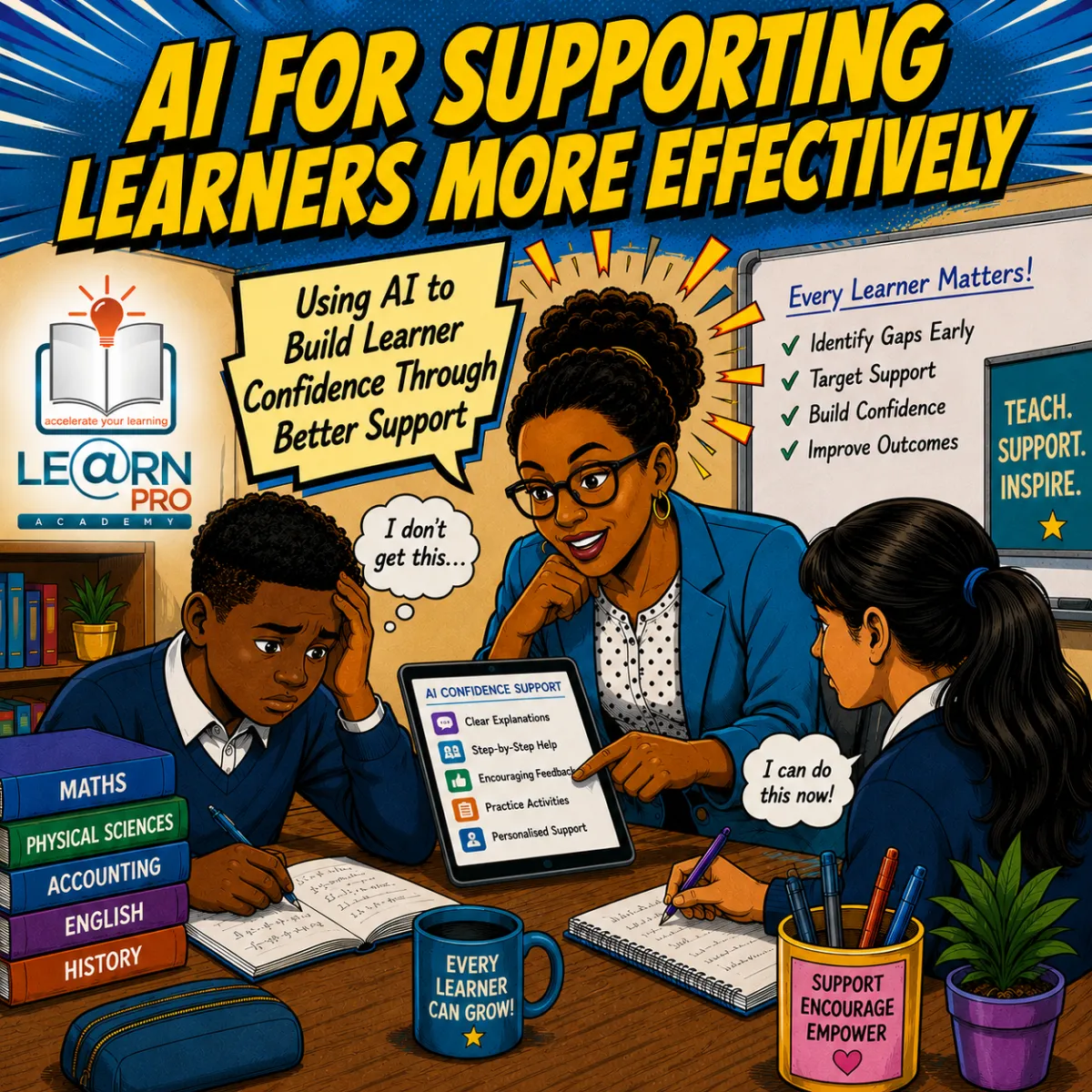
Using AI to Build Learner Confidence Through Better Support
This is article #4 of 5 in the AI for Supporting Learners More Effectively Series
Introduction
Confidence plays a vital role in learning. Two learners with the same ability can achieve very different results simply because one believes they can succeed while the other has convinced themselves they cannot. In classrooms across South Africa, many learners gradually lose confidence after repeated struggles, poor test results, or difficulty understanding new concepts. Over time, they begin to label themselves as "bad at Mathematics," "hopeless at Science," or "not clever enough."
These beliefs can become more damaging than the original learning difficulty. Learners who lose confidence often stop asking questions, avoid challenging tasks, and become afraid of making mistakes. They may complete less homework, participate less in class discussions, and approach assessments expecting failure.
Artificial Intelligence (AI) cannot replace the encouragement and relationships that educators build every day, but it can help teachers provide the kind of personalised academic support that strengthens learner confidence. AI can generate scaffolded activities, produce clearer explanations, identify suitable next steps, create targeted practice, and provide additional examples that allow learners to experience gradual success.
The objective is not to make work easier. Instead, it is to help learners progress in manageable stages so they experience regular achievement while working toward the same curriculum standards as their peers.
When used thoughtfully, AI becomes another tool that helps educators build capable, resilient, and confident learners who believe that improvement is possible through effort, practice, and support.
This article explores practical ways educators can use AI to strengthen learner confidence while maintaining high expectations and meaningful learning.
Understanding The Link Between Confidence And Learning
Confidence and learning influence one another.
When learners understand a topic, they usually become more confident.
When they become more confident, they are more willing to participate, ask questions, attempt difficult problems, and learn from mistakes.
Unfortunately, the opposite is also true.
Repeated struggles often lead learners to believe they lack ability rather than recognising that they need additional support.
This can create a cycle:
Learner struggles.
Confidence decreases.
Participation decreases.
Practice decreases.
Performance declines further.
Confidence drops again.
Breaking this cycle requires both academic support and emotional encouragement.
Confidence Is Built Through Success
Confidence is not developed through praise alone.
Learners become confident when they experience genuine progress.
This means:
Understanding a difficult concept
Solving problems independently
Improving assessment results
Completing challenging tasks
Seeing evidence of personal growth
AI helps educators create these opportunities by providing additional learning support that matches each learner's current level.
Small successes gradually build larger confidence.
AI Helps Personalise Learning
Large classes often make individual support difficult.
AI allows educators to create more personalised learning experiences without dramatically increasing preparation time.
Teachers can ask AI to generate:
Simpler explanations
Extra examples
Guided practice
Additional revision
Vocabulary support
Catch-up activities
Alternative explanations
Rather than every learner completing identical work, some learners receive additional support while working toward the same learning outcomes.
This individual attention helps learners experience success more regularly.
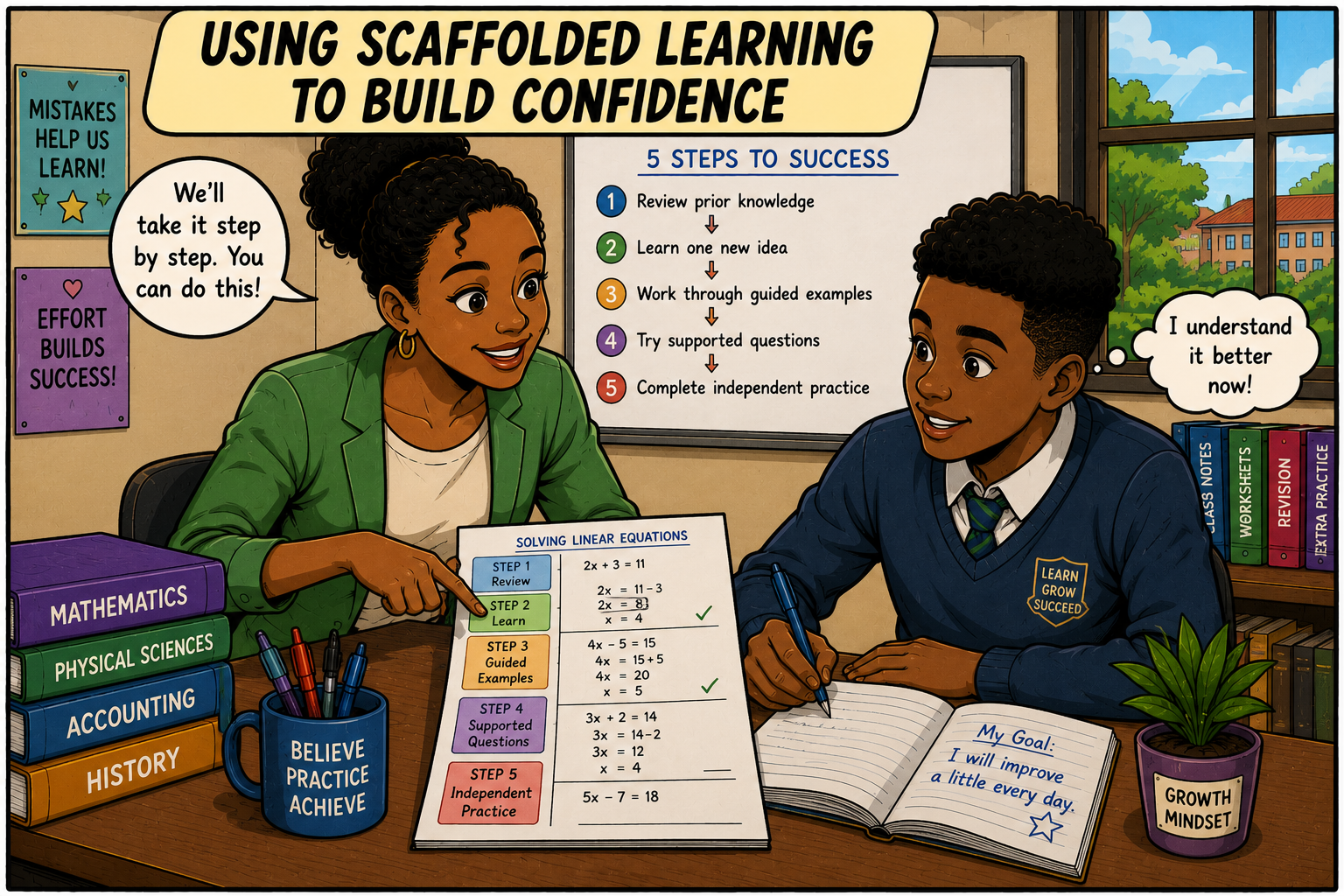
Using Scaffolded Learning To Build Confidence
Scaffolding provides structured support before expecting independent performance. AI can help educators design activities that progress gradually.
For example:
Step 1: Review prior knowledge.
Step 2: Introduce one new idea.
Step 3: Complete guided examples.
Step 4: Attempt supported questions.
Step 5: Complete independent practice.
Instead of feeling overwhelmed by a difficult task, learners experience continuous progress.
Each successful step strengthens confidence.
Providing Simpler Explanations Without Lowering Standards
Some learners lose confidence simply because the language used in textbooks feels overwhelming.
AI can rewrite explanations using:
Simpler vocabulary
Shorter sentences
Familiar examples
Clearer structure
For example, instead of introducing a difficult scientific definition immediately, educators can first present a simpler explanation before introducing formal terminology.
The curriculum remains unchanged.
Only the pathway to understanding becomes clearer.
Generating Additional Practice Opportunities
Confidence grows through repeated success. AI allows educators to create additional practice quickly.
Examples include:
Extra worksheets
Short quizzes
Homework
Revision activities
Worked examples
Multiple-choice questions
Fill-in-the-blank exercises
Learners who require more practice receive additional opportunities to improve before formal assessments.
Rather than feeling left behind, they continue progressing alongside their classmates.
Giving Immediate Opportunities To Improve
Many learners become discouraged when they receive poor marks but have no opportunity to correct their mistakes.
AI makes it easier to generate follow-up activities based on specific errors.
For example:
If a learner struggles with fractions, AI can produce ten additional fraction questions at an appropriate level.
After completing these successfully, learners experience immediate improvement.
This reinforces the idea that ability develops through practice.
Helping Learners Learn From Mistakes
Mistakes should become learning opportunities rather than sources of embarrassment.
AI can generate activities such as:
Error analysis
Correction exercises
"Find the mistake" activities
Alternative solution methods
Reflection questions
Instead of focusing only on incorrect answers, educators help learners understand why mistakes happened.
This develops resilience and reduces fear of failure.
Encouraging A Growth Mindset
Learners who believe intelligence is fixed often avoid difficult work.
Educators can use AI to create activities that reinforce a growth mindset.
Examples include:
Reflection journals
Goal-setting templates
Progress trackers
Weekly review questions
Personal improvement plans
These activities encourage learners to focus on progress rather than perfection.
AI supports this process by reducing preparation time.
Creating Individual Learning Goals
Confidence increases when learners work toward realistic goals.
AI can help educators generate personalised learning plans.
Examples include:
Week 1: Master multiplication of fractions.
Week 2: Solve mixed fraction problems.
Week 3: Apply fractions in word problems.
Breaking learning into achievable milestones helps learners experience continuous success.
Supporting Learners Before They Become Discouraged
Educators often notice warning signs before learners fail assessments.
These signs include:
Avoiding participation
Incomplete homework
Low motivation
Poor concentration
Increased frustration
Frequent guessing
AI can assist by generating additional support material immediately rather than waiting until after the assessment.
Early intervention prevents confidence from declining further.
Differentiating Support Without Singling Learners Out
Many learners dislike being identified as needing extra help. AI allows educators to create differentiated activities naturally.
For example:
Different groups may complete:
Guided questions
Independent tasks
Extension activities
All learners remain actively engaged while receiving appropriate levels of support.
This reduces embarrassment while encouraging progress.
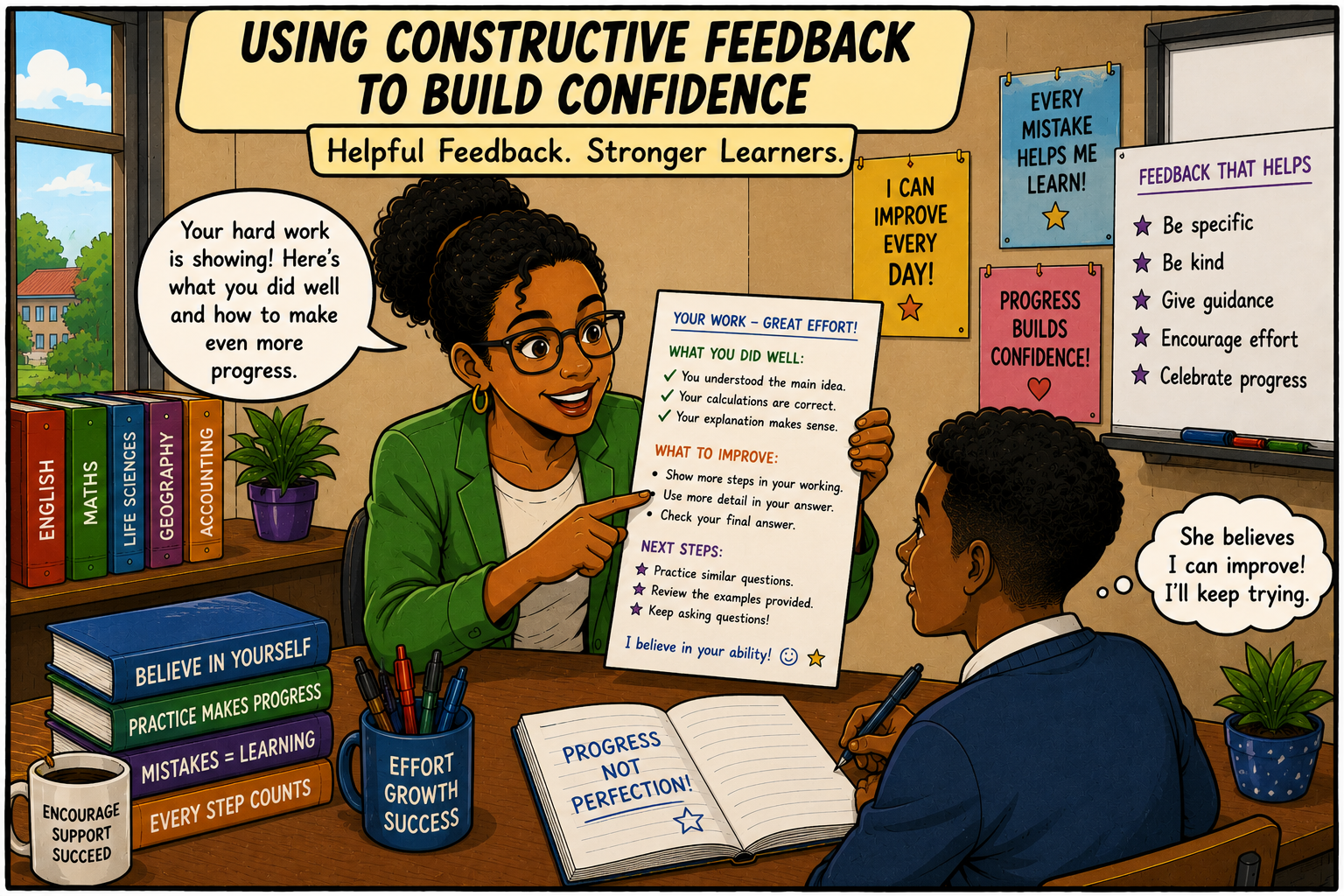
Using Positive Feedback Effectively
AI can help educators draft personalised feedback comments that are:
Specific
Encouraging
Action-oriented
Focused on improvement
Instead of writing: "Needs improvement."
AI might suggest: "You have correctly identified the main concept. The next step is to practise explaining your reasoning more clearly. Keep working through similar examples—you are making progress."
Constructive feedback encourages continued effort.
Helping Learners Recognise Their Own Progress
Many learners focus only on final marks. Educators should also highlight improvement.
AI can help generate:
Progress charts
Learning journals
Reflection questions
Goal reviews
Achievement trackers
When learners see measurable progress over several weeks, confidence develops naturally.
Supporting Independent Learning
Confident learners take greater responsibility for their own learning.
Educators can teach learners to use AI responsibly by asking questions such as:
"Explain this differently."
"Give me another example."
"Quiz me on this topic."
"Help me understand where I made a mistake."
"Create five practice questions."
These prompts encourage active learning instead of passive dependence.
Encouraging Classroom Participation
Learners with low confidence often remain silent even when they understand part of the lesson.
AI can help educators prepare:
Discussion prompts
Sentence starters
Guided responses
Think-pair-share activities
Confidence-building classroom questions
Structured participation allows hesitant learners to contribute successfully.
Positive classroom experiences strengthen confidence.
Building Confidence Across Different Subjects
Confidence challenges appear in every subject.
AI can generate targeted support for:
Mathematics
Worked examples
Gradual problem solving
Visual explanations
English
Vocabulary practice
Guided writing
Reading support
Physical Sciences
Simplified explanations
Practical examples
Step-by-step calculations
History
Essay planning
Source analysis
Timeline activities
Geography
Diagram interpretation
Case studies
Map work
Each subject benefits from personalised support.
Reviewing AI Content Carefully
Educators remain responsible for every resource used in the classroom.
Always review AI-generated material for:
Accuracy
CAPS alignment
Appropriate difficulty
Inclusive language
Cultural relevance
Correct answers
Suitable examples
AI supports teaching—it does not replace professional expertise.
Practical AI Prompts For Confidence Building
Educators can adapt prompts like these:
Simplify Learning:
"Explain Grade 10 algebra using simple English and everyday examples."
Generate Scaffolded Practice:
"Create a worksheet that progresses from easy to challenging questions on photosynthesis."
Build Confidence:
"Generate ten practice questions that gradually increase in difficulty for Grade 11 Accounting."
Reflection Activity:
"Create learner reflection questions that help students recognise their weekly progress."
Correct Misconceptions:
"Generate activities that help learners understand common mistakes in solving linear equations."
These prompts provide valuable starting points that educators can personalise.
The Human Relationship Remains The Greatest Confidence Builder
No technology can replace the influence of a caring educator:
Learners remember teachers who believed in them.
They remember encouragement after failure.
They remember patience when they struggled.
AI cannot recognise disappointment on a learner's face.
It cannot celebrate a breakthrough moment.
It cannot reassure a nervous learner before an examination.
Those moments belong to educators.
AI simply gives teachers more time and better resources to create them.
Creating A Classroom Where Every Learner Believes They Can Succeed
Confidence grows in classrooms where:
Mistakes are treated as learning opportunities.
Questions are welcomed.
Progress is celebrated.
Effort is recognised.
Learners support one another.
Success is measured over time, not by one assessment.
AI helps educators provide the personalised support that makes this environment easier to achieve.
Technology becomes valuable not because it replaces teaching, but because it strengthens the educator's ability to reach every learner.
Conclusion
Learner confidence is built through meaningful support, consistent encouragement, and repeated experiences of success. Many learners who appear to lack ability are simply carrying learning gaps, language barriers, or previous disappointments that have caused them to lose belief in themselves. With the right guidance and opportunities to improve, these learners can rebuild both their understanding and their confidence.
AI offers educators practical ways to make this support more achievable. By generating scaffolded activities, differentiated practice, personalised explanations, targeted revision, and constructive feedback, AI allows teachers to provide more individualised learning experiences without dramatically increasing their workload. Learners benefit from steady progress, achievable challenges, and regular opportunities to experience success while working toward the same curriculum outcomes as their classmates.
However, confidence ultimately grows through human relationships. An encouraging conversation, patient guidance, thoughtful feedback, and genuine belief in a learner's potential remain the most powerful confidence-building tools in education. AI cannot replace these interactions, but it can create more time for them by reducing routine preparation tasks.
When educators combine their professional expertise with thoughtfully used AI tools, they create classrooms where learners are supported academically, encouraged emotionally, and inspired to believe that improvement is always possible. That belief becomes the foundation for stronger performance, greater resilience, and lifelong learning.
Additional Articles in the AI for Supporting Learners More Effectively Series
How AI Can Help Educators Support Struggling Learners
Using AI to Create Extra Practice Material for Learners Who Need More Help
How AI Can Support Learners with Language Barriers in the Classroom
Using AI to Build Learner Confidence Through Better Support
How to Use AI to Identify Common Learning Gaps Before Exams
Disclaimer
AI Tools were used to assist with research. Remember to always cross-check everything that you read.