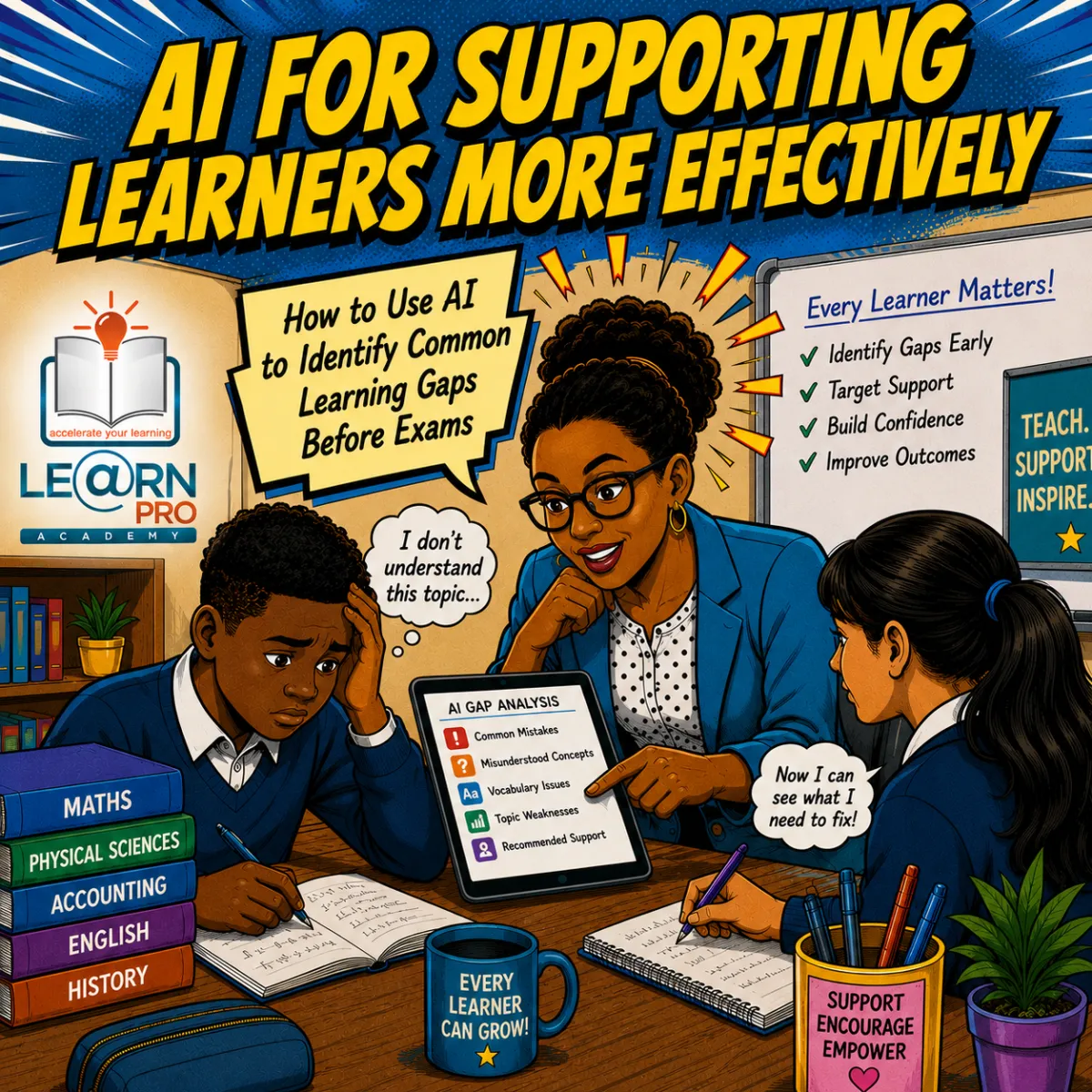
How to Use AI to Identify Common Learning Gaps Before Exams
This is article #5 of 5 in the AI for Supporting Learners More Effectively Series
Introduction
One of the greatest challenges educators face is discovering that many learners have misunderstood important concepts only when they begin preparing for examinations. By that stage, time is limited, pressure is increasing, and both teachers and learners are trying to correct months of misunderstandings in just a few weeks. Revision becomes stressful because educators are not only reviewing content — they are reteaching concepts that learners never fully understood in the first place.
In South African classrooms, where educators often teach large classes while balancing curriculum coverage, assessment, administration, and extracurricular responsibilities, it is not always easy to identify every learner's difficulties early enough. A learner may appear to understand a lesson during class, complete homework with assistance at home, and only reveal significant misconceptions during a formal assessment.
Artificial Intelligence (AI) offers practical ways to help educators identify these learning gaps much earlier. By analysing learner responses, spotting recurring mistakes, identifying common misconceptions, and helping organise assessment data, AI can reveal patterns that might otherwise remain hidden. Instead of focusing only on individual learners, AI can also help teachers recognise class-wide weaknesses and generate targeted revision materials before small misunderstandings become major examination problems.
Importantly, AI does not replace professional judgement. Educators still interpret assessment results, understand their learners, and decide how best to respond. AI simply helps process information more efficiently, allowing teachers to spend more time supporting learners rather than searching for patterns manually.
This article explores how educators can use AI responsibly to identify common learning gaps early, plan targeted interventions, and help learners enter examinations with greater understanding and confidence.
Understanding Learning Gaps
A learning gap is the difference between what learners are expected to know and what they actually understand.
Learning gaps develop for many reasons, including:
Missing foundational knowledge
Misunderstanding earlier lessons
Language barriers
Poor attendance
Limited practice
Lack of confidence
Rushing through the curriculum
Memorising instead of understanding
These gaps often remain hidden until learners encounter more advanced work that depends on earlier concepts.
For example, a learner who never fully understood fractions may struggle with algebra, percentages, probability, and financial mathematics later in the year.
Identifying these gaps early is one of the most valuable ways educators can improve learner outcomes.
Why Waiting Until Exam Revision Is Too Late
Many schools begin intensive revision only a few weeks before examinations. Although revision is important, it cannot replace months of consistent understanding.
When major misconceptions are discovered during revision:
Learners feel overwhelmed.
Teachers have less time to provide support.
Confidence decreases.
Revision becomes reteaching.
Examination anxiety increases.
AI helps educators identify these issues much earlier so that intervention becomes part of everyday teaching rather than an emergency response.
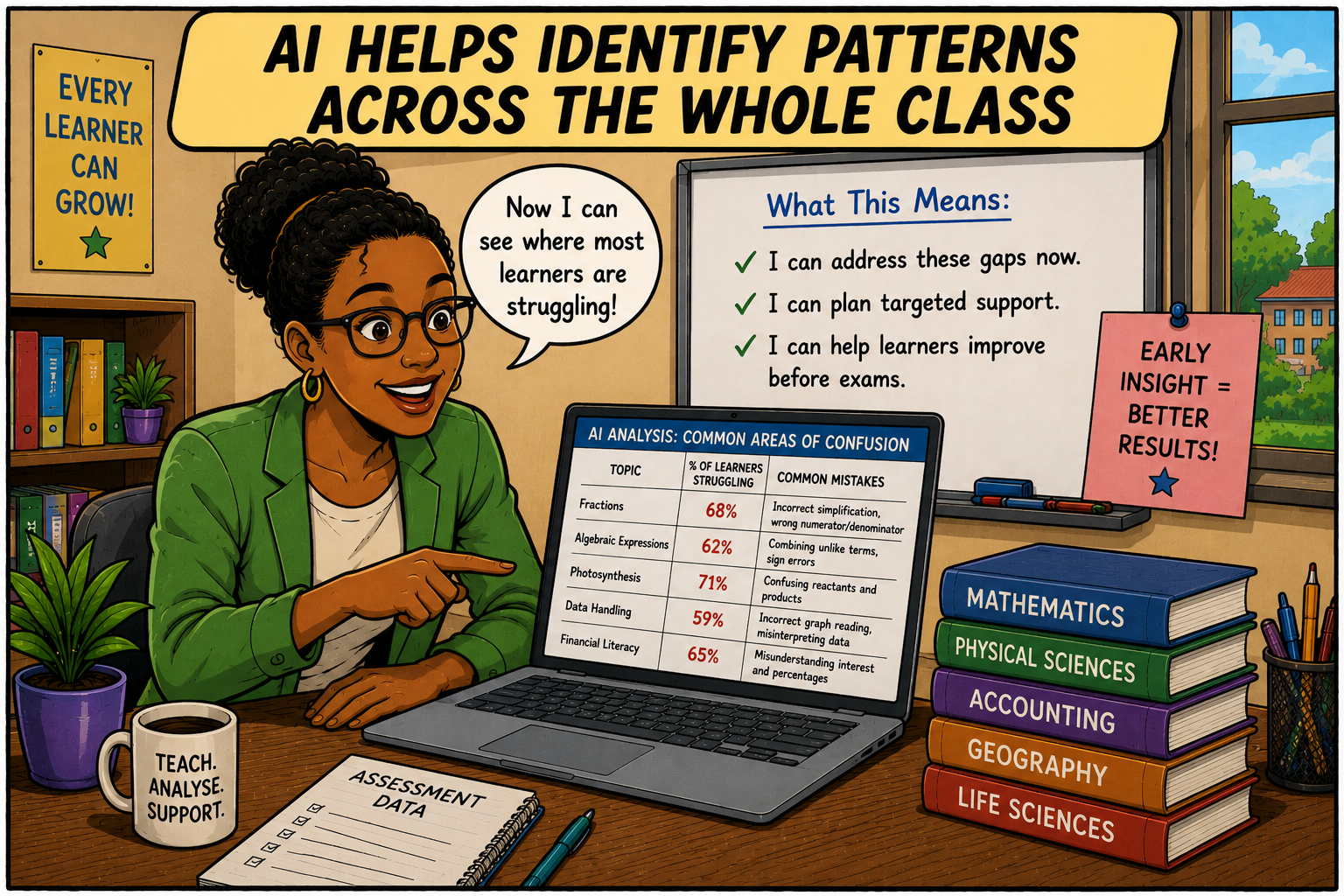
AI Helps Identify Patterns Across The Whole Class
Educators naturally notice individual learners who struggle.
However, identifying patterns across thirty or forty learners is much more difficult.
AI can help educators analyse:
Common incorrect answers
Frequently misunderstood concepts
Repeated vocabulary errors
Common calculation mistakes
Frequently skipped questions
Topics with consistently low marks
For example, after reviewing a class test, AI may identify that 70% of learners misunderstood one particular concept.
This allows the educator to revisit that topic before moving forward.
Looking Beyond Marks
Marks alone do not explain why learners struggle. Two learners who score 50% may have completely different learning needs.
AI encourages educators to analyse:
Which questions were missed
Why answers were incorrect
Which concepts caused difficulty
Whether mistakes followed similar patterns
Whether language affected understanding
This deeper analysis provides far more useful information than percentages alone.
Using Formative Assessment More Effectively
Formative assessment provides regular information about learner understanding.
Examples include:
Class discussions
Exit tickets
Homework
Short quizzes
Practical activities
Oral questioning
AI can help educators review these smaller assessments and identify trends before formal examinations.
Instead of waiting for term tests, teachers receive ongoing information about learner progress.
Identifying Common Misconceptions
Many learner mistakes follow predictable patterns.
For example:
Mathematics
Confusing numerator and denominator.
Physical Sciences
Mixing up mass and weight.
Geography
Confitting weather and climate.
Accounting
Misclassifying assets and expenses.
History
Confusing causes with consequences.
AI can identify these recurring misconceptions and suggest targeted revision activities.
Spotting Vocabulary Problems
Sometimes learners understand concepts but misunderstand assessment questions because of unfamiliar academic vocabulary.
AI can identify words that repeatedly confuse learners, including:
evaluate
justify
compare
analyse
infer
distinguish
calculate
Educators can then create focused vocabulary activities before examinations.
Improving understanding of command words often leads to better assessment performance.
Tracking Progress Throughout The Year
Learning gaps become easier to address when educators monitor progress continuously.
AI can help organise assessment information by:
Topic
Term
Individual learner
Class averages
Frequently missed concepts
This allows teachers to identify whether learners are improving or whether the same problems continue appearing.
Progress tracking supports better long-term planning.
Comparing Different Assessments
A single assessment provides limited information.
AI becomes more valuable when educators compare several assessments.
For example:
If learners repeatedly struggle with algebra across three different tests, the educator gains strong evidence that additional intervention is needed.
This prevents teachers from assuming poor performance resulted from one difficult assessment.
Generating Targeted Revision Material
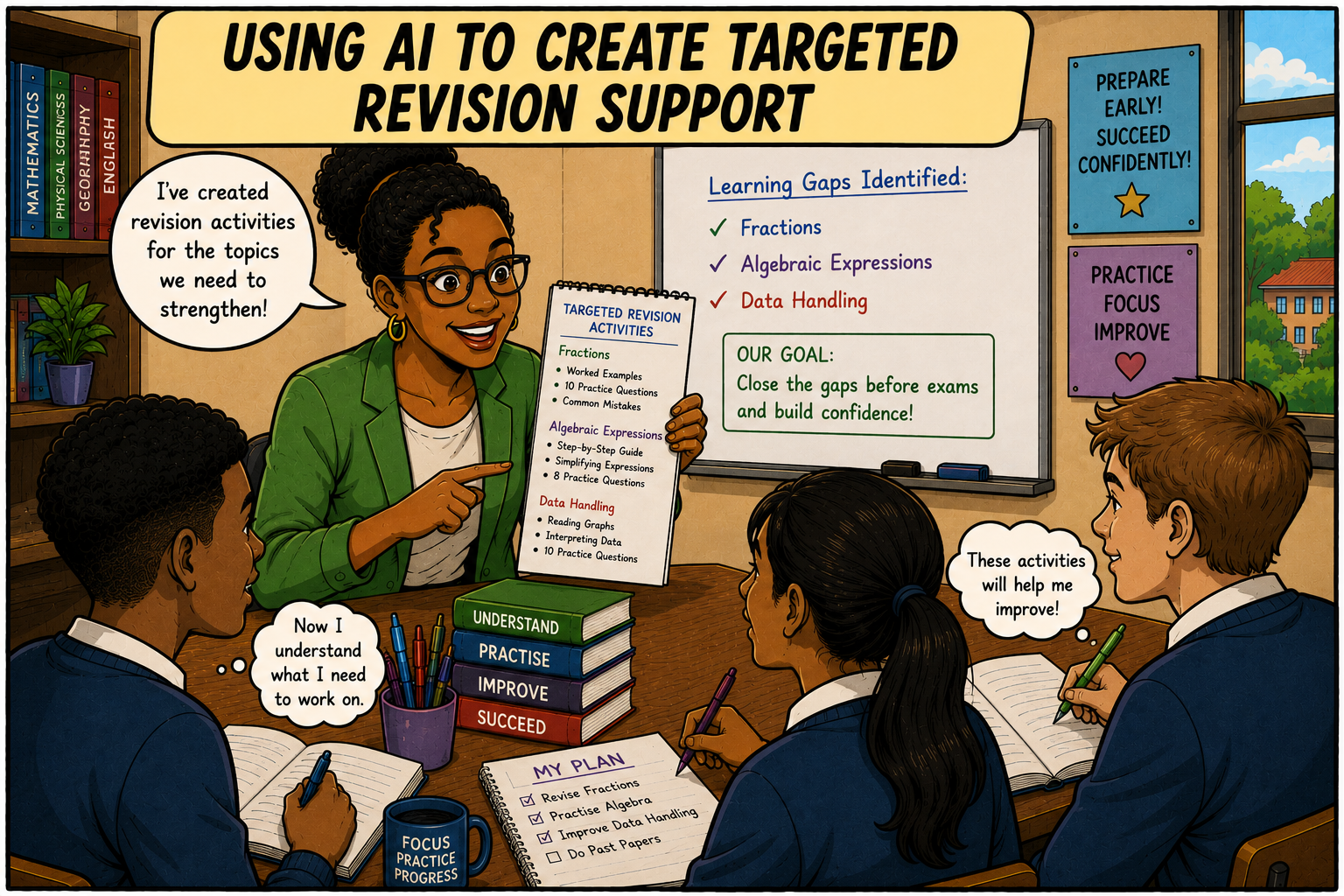
Once learning gaps have been identified, AI can help create focused revision resources.
Examples include:
Revision worksheets
Worked examples
Vocabulary activities
Summary notes
Practice quizzes
Multiple-choice questions
Homework
Small group activities
Rather than revising every topic equally, educators can concentrate on the areas where learners need the most support.
Supporting Small-Group Intervention
Different learners often require different support.
AI can help educators organise targeted intervention groups.
For example:
Group One
Needs support with fractions.
Group Two
Needs support with academic vocabulary.
Group Three
Needs extension work.
This allows teachers to provide more focused instruction while managing large classes effectively.
Helping Individual Learners
Although class-wide trends are important, individual learners also benefit from targeted support.
AI can help educators create personalised revision plans based on learner needs.
For example:
Learner A:
Improve graph interpretation
Revise percentages
Practise data handling
Learner B:
Strengthen essay planning
Learn key terminology
Improve source analysis
Personalised guidance increases revision efficiency.
Supporting Learners Before Confidence Declines
Confidence often decreases when learners repeatedly experience failure.
By identifying learning gaps earlier, educators can intervene before learners begin believing they cannot succeed.
Early support may include:
Additional explanations
Guided practice
Small-group teaching
Peer support
Scaffolded activities
Extra homework
Success builds confidence, making learners more willing to engage with future learning.
AI Helps Save Valuable Teacher Time
Reviewing hundreds of learner responses manually requires significant time.
AI can assist by:
Organising assessment data
Summarising common mistakes
Highlighting recurring trends
Suggesting intervention priorities
Drafting revision resources
Instead of spending hours analysing papers, educators can spend more time teaching, supporting learners, and planning interventions.
Maintaining Professional Judgement
AI should never decide what learners know.
Educators remain responsible for interpreting assessment evidence.
Teachers understand:
Classroom participation
Learner attitudes
Individual circumstances
Language barriers
Behaviour during assessments
Emotional wellbeing
AI provides useful information.
Professional judgement turns that information into effective teaching.
Reviewing AI Analysis Carefully
AI-generated analysis should always be reviewed.
Educators should check:
Accuracy of identified patterns
Correct interpretation
Curriculum alignment
Context of learner responses
Whether unusual circumstances affected results
AI supports analysis but should never replace thoughtful educational decision-making.
Practical AI Prompts For Identifying Learning Gaps
The following prompts can help educators begin using AI effectively.
Analyse Assessment Results
"Review these anonymous learner responses and identify the five most common misconceptions."
Identify Revision Priorities
"Suggest which topics should receive additional revision based on these assessment results."
Generate Targeted Practice
"Create a revision worksheet focusing on learners who struggle with quadratic equations."
Identify Vocabulary Issues
"List academic words that learners may misunderstand in this Geography assessment."
Create Intervention Activities
"Suggest three classroom activities to address common misconceptions about photosynthesis."
These prompts help educators transform assessment data into meaningful action.
Building A Culture Of Continuous Improvement
The ultimate goal is not simply identifying learning gaps.
It is creating a classroom culture where:
Mistakes are expected.
Learners ask questions confidently.
Assessment guides teaching.
Progress is monitored regularly.
Revision happens throughout the year.
Improvement is celebrated.
AI supports this culture by making ongoing analysis more manageable.
Instead of waiting for examination season, educators continuously strengthen learner understanding.
Preparing Learners For Exam Success
Effective examination preparation begins months before the examination itself.
Learners perform better when:
Foundations are secure.
Misconceptions are corrected early.
Vocabulary is understood.
Practice is targeted.
Confidence develops gradually.
AI helps educators make these conditions easier to achieve.
Rather than reacting to poor results, teachers become proactive in supporting learner success.
The Educator Remains At The Centre
Technology can identify patterns.
Technology can organise information.
Technology can suggest resources.
Only educators can decide how to respond.
Teachers understand their learners' personalities, strengths, challenges, and motivation.
They know when a learner needs another explanation, additional encouragement, or simply reassurance before an assessment.
AI strengthens these professional decisions — it never replaces them.
Conclusion
Learning gaps rarely appear suddenly during examination season. Most begin much earlier through small misunderstandings, missed lessons, limited practice, or incomplete understanding of foundational concepts. When these gaps remain unnoticed, they gradually affect learner confidence and performance across multiple topics. By the time final revision begins, educators often face the difficult task of reteaching important concepts under significant time pressure.
AI provides practical ways to identify these learning gaps sooner. By analysing learner responses, recognising recurring misconceptions, highlighting vocabulary difficulties, comparing assessment results, and generating targeted revision resources, AI enables educators to intervene before misunderstandings become major obstacles. Instead of relying only on final marks, teachers gain deeper insight into why learners are struggling and where additional support will have the greatest impact.
However, AI remains a support tool rather than a decision-maker. Professional judgement, classroom observation, learner relationships, and teaching experience continue to guide every intervention. Educators determine which patterns matter, how learners should be supported, and how revision should be planned to meet the needs of their specific classes.
When teachers combine thoughtful assessment with responsible AI use, they create learning environments where misconceptions are addressed early, confidence grows steadily, and learners enter examinations better prepared for success. Early intervention, supported by AI and guided by skilled educators, transforms assessment from a record of performance into a powerful tool for improving learning.
Additional Articles in the AI for Supporting Learners More Effectively Series
How AI Can Help Educators Support Struggling Learners
Using AI to Create Extra Practice Material for Learners Who Need More Help
How AI Can Support Learners with Language Barriers in the Classroom
Using AI to Build Learner Confidence Through Better Support
How to Use AI to Identify Common Learning Gaps Before Exams
Disclaimer
AI Tools were used to assist with research. Remember to always cross-check everything that you read.