
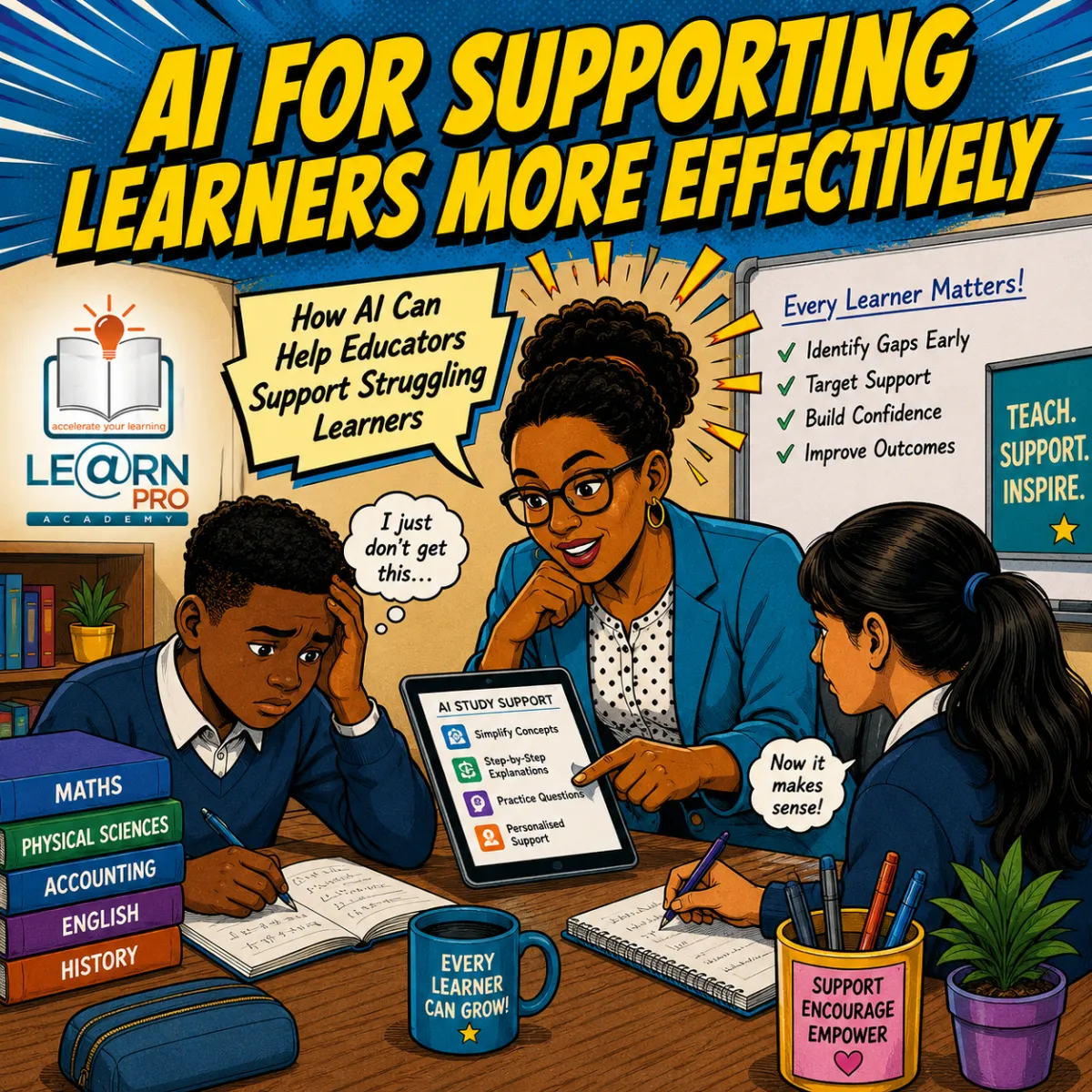
How AI Can Help Educators Support Struggling Learners
This is article #1 of 5 in the AI for Supporting Learners More Effectively Series
Introduction
Every classroom includes learners who struggle at some point. Some battle to understand new concepts because they missed important foundations earlier in the year. Others lose confidence after repeated poor marks, while some simply need information explained in a different way. In South African classrooms, educators also work with learners who have different language backgrounds, learning speeds, home circumstances, and access to resources. Supporting every learner individually is one of the greatest challenges teachers face.
Artificial Intelligence (AI) is not a replacement for the educator's knowledge, experience, or care. Instead, it can serve as a practical assistant that helps teachers create additional learning resources more quickly. AI can generate simpler explanations, produce extra examples, suggest alternative teaching methods, and create differentiated activities that give struggling learners more opportunities to succeed.
The key is to remember that AI should strengthen personalised teaching—not replace it. Educators remain the professionals who understand their learners' personalities, abilities, and learning needs. AI simply helps reduce preparation time so teachers can spend more time supporting learners where it matters most.
This article explores practical ways educators can use AI to provide better support for struggling learners while maintaining high academic standards and encouraging genuine understanding.
Understanding Why Learners Struggle
Before using AI, it is important to understand that struggling learners are not all struggling for the same reasons.
One learner may have missed several weeks of school because of illness. Another may not fully understand English, even though they understand the subject itself. Some learners experience anxiety during assessments, while others simply require more repetition before concepts become clear.
Common reasons learners struggle include:
Missing foundational knowledge
Language barriers
Lack of confidence
Learning at a different pace
Limited study skills
Poor attendance
Difficult home circumstances
Fear of making mistakes
Learning disabilities or special educational needs
Limited access to learning resources outside school
These challenges often overlap. A learner who lacks confidence may stop asking questions, causing even more misunderstandings over time.
AI cannot solve these problems on its own, but it can help educators respond more effectively.
AI Helps Educators Differentiate More Easily
Differentiated teaching means providing different forms of support while working toward the same learning outcomes.
In reality, creating multiple versions of every lesson takes considerable time.
AI can help generate:
Simpler explanations
Additional examples
Easier practice questions
Extension activities
Vocabulary support
Revision summaries
Alternative classroom activities
Instead of preparing everything from scratch, educators can ask AI to generate a first draft and then adapt it for their own learners.
For example: "Explain photosynthesis to a Grade 10 learner using simple English and everyday examples suitable for South African learners."
Or: "Create three different explanations of Newton's Laws using increasing levels of difficulty."
The educator still reviews and improves the material before using it.
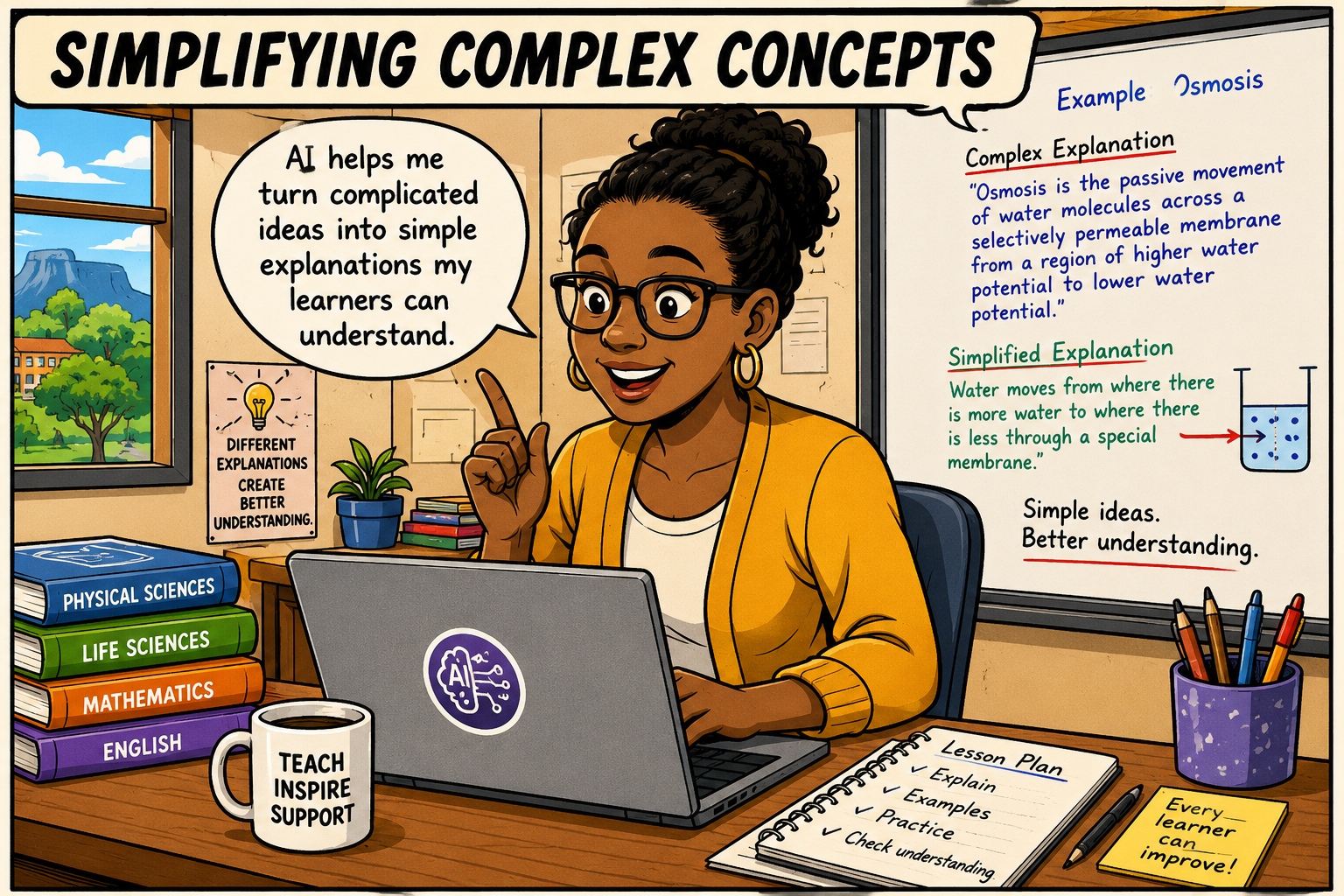
Simplifying Complex Concepts
Many learners struggle because textbooks often introduce ideas using formal academic language. AI can help translate difficult explanations into language that learners understand more easily. Instead of replacing correct terminology, AI can build understanding step by step.
For example:
Original explanation: "Osmosis is the passive movement of water molecules across a selectively permeable membrane from a region of higher water potential to lower water potential."
AI-assisted simplified version: "Imagine water moving through a fine filter. Water naturally moves from where there is more water to where there is less. In living cells, this movement happens through a special membrane called a selectively permeable membrane."
Once learners understand the simple explanation, educators can introduce the scientific terminology with greater confidence.
Providing Multiple Explanations
Not every learner understands information presented in the same way.
Some learners prefer:
Stories
Analogies
Diagrams
Step-by-step instructions
Real-life examples
Practical demonstrations
AI can quickly generate multiple explanations of the same concept.
For example:
A Mathematics teacher might ask AI to explain simultaneous equations:
using algebra
using graphs
using everyday scenarios
using simple numerical examples
This flexibility allows educators to reach learners who may not respond to one teaching approach alone.
Generating Extra Practice Without Starting Over
Practice is one of the most effective ways to improve understanding. Unfortunately, creating new practice material every week requires significant preparation time.
AI can help produce:
Additional worksheets
Short quizzes
Homework activities
Revision questions
Matching exercises
Multiple-choice questions
Fill-in-the-blank activities
Sentence correction exercises
For example:
Instead of giving every learner the same worksheet repeatedly, an educator can ask AI to create five similar questions that test the same skill without repeating identical numbers or wording.
This provides valuable reinforcement while reducing preparation time.
Supporting Learners Who Missed Previous Work
Many struggling learners fall behind because they missed important lessons.
Rather than asking them to catch up alone, educators can use AI to generate:
Lesson summaries
Key vocabulary lists
Essential concepts
Catch-up worksheets
Guided revision plans
Short reading notes
For example:
A learner returning after illness may receive a simplified summary of the previous week's work before joining the rest of the class.
This helps close learning gaps more quickly.
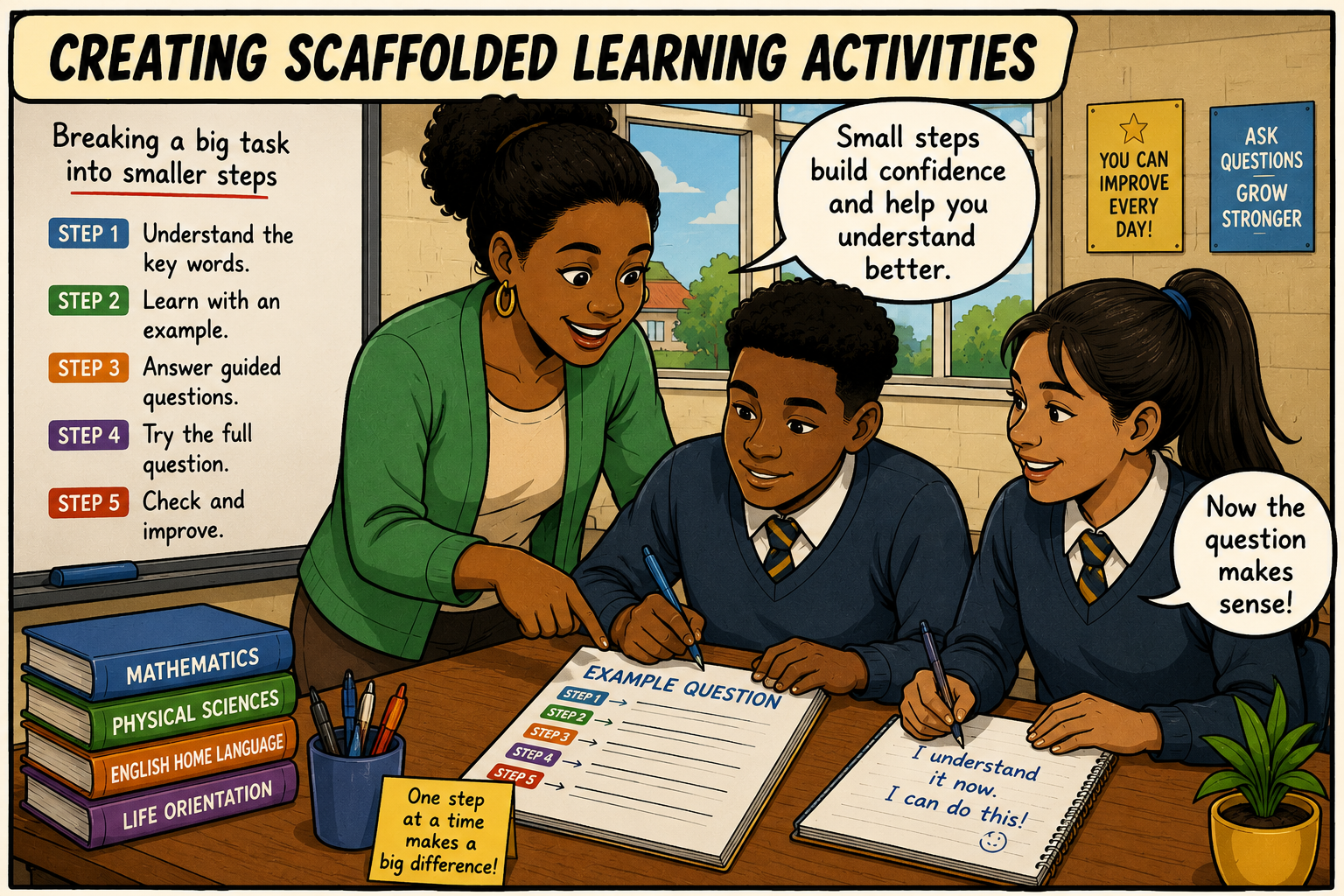
Creating Scaffolded Learning Activities
Scaffolding means providing structured support before expecting learners to complete tasks independently.
AI can help educators design activities that gradually increase in difficulty.
For example:
Instead of giving one difficult Geography question immediately, AI could generate:
Step 1: Identify the important words.
Step 2: Explain each word.
Step 3: Read a short example.
Step 4: Answer guided questions.
Step 5: Answer the original examination question.
This gradual progression helps learners experience success while building confidence.
Helping Learners Build Vocabulary
Vocabulary is often one of the biggest barriers to learning.
Subjects such as:
Physical Sciences
Accounting
Geography
Business Studies
Life Sciences
contain specialised language that learners must understand before they can answer questions correctly.
AI can generate:
Vocabulary lists
Simple definitions
Flashcards
Word games
Matching activities
Example sentences
Revision quizzes
Instead of memorising definitions, learners begin understanding how vocabulary is used within the subject.
Supporting English Additional Language Learners
South African classrooms include many learners who speak English as an additional language. Often these learners understand ideas better than they can express them in English.
AI can help educators:
simplify instructions
explain unfamiliar words
rewrite passages using simpler language
generate bilingual vocabulary lists where appropriate
create additional comprehension questions
Importantly, AI should not lower academic expectations.
Instead, it should remove unnecessary language barriers so learners can demonstrate what they actually know.
Encouraging Independent Learning
The goal is not to make learners dependent on AI. Instead, educators can teach learners how to use AI responsibly to support their own learning.
For example, learners might ask AI:
"Explain this paragraph in simpler English."
"Give me another example."
"Ask me five revision questions."
"Explain where I made a mistake."
"Create a short quiz on this chapter."
These uses encourage active learning rather than passive copying.
Educators should also teach learners to verify AI responses using textbooks, class notes, and trusted educational sources.
Identifying Misunderstandings Earlier
Sometimes learners appear to understand a lesson but reveal misconceptions during assessments.
AI can help educators review:
common incorrect answers
repeated misconceptions
confusing terminology
frequently missed calculations
patterns across multiple learners
For example:
If many learners confuse velocity with speed, AI may identify that misunderstanding after analysing assessment responses and suggest additional teaching activities.
This enables earlier intervention before misconceptions become permanent.
Creating Individualised Revision Material
Although educators cannot realistically produce completely different revision packs for every learner, AI can make individualisation more achievable.
Teachers can ask AI to generate:
easier revision sheets
targeted question sets
additional worked examples
simplified summaries
topic-specific practice
For example:
One learner may need extra support with fractions, while another struggles with algebra.
Both can receive revision materials focused on their specific needs.
Saving Time for Meaningful Teacher Support
One of AI's greatest advantages is not simply creating content — it is saving educator time.
Time saved on preparing worksheets or summaries can instead be invested in:
one-on-one conversations
small group teaching
learner encouragement
parent communication
classroom observation
individual feedback
Technology should never replace these valuable human interactions.
Instead, it should create more opportunities for them.
Maintaining High Academic Standards
Supporting struggling learners does not mean making learning easier. It means making learning more accessible. Educators should avoid asking AI to reduce the curriculum or remove challenging concepts.
Instead, AI should help learners reach the required standards through:
clearer explanations
additional practice
gradual progression
structured guidance
improved revision opportunities
High expectations combined with strong support produce better long-term learning outcomes.
Reviewing AI Content Before Using It
Educators should never use AI-generated material without reviewing it carefully.
Always check:
factual accuracy
curriculum alignment
CAPS requirements
appropriate language level
cultural relevance
examples suitable for South African learners
spelling and grammar
correct calculations
AI occasionally makes mistakes or provides examples that are not appropriate for local classrooms.
Professional judgement remains essential.
Practical AI Prompts Educators Can Use
Here are some practical prompts educators can adapt.
Simplify A Concept: "Explain Grade 11 chemical equilibrium using simple English suitable for South African learners."
Generate Additional Practice: "Create ten additional Grade 10 Mathematics questions on quadratic equations with answers."
Build Vocabulary: "Create a vocabulary list for Grade 12 Geography climate change with learner-friendly definitions."
Support Catch-Up Learning: "Summarise the key concepts from this History lesson for a learner who missed class."
Identify Misunderstandings: "Suggest common misconceptions learners have about electric circuits and provide activities to correct them."
These prompts save preparation time while allowing teachers to customise the final materials.
Keeping The Human Connection At The Centre
Learners who struggle academically often need more than additional worksheets.
They need encouragement.
They need patience.
They need someone who believes they can improve.
AI cannot recognise when a learner feels discouraged after repeated failure.
It cannot notice a learner becoming withdrawn during a lesson.
It cannot replace the positive relationships that motivate learners to keep trying.
The educator remains the most important influence in the classroom.
AI should simply make it easier for teachers to provide the personalised support that every learner deserves.
Conclusion
Supporting struggling learners has always been one of the most rewarding — and demanding — parts of teaching. Every learner brings different strengths, challenges, experiences, and learning needs into the classroom. Providing the right support for each individual can be difficult, especially when educators are balancing large classes, administrative responsibilities, assessment, and curriculum requirements.
AI offers practical ways to reduce some of this workload. It can help educators generate simpler explanations, create additional practice activities, identify common misconceptions, produce targeted revision material, and provide differentiated learning resources in far less time than traditional preparation methods.
However, successful learner support still depends on professional judgement. Teachers understand their learners in ways that AI never can. They recognise emotional needs, identify barriers to learning, build trust, and encourage perseverance when learners begin to lose confidence.
When educators combine their expertise with thoughtfully used AI tools, they can provide more personalised, timely, and effective support without lowering academic standards. Used responsibly, AI becomes a valuable teaching assistant that helps every learner move closer to success — one clearer explanation, one extra opportunity to practise, and one encouraging conversation at a time.
Additional Articles in the AI for Supporting Learners More Effectively Series
How AI Can Help Educators Support Struggling Learners
Using AI to Create Extra Practice Material for Learners Who Need More Help
How AI Can Support Learners with Language Barriers in the Classroom
Using AI to Build Learner Confidence Through Better Support
How to Use AI to Identify Common Learning Gaps Before Exams
Disclaimer
AI Tools were used to assist with research. Remember to always cross-check everything that you read.