
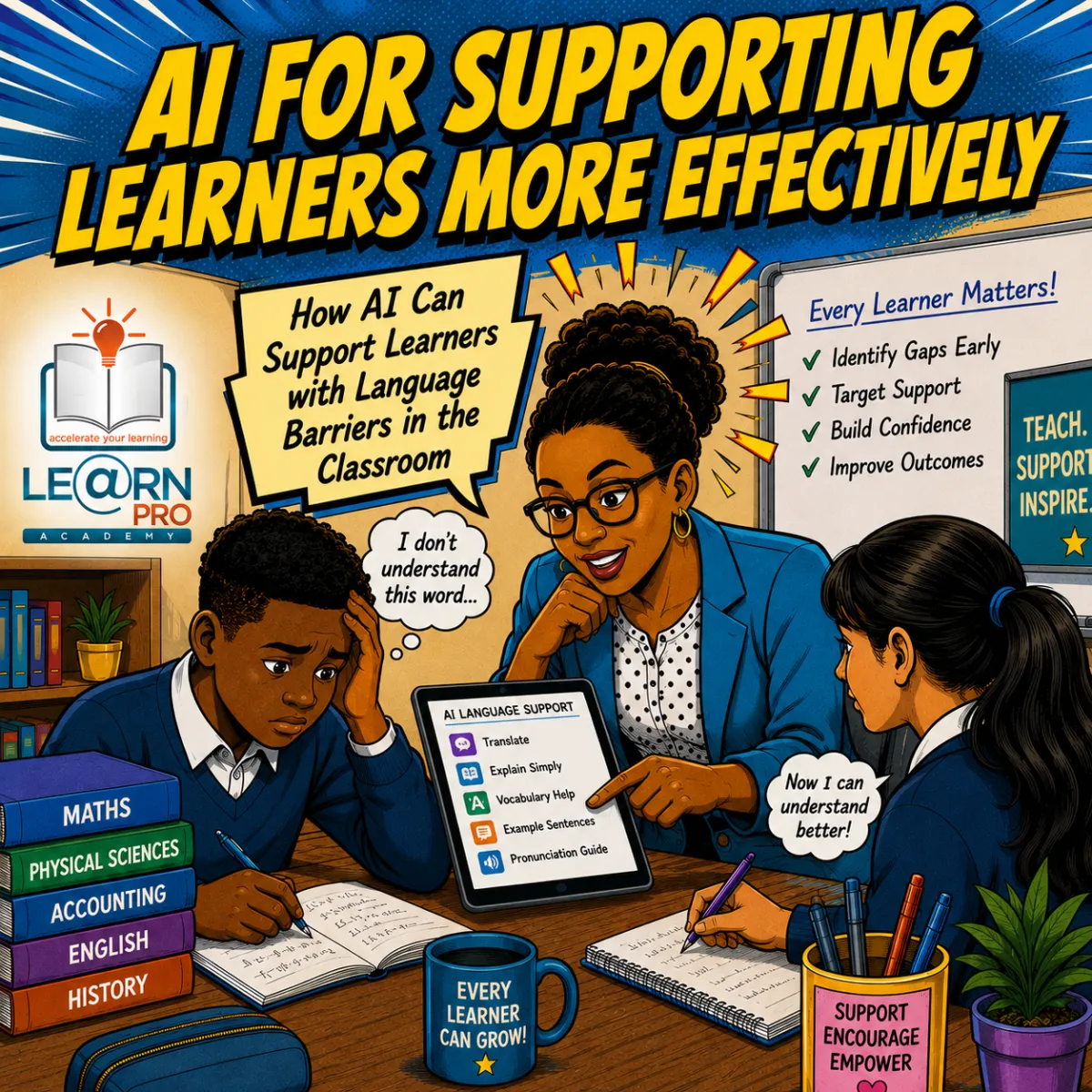
How AI Can Support Learners with Language Barriers in the Classroom
This is article #3 of 5 in the AI for Supporting Learners More Effectively Series
Introduction
South Africa is one of the most linguistically diverse countries in the world. Many learners speak one of the country's eleven official languages at home, yet receive much of their education in English. While many learners develop good conversational English, academic English presents a very different challenge. Understanding subject-specific vocabulary, complex instructions, examination questions, and formal textbooks requires language skills that take years to develop.
As a result, many learners understand the underlying ideas but struggle to express what they know in English. Others misunderstand assessment questions because of unfamiliar vocabulary rather than a lack of subject knowledge. These language barriers can affect performance across every subject, from Mathematics and Physical Sciences to History, Geography, and Business Studies.
Artificial Intelligence (AI) offers educators practical ways to reduce these language barriers without lowering academic expectations. AI can simplify explanations, rephrase instructions, generate vocabulary support, create examples using simpler language, and produce additional learning materials that make complex concepts more accessible. Used responsibly, AI helps learners access the curriculum more effectively while continuing to build their English proficiency.
However, AI should never replace language development. The goal is not to remove English from learning but to provide temporary support that helps learners understand increasingly complex academic language over time. Educators remain responsible for maintaining curriculum standards, encouraging language growth, and ensuring that learners continue developing the communication skills they will need beyond school.
This article explores practical ways educators can use AI to support learners with language barriers while promoting both academic success and long-term language development.
Understanding Language Barriers In The Classroom
Language barriers are often misunderstood.
A learner who struggles to answer questions in English is not necessarily struggling with the subject itself. Many learners understand concepts when they are explained verbally or demonstrated practically, yet find it difficult to read complex textbook language or write detailed academic answers.
Common language-related challenges include:
Understanding unfamiliar vocabulary
Reading long textbook passages
Interpreting examination questions
Following detailed written instructions
Expressing ideas in formal English
Using subject-specific terminology correctly
Participating confidently in discussions
Writing extended responses
These challenges affect learning across every subject.
Recognising the difference between language difficulties and content difficulties allows educators to provide more appropriate support.
Why Language Matters Across Every Subject
Language is not only important in English Home Language or English First Additional Language.
Every subject depends on learners understanding instructions, reading information, and communicating ideas clearly.
For example:
In Mathematics, learners must interpret word problems before solving calculations.
In Physical Sciences, they must understand scientific terminology before applying formulas.
In Geography, they need to explain processes using correct vocabulary.
In History, they must interpret sources and construct reasoned arguments.
If learners misunderstand the language, they may never have the opportunity to demonstrate what they actually know.
AI can help remove unnecessary language obstacles while preserving academic challenge.
AI Can Simplify Without Oversimplifying
One of AI's greatest strengths is its ability to rewrite information using different language levels. Instead of removing important concepts, AI can explain them more clearly.
For example, an educator might ask: "Rewrite this Grade 11 Life Sciences explanation using simpler English while keeping all the scientific terms learners need to know."
The response may include:
Shorter sentences
Familiar vocabulary
Clearer sentence structure
Easier transitions between ideas
Practical examples
The academic content remains the same. Only the language becomes more accessible.
Rephrasing Classroom Instructions
Sometimes learners lose marks because they misunderstand what a task requires. Long instructions filled with unfamiliar vocabulary can create unnecessary confusion. AI can help educators rewrite classroom instructions into simpler English.
For example:
Original instruction: "Evaluate the effectiveness of the government's environmental conservation strategies using evidence from the case study."
Simplified version: "Use information from the case study to explain whether the government's environmental conservation plans are working well. Give reasons for your answer."
Both instructions assess the same learning outcome.
The second version is simply easier to understand.
Supporting Academic Vocabulary Development
Academic vocabulary is often one of the biggest barriers for multilingual learners.
Words such as:
analyse
compare
evaluate
justify
infer
calculate
classify
interpret
appear regularly in assessments.
AI can generate:
Learner-friendly definitions
Vocabulary lists
Example sentences
Flashcards
Matching exercises
Revision quizzes
Word games
Educators can introduce these words repeatedly across the school year, helping learners become increasingly confident.
Explaining Subject Terminology More Clearly
Every subject contains specialised terminology.
For example:
Physical Sciences:
acceleration
momentum
equilibrium
Business Studies:
entrepreneurship
profitability
stakeholders
History:
colonialism
nationalism
segregation
Life Sciences:
photosynthesis
diffusion
biodiversity
AI can produce simple explanations before introducing formal textbook definitions. This helps learners understand concepts before memorising terminology.
Generating Multiple Examples
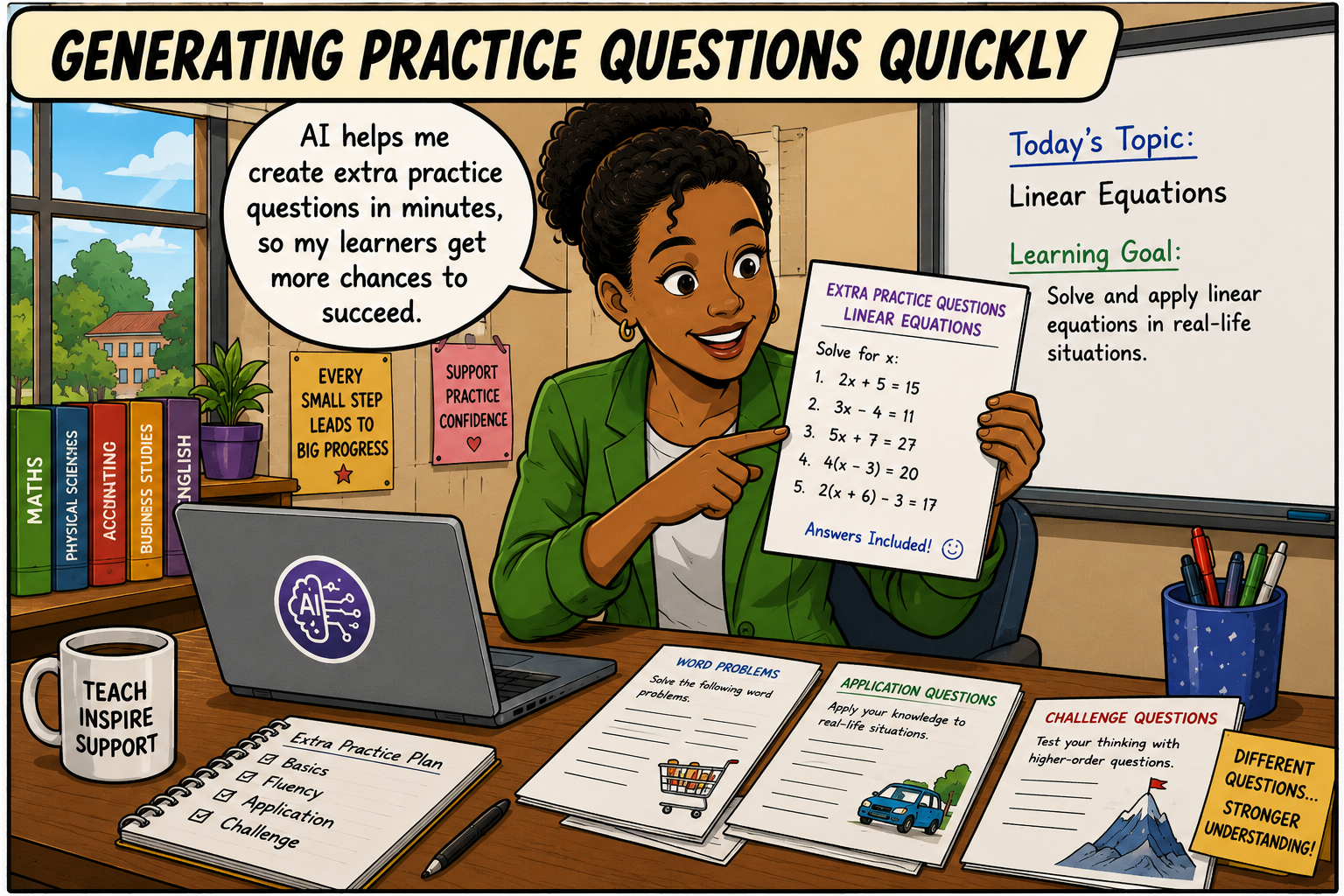
Many learners understand a concept only after seeing several examples. AI can generate numerous examples using familiar South African contexts.
For example:
Instead of explaining percentages only through abstract calculations, AI could create examples involving:
Shopping discounts
Mobile phone data
Soccer statistics
Cricket scores
School fundraising
Taxi fares
Relatable examples make learning more meaningful.
Supporting Reading Comprehension
Long textbook passages can discourage learners who are still developing English proficiency.
AI can assist educators by:
Summarising long passages
Highlighting key ideas
Identifying important vocabulary
Generating comprehension questions
Explaining difficult paragraphs
Teachers can provide these resources alongside the original text, encouraging learners to engage with both.
This supports understanding without replacing authentic reading practice.
Helping Learners Understand Assessment Questions
Many learners lose marks because they misunderstand command words in tests and examinations.
AI can help educators teach learners what common assessment terms mean.
For example:
Describe: Tell what happened.
Explain: Give reasons why something happened.
Compare: Show how two things are similar and different.
Evaluate: Give your opinion using evidence.
Regular exposure to these command words improves learner confidence during assessments.
Creating Bilingual Support Resources
Where appropriate, AI can assist educators in creating bilingual learning resources.
These might include:
Vocabulary lists
Key definitions
Glossaries
Concept summaries
For example, important English terminology may be paired with equivalents in isiZulu, Sesotho, Afrikaans, isiXhosa, Setswana, or another locally relevant language where appropriate for the learners.
These resources support understanding while encouraging learners to continue using correct English academic terminology in class and assessments.
Educators should ensure translations are accurate and appropriate before using them.
Encouraging Classroom Participation
Language barriers often reduce learner participation.
Some learners avoid answering questions because they fear making mistakes in English.
AI can help educators prepare:
Sentence starters
Discussion prompts
Speaking frames
Guided responses
Classroom conversation activities
For example:
"I think the answer is..."
"The evidence suggests..."
"My reason is..."
Providing these structures helps learners participate more confidently.
Supporting Writing Development
Writing is often one of the most difficult language skills to develop.
AI can support educators by generating:
Writing templates
Paragraph structures
Model answers
Essay outlines
Editing exercises
Grammar activities
Importantly, learners should never copy AI-generated work.
Instead, educators should use AI examples to demonstrate organisation, vocabulary, and sentence construction before learners write independently.
Creating Differentiated Learning Materials
Not every learner requires the same level of language support.
AI makes differentiation easier.
For example:
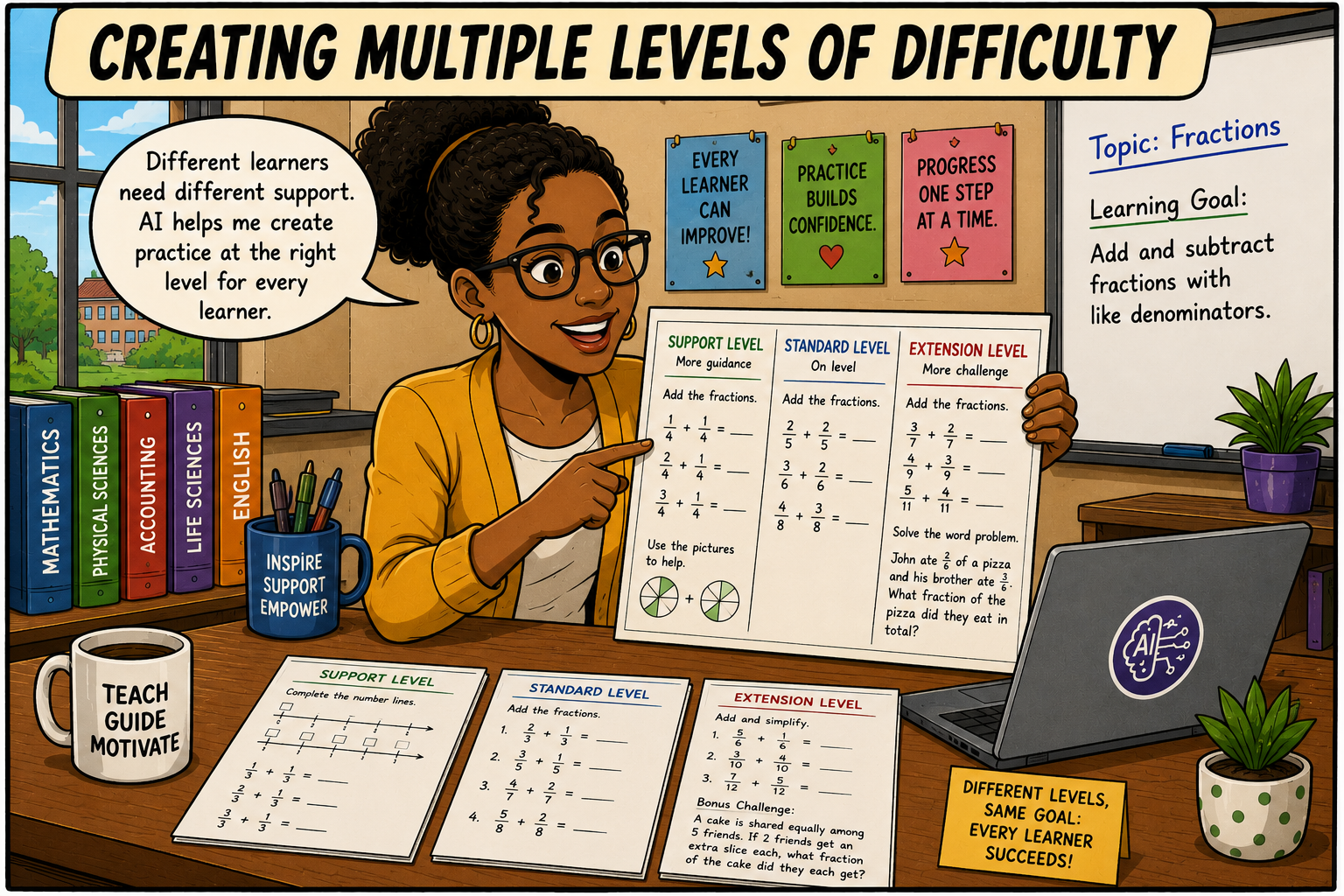
Support Version
Very simple language
Short paragraphs
Guided questions
Vocabulary support
Standard Version
Normal classroom language
Independent reading
Moderate support
Extension Version
More complex texts
Higher-order questions
Academic vocabulary
Every learner works toward the same curriculum outcomes while receiving appropriate language support.
Helping Parents Support Learning At Home
Many parents want to help but feel uncertain about English terminology used at school.
AI can help educators produce:
Simplified homework explanations
Parent guidance sheets
Vocabulary summaries
Learning tips
These resources help families support learning regardless of their own English proficiency.
Reviewing AI Content Carefully
Although AI is helpful, educators should never use AI-generated language resources without careful review.
Always check:
Translation accuracy
Cultural appropriateness
CAPS alignment
Correct terminology
Grammar
Spelling
Appropriate reading level
Sometimes AI may choose words that are technically correct but unfamiliar or unnatural within the South African educational context.
Professional judgement remains essential.
Practical AI Prompts For Educators
Here are practical prompts educators can adapt.
Simplify Language:
"Rewrite this Grade 10 Geography explanation using simpler English while keeping all key concepts."
Explain Vocabulary:
"Explain the word 'photosynthesis' using learner-friendly language suitable for Grade 10 learners."
Create Reading Support:
"Summarise this History chapter into one page using simple English and include five comprehension questions."
Generate Vocabulary Activities:
"Create a vocabulary matching activity for Grade 11 Accounting terminology."
Explain Assessment Language:
"Explain the difference between 'describe', 'explain', 'analyse', and 'evaluate' using classroom examples."
These prompts help educators prepare support materials quickly while maintaining curriculum quality.
AI Supports Learning —It Does Not Replace Language Development
It is important that AI does not become a shortcut that prevents learners from improving their English.
The aim is gradual independence.
Educators should encourage learners to:
Read original texts alongside simplified versions.
Learn new academic vocabulary every week.
Practise speaking in English during classroom discussions.
Write independently before asking AI for feedback.
Reflect on corrections and improvements.
As learners become more confident, educators can gradually reduce the level of language support provided.
This approach strengthens both subject knowledge and language proficiency.
The Educator Remains The Most Important Language Teacher
Technology cannot replace the encouragement, patience, and guidance that educators provide every day.
Teachers recognise when learners hesitate because of language uncertainty.
They know when to ask follow-up questions, provide another explanation, or encourage learners to keep trying.
AI cannot build classroom relationships.
It cannot celebrate progress.
It cannot recognise the confidence that grows when a learner successfully explains a difficult concept in English for the first time.
The educator remains the central figure in supporting language development.
AI simply provides another practical tool that makes personalised support easier to deliver.
Conclusion
Language barriers should never prevent learners from demonstrating their true ability or achieving their academic potential. In South Africa's multilingual classrooms, educators regularly teach learners who understand important concepts but struggle to access them through complex English vocabulary, lengthy instructions, or unfamiliar academic language. These challenges affect performance across every subject and require thoughtful, consistent support.
AI provides practical ways to reduce these barriers without lowering curriculum standards. It can simplify explanations, clarify assessment instructions, generate vocabulary activities, create differentiated reading materials, develop bilingual support resources where appropriate, and provide additional examples that make learning more accessible. Most importantly, AI saves educators valuable preparation time while allowing them to provide more personalised support to diverse learners.
However, AI should always be viewed as a bridge rather than a destination. Its purpose is to help learners gain confidence while steadily developing the English language skills they will need for higher education, employment, and lifelong learning. Educators continue to play the central role by selecting appropriate resources, maintaining high expectations, encouraging communication, and creating supportive classroom environments where every learner feels capable of succeeding.
When used thoughtfully alongside professional judgement, AI becomes a valuable teaching assistant that helps educators strengthen understanding, improve communication, and ensure that language barriers become opportunities for growth rather than obstacles to achievement.
Additional Articles in the AI for Supporting Learners More Effectively Series
How AI Can Help Educators Support Struggling Learners
Using AI to Create Extra Practice Material for Learners Who Need More Help
How AI Can Support Learners with Language Barriers in the Classroom
Using AI to Build Learner Confidence Through Better Support
How to Use AI to Identify Common Learning Gaps Before Exams
Disclaimer
AI Tools were used to assist with research. Remember to always cross-check everything that you read.