
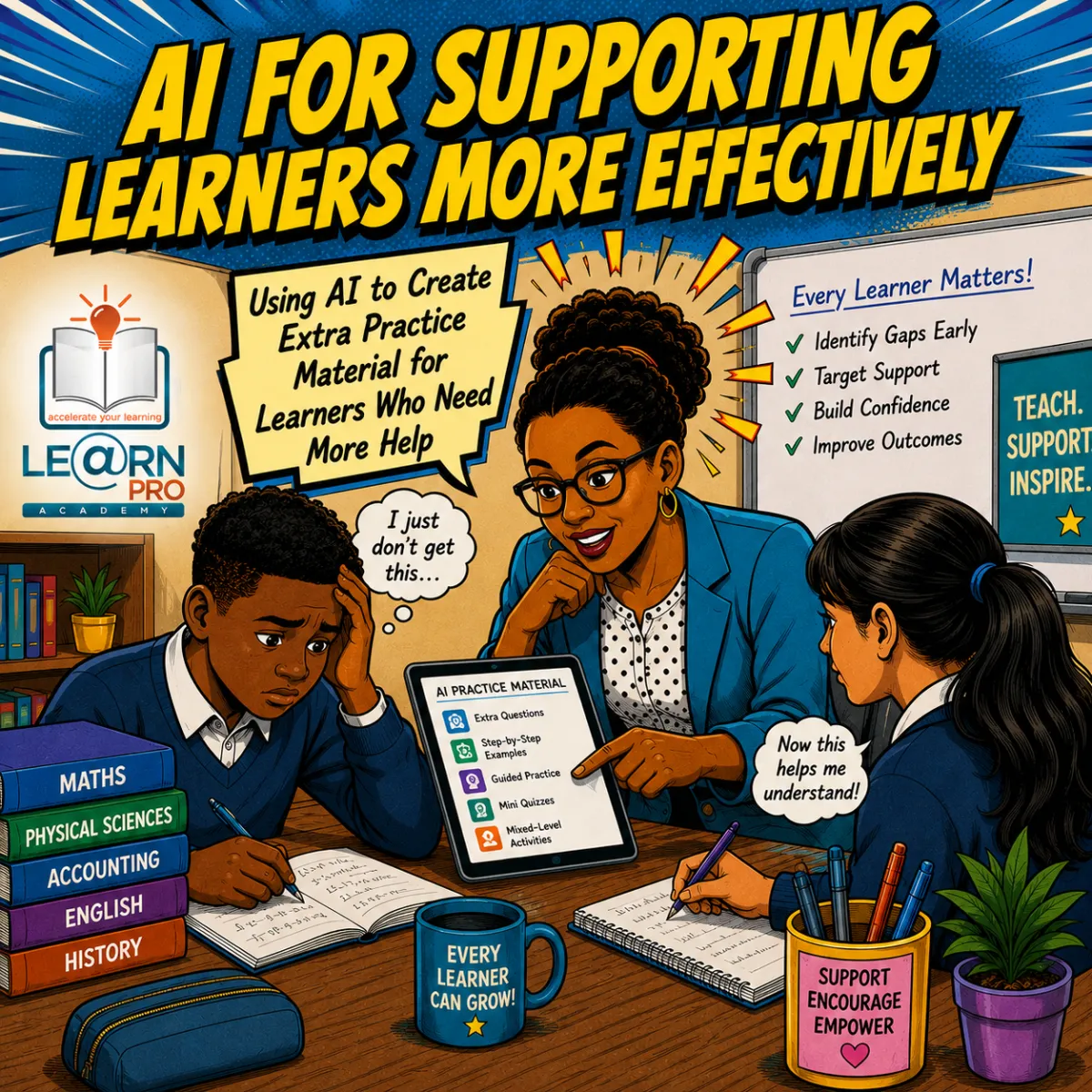
Using AI to Create Extra Practice Material for Learners Who Need More Help
This is article #2 of 5 in the AI for Supporting Learners More Effectively Series
Introduction
Every educator has experienced the same situation. You finish teaching a lesson, most learners understand the concept, but a few still look confused. You explain it again, provide another example, and answer questions, yet some learners still need more practice before they fully understand. Unfortunately, creating additional worksheets, revision activities, and practice questions for different ability levels takes time that many teachers simply do not have.
In South African classrooms, where class sizes are often large and educators already balance teaching, marking, administration, meetings, and extracurricular responsibilities, preparing extra learning material for individual learners can become overwhelming. Yet additional practice is often exactly what struggling learners need. More opportunities to apply a concept can strengthen understanding, improve confidence, and prevent small misunderstandings from becoming larger learning gaps.
Artificial Intelligence (AI) can help educators create this extra practice more efficiently. Instead of starting every worksheet from a blank page, teachers can use AI to generate first drafts of exercises, examples, revision activities, quizzes, comprehension questions, vocabulary practice, and homework tasks. The educator then reviews, edits, and adapts the material to suit the curriculum and the specific needs of the learners.
AI should never replace thoughtful lesson planning or professional judgement. Instead, it serves as a teaching assistant that reduces preparation time while helping educators provide more personalised learning opportunities. This article explores practical ways teachers can use AI to create extra practice material that supports struggling learners while maintaining high academic standards.
Why Extra Practice Matters
Learning rarely happens after hearing a concept only once.
Some learners understand immediately, while others need repeated exposure before the information becomes meaningful. This difference is completely normal. Every classroom includes learners who learn at different speeds and in different ways.
Extra practice allows learners to:
Reinforce new knowledge
Correct misunderstandings
Develop confidence
Build fluency
Improve long-term memory
Apply knowledge in different situations
Prepare more effectively for assessments
Many struggling learners do not need easier work — they simply need more opportunities to practise.
Repeated exposure strengthens understanding and helps learners become more independent over time.
The Challenge Facing Educators
Providing additional practice sounds simple, but creating new learning material every week requires significant effort.
Teachers often need to prepare:
Lesson presentations
Assessments
Memorandums
Homework
Class activities
Marking
Administrative reports
Finding time to create multiple versions of worksheets for different learners can be difficult.
As a result, educators sometimes reuse older worksheets even when learners would benefit from fresh examples. AI helps reduce this workload by generating first drafts within minutes.
Instead of spending an hour creating twenty new questions, teachers can spend that hour reviewing AI-generated content, making improvements, and supporting learners directly.
AI As A Resource Creation Assistant
AI works best when educators use it as a creative assistant rather than expecting it to produce perfect classroom material.
Teachers can ask AI to generate:
Practice worksheets
Additional examples
Homework activities
Revision quizzes
Vocabulary exercises
Reading passages
Writing prompts
Problem-solving questions
Multiple-choice quizzes
Matching activities
Fill-in-the-blank exercises
Short answer questions
The educator remains responsible for checking:
Accuracy
CAPS alignment
Appropriate difficulty
Local relevance
Language level
Correct answers
AI provides the starting point, while professional judgement produces the finished classroom resource.
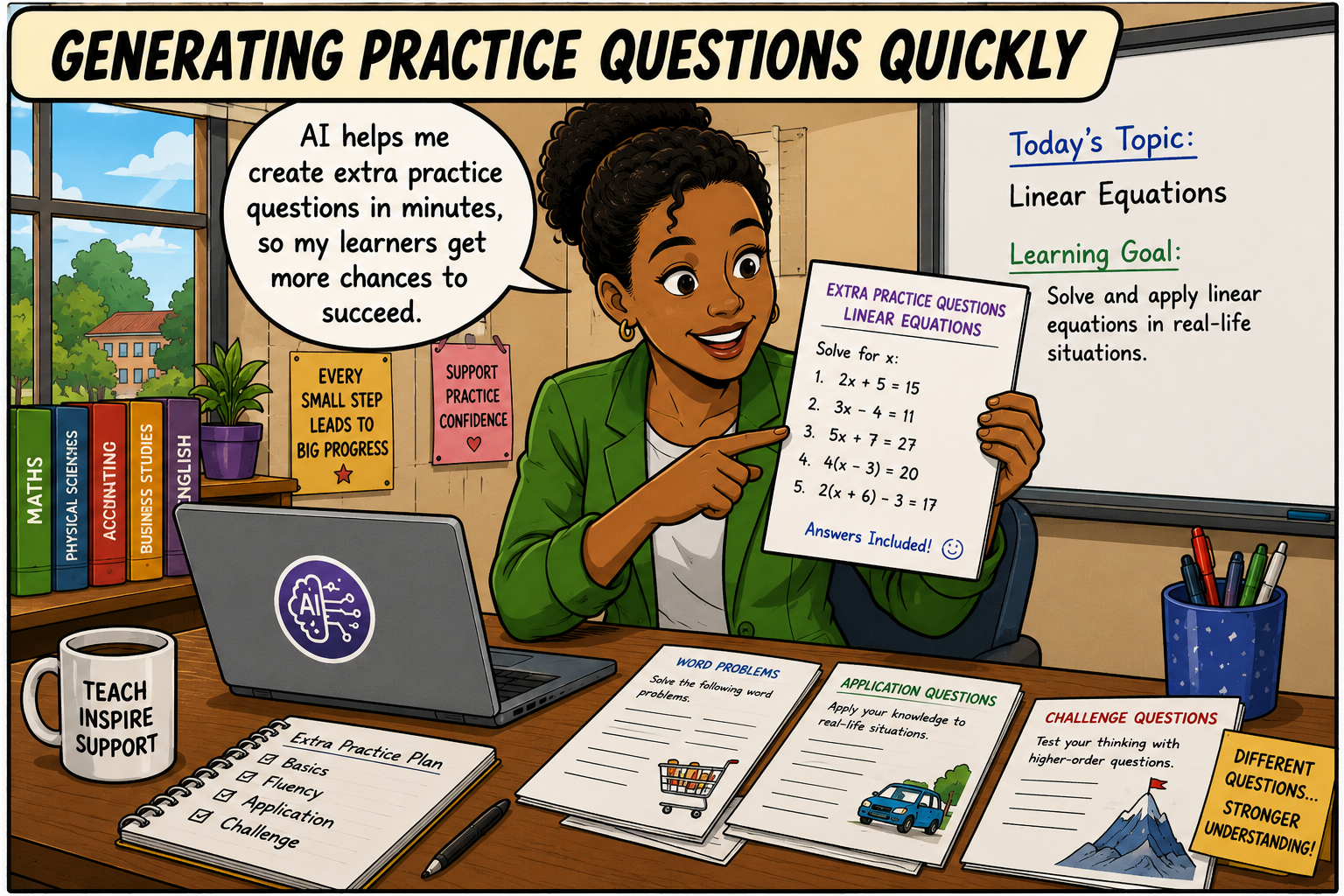
Generating Practice Questions Quickly
One of AI's biggest strengths is producing multiple questions that assess the same skill.
For example, a Mathematics educator might prompt: "Create fifteen Grade 10 algebra questions that increase gradually in difficulty. Include a full memorandum."
A History teacher could ask: "Generate ten source-based questions about the causes of World War One suitable for Grade 11 learners."
An English educator might request: "Create fifteen grammar correction exercises focusing on subject-verb agreement."
Within seconds, AI produces material that can be refined and adapted.
Creating Multiple Levels Of Difficulty
Every classroom includes learners who require different levels of support.
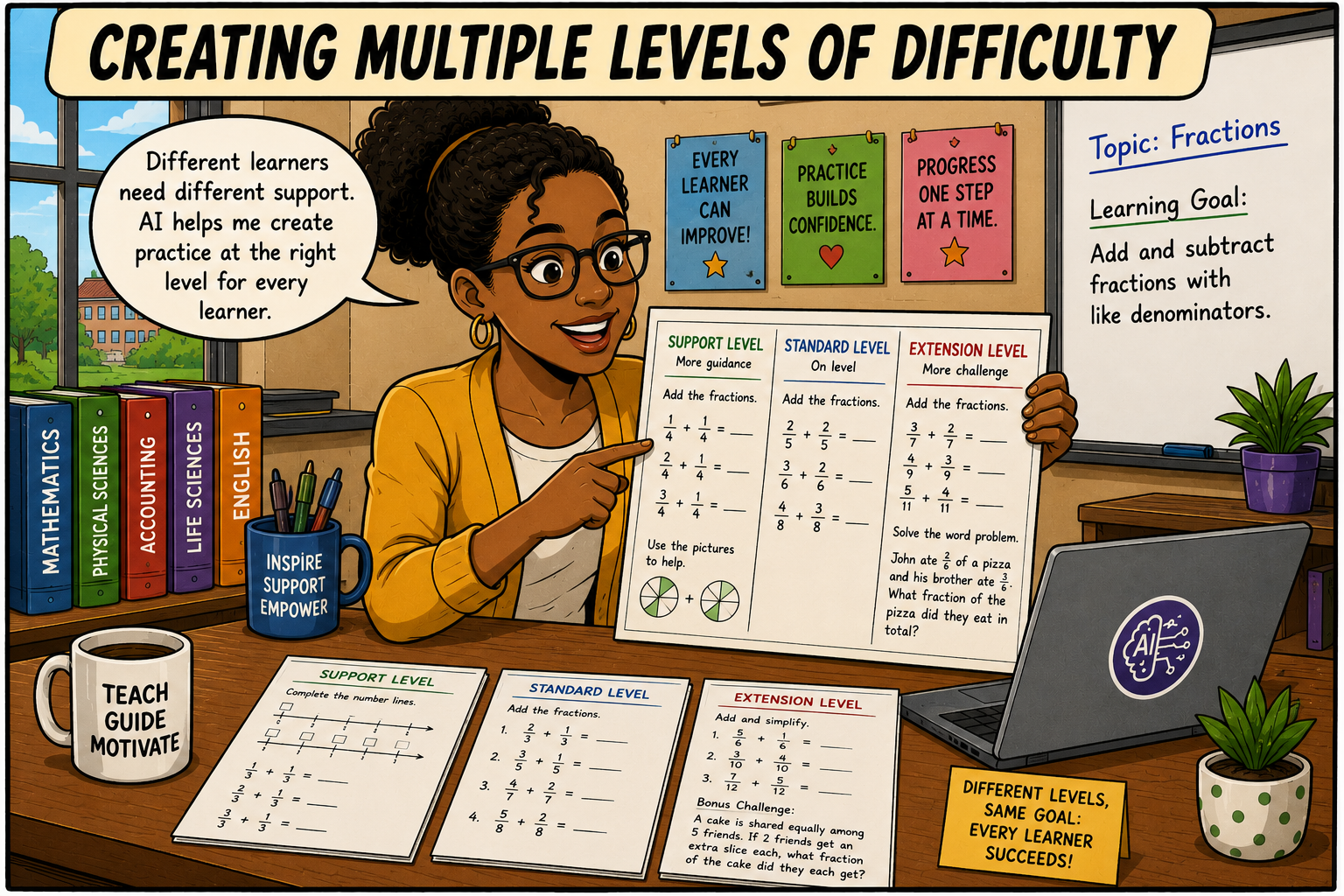
Instead of giving exactly the same worksheet to everyone, educators can use AI to create different versions.
For example:
Support Version
Simple language
Guided questions
Worked examples
More hints
Standard Version
Normal classroom level
Moderate support
Independent thinking
Extension Version
More challenging questions
Higher-order thinking
Application tasks
Problem solving
All learners work toward the same learning outcomes while receiving appropriate support.
Producing Worked Examples
Many learners struggle because they cannot see how a solution develops step by step. AI can generate detailed worked examples showing every stage of the process.
For example, in Accounting, AI can demonstrate:
Journal entries
Ledger postings
Trial balances
Financial statements
In Mathematics, it can provide:
Step-by-step calculations
Alternative solution methods
Common mistakes
Explanations for each step
Worked examples allow learners to compare their own thinking with a correct solution.
Creating Additional Reading Comprehension Activities
Reading comprehension improves through practice.
AI can generate passages suitable for different reading levels while focusing on curriculum topics.
For example:
A Grade 10 Geography teacher might request: "Write a 400-word passage about drought in South Africa with ten comprehension questions covering literal, inferential, and evaluative thinking."
An educator can then adapt the vocabulary and difficulty before classroom use.
This saves considerable preparation time while providing learners with valuable reading practice.
Supporting Language Development Across Subjects
Every subject requires learners to understand specialised vocabulary.
AI can create:
Vocabulary lists
Matching exercises
Sentence completion activities
Definition quizzes
Flashcards
Crossword puzzles
Word searches
Cloze activities
These resources strengthen academic language while reinforcing subject knowledge.
This is particularly valuable in multilingual South African classrooms.
Developing Revision Worksheets
As tests and examinations approach, many learners need additional revision opportunities.
AI can quickly generate revision packs covering:
One chapter
Several topics
Entire terms
Common misconceptions
Frequently examined concepts
Teachers might ask: "Generate a Grade 12 Life Sciences revision worksheet covering genetics, inheritance, and DNA with answers."
Rather than searching through old assessments, educators receive fresh material that can be customised immediately.
Creating Homework That Reinforces Learning
Homework should reinforce classroom learning rather than introduce completely new concepts.
AI can generate homework that:
Revises today's lesson
Includes manageable question numbers
Gradually increases difficulty
Provides variety
Encourages independent thinking
Educators can also ask AI to create different homework versions if learners need additional reinforcement.
Generating Practice For Learners Who Missed Lessons
Illness, family responsibilities, sporting events, and transport challenges sometimes cause learners to miss school.
AI can help educators produce catch-up resources that include:
Lesson summaries
Key concepts
Vocabulary
Practice questions
Revision activities
Self-check quizzes
This allows learners to return with greater confidence instead of feeling overwhelmed.
Reinforcing Learning Through Variety
Completing the same type of exercise repeatedly can become repetitive.
AI allows educators to present the same concept in different formats.
For example, instead of only answering questions, learners might complete:
Matching activities
True or false questions
Short quizzes
Multiple-choice questions
Sorting activities
Word puzzles
Scenario-based questions
Pair discussions
Reflection questions
Variety keeps learners engaged while strengthening understanding.
Helping Learners Build Confidence
Learners who repeatedly struggle often begin believing they are incapable of success.
Extra practice should help learners experience small victories.
AI can generate exercises that:
Begin with easier questions
Build gradually
Reinforce success
Increase confidence
Prepare learners for more difficult work
Confidence grows when learners experience steady progress rather than repeated failure.
Identifying Common Areas That Need More Practice
Educators often notice that several learners make similar mistakes.
Instead of creating entirely new lessons, AI can generate focused reinforcement activities targeting those common misconceptions.
For example:
If many learners confuse independent and dependent variables in Mathematics, AI can create twenty focused practice questions on that single concept.
This targeted approach makes revision more efficient.
Creating Subject-Specific Practice
Different subjects require different forms of reinforcement.
AI can generate subject-specific practice such as:
Mathematics
Calculations
Word problems
Graph interpretation
Algebra exercises
Physical Sciences
Calculations
Concept explanations
Practical scenarios
Data analysis
English
Grammar
Essay planning
Comprehension
Vocabulary
History
Source analysis
Essay questions
Timelines
Historical interpretation
Business Studies
Case studies
Definitions
Application questions
Extended responses
Geography
Map work
Data interpretation
Climate graphs
Case studies
Each activity can be adapted to suit the learners' current level of understanding.
Checking AI-Generated Material Carefully
Although AI saves time, educators should never use material without reviewing it first.
Check every resource for:
Correct facts
CAPS alignment
Appropriate terminology
Age suitability
Cultural relevance
Correct calculations
Complete memorandums
Grammar and spelling
Sometimes AI produces inaccurate information or unrealistic examples.
Professional review ensures classroom quality.
Encouraging Independent Practice
Extra practice should not become another form of copying from AI.
Instead, educators can teach learners to use AI responsibly by asking questions like:
"Give me five more questions like this."
"Explain why my answer is incorrect."
"Create another example."
"Test me without giving the answers first."
"Help me identify where I made a mistake."
These prompts encourage active learning rather than dependence.
Practical AI Prompts For Educators
The following prompts can save considerable preparation time.
Worksheet Creation:
"Create a Grade 11 Accounting worksheet on depreciation with twenty questions and a memorandum."
Revision Questions:
"Generate fifteen revision questions covering Grade 12 chemical reactions with increasing difficulty."
Vocabulary Support:
"Create a vocabulary activity for Grade 10 Geography using simple learner-friendly definitions."
Reading Practice:
"Write a comprehension passage about renewable energy suitable for Grade 11 learners with ten questions."
Catch-Up Material:
"Summarise the key concepts from this Business Studies chapter and generate ten practice questions."
Each prompt produces material that educators can edit and personalise.
Using AI Without Increasing Teacher Workload
The purpose of AI is not to create endless new resources simply because it can.
Instead, teachers should use AI strategically.
Consider:
Which learners genuinely need extra support?
Which concepts cause repeated confusion?
Which topics appear most frequently in assessments?
Which resources can be reused next year?
Building a library of AI-assisted worksheets over time reduces preparation even further.
Many educators discover that after one year they have developed an extensive collection of differentiated learning materials that only require small updates each year.
Keeping Learners Motivated
Practice is only valuable if learners remain motivated.
Educators should celebrate progress, not just perfect marks.
AI-generated practice can support this by allowing learners to:
Complete manageable tasks
Track improvement
Correct mistakes
Retry questions
Build mastery gradually
When learners see themselves improving, they become more willing to continue practising.
The educator's encouragement remains the most important factor in maintaining motivation.
Conclusion
Creating additional practice material has always been one of the most effective ways to support learners who need reinforcement, but it has also been one of the most time-consuming responsibilities for educators. Developing new worksheets, revision activities, homework exercises, and worked examples for different learner needs requires significant preparation, particularly in busy South African classrooms where teachers already manage many competing responsibilities.
AI offers a practical solution by dramatically reducing the time needed to produce high-quality first drafts of learning resources. Educators can quickly generate additional questions, differentiated worksheets, vocabulary activities, reading passages, revision packs, and subject-specific exercises that provide struggling learners with more opportunities to practise and improve. Rather than replacing professional expertise, AI allows teachers to spend less time creating resources from scratch and more time supporting learners directly.
The greatest value of AI lies not in producing more worksheets, but in making personalised learning more achievable. Learners benefit from targeted practice that addresses their specific learning gaps, while educators retain full control over curriculum alignment, teaching quality, and learner support.
Used thoughtfully, AI becomes a reliable teaching assistant that helps educators provide timely reinforcement, build learner confidence, and create richer learning experiences. Combined with professional judgement, encouragement, and meaningful classroom relationships, AI can help ensure that every learner receives the extra opportunities they need to achieve success.
Additional Articles in the AI for Supporting Learners More Effectively Series
How AI Can Help Educators Support Struggling Learners
Using AI to Create Extra Practice Material for Learners Who Need More Help
How AI Can Support Learners with Language Barriers in the Classroom
Using AI to Build Learner Confidence Through Better Support
How to Use AI to Identify Common Learning Gaps Before Exams
Disclaimer
AI Tools were used to assist with research. Remember to always cross-check everything that you read.